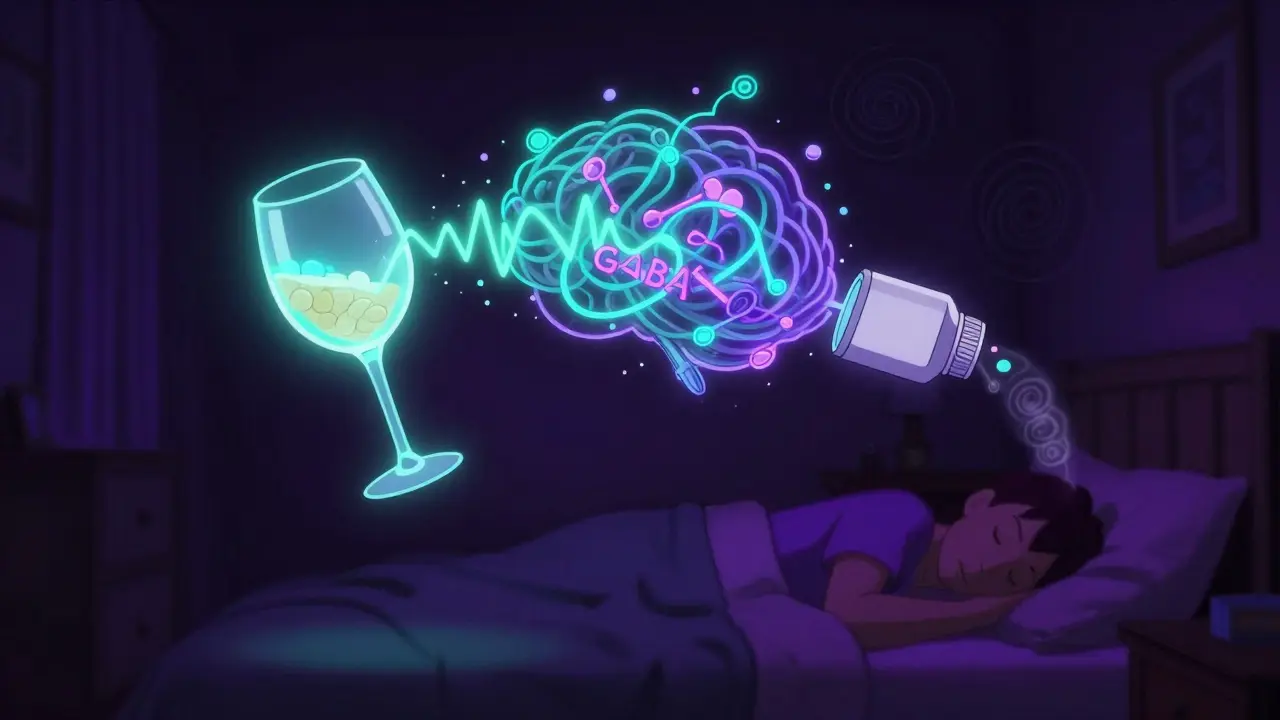
It’s 11 p.m. You’ve had a long day. A glass of wine helps you unwind. You take your prescribed sleep pill-maybe Ambien, maybe Lunesta-because you know you need to sleep. You don’t think twice about it. But what you don’t realize is that you’re not just combining two things that make you sleepy. You’re mixing two powerful depressants that can shut down your breathing, erase your memory, and even kill you. And it doesn’t take much.
Why This Mix Is So Dangerous
Alcohol and sleep medications don’t just add up-they multiply. Both work on the same part of your brain: the GABA receptors. These are the brain’s natural brakes. When activated, they slow down nerve activity, which makes you feel calm, drowsy, and relaxed. Alcohol boosts these brakes. So do prescription sleep meds like zolpidem (Ambien), eszopiclone (Lunesta), and zaleplon (Sonata). When you combine them, your brain’s braking system goes into overdrive. The result? Extreme sedation that’s far worse than either substance alone.The science is clear: a single drink with a sleep pill can double or even triple the sedative effect. In clinical studies, blood alcohol levels as low as 0.02%-about one drink-caused zolpidem’s half-life to stretch from 2.5 hours to over 6 hours. That means the drug stays in your system much longer, and your body has no chance to recover. Your breathing slows. Your oxygen levels drop. Your reflexes vanish. And you might not even know it’s happening.
The Medications That Pose the Greatest Risk
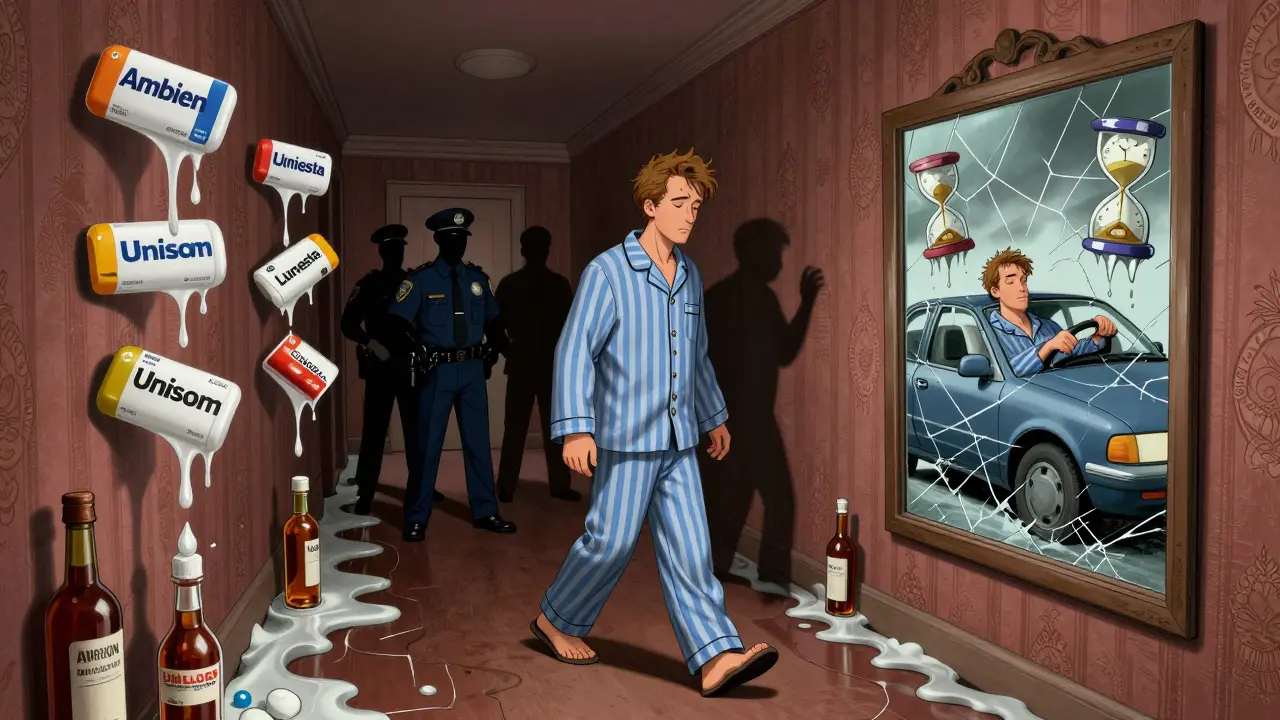
Not all sleep aids are created equal when mixed with alcohol. The biggest dangers come from three types:- Z-drugs (zolpidem, eszopiclone, zaleplon): These are the most dangerous. Ambien alone can cause sleepwalking, but with alcohol, the risk jumps from 0.15% to 2.4%. One study found that combining Ambien with alcohol made people 2.7 times more impaired behind the wheel than alcohol alone.
- Benzodiazepines (lorazepam, clonazepam, temazepam): Older but still widely prescribed. They’re less likely to cause sleep-driving than Z-drugs, but they still dangerously slow breathing and increase fall risk.
- OTC sleep aids (diphenhydramine in ZzzQuil, doxylamine in Unisom): These might seem harmless, but they’re especially risky for older adults. In people over 65, mixing these with alcohol triples the chance of falling and breaking a hip. It also increases delirium risk by 400%.
Even melatonin-a natural supplement many people think is safe-isn’t risk-free. While it doesn’t depress breathing like the others, it still increases next-day drowsiness by 35% when mixed with alcohol. That’s enough to make you clumsy, foggy, and unsafe to drive.
Real Stories Behind the Numbers
The data doesn’t tell the whole story. Real people are waking up miles from home, with no memory of driving. They’re found unconscious in bathtubs, on sidewalks, in their cars. One Reddit user, u/SleepWalker99, posted in March 2023: “I woke up two miles from home with no memory of driving there after taking half an Ambien with two glasses of wine.”These aren’t rare cases. The FDA received over 1,800 consumer reports in 2021 alone about alcohol-sleep medication interactions. Nearly two-thirds of those people said they had “no memory of events.” Almost a third needed emergency care. On Drugs.com, Ambien has a 1.8 out of 5 safety rating when mixed with alcohol. The most common complaint? “Extreme drowsiness lasting 12+ hours.”
For older adults, the consequences are even grimmer. AARP community posts reveal that 73% of people over 65 who mixed OTC sleep aids with alcohol ended up in the hospital with severe disorientation. One woman in Melbourne told her doctor she couldn’t remember her own name for three days after having one glass of wine with her Unisom.
Who’s Most at Risk-and Why
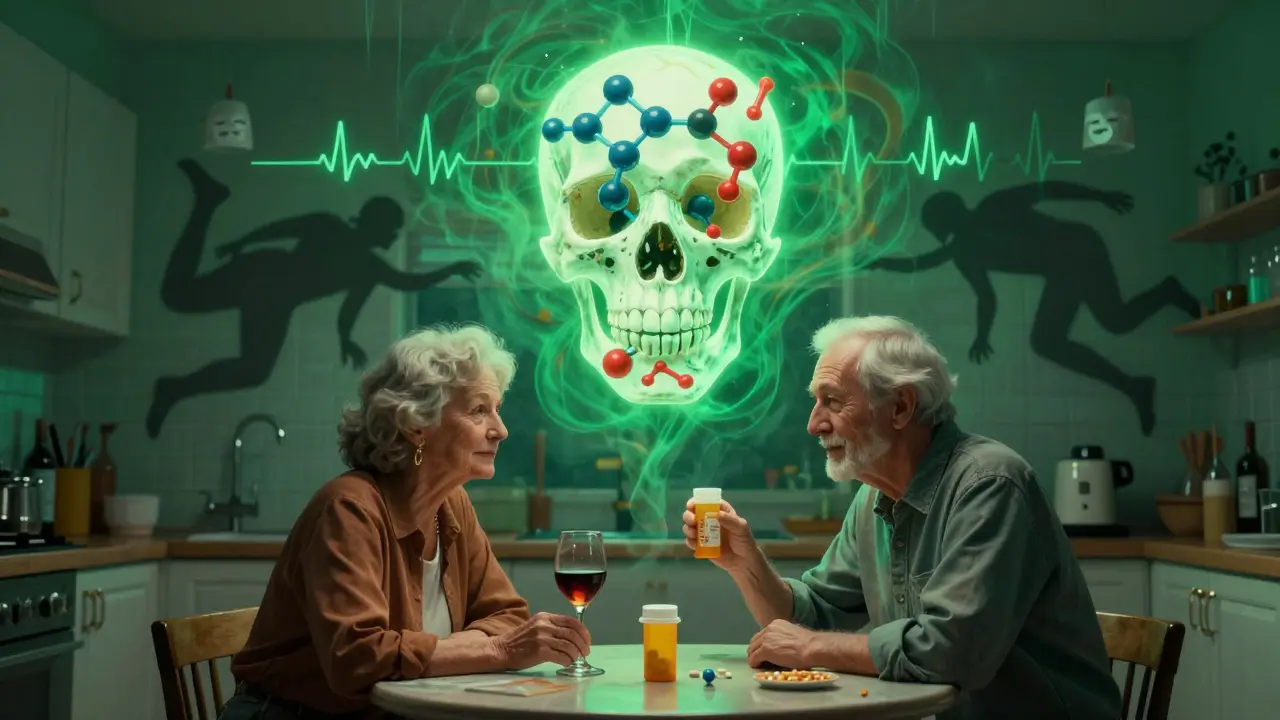
The biggest group affected? Adults aged 35 to 54. They’re the ones most likely to be prescribed sleep meds and still drink socially. But the most severe outcomes? They hit people over 65.Why? As we age, our liver slows down. It takes longer to break down alcohol and sleep meds. That means both substances hang around longer, building up in the system. For someone 70, a single drink and a pill can have the same effect as two drinks and two pills would on a 30-year-old. That’s why the American Geriatrics Society now says: avoid alcohol completely if you’re over 65 and taking any sleep medication.
And it’s not just about drinking. People who take sleep meds for anxiety, PTSD, or chronic pain often use alcohol to manage those symptoms too. They’re not trying to get high-they’re trying to sleep. But the combination turns a solution into a silent threat.
What the Experts Say
The warnings aren’t just cautious-they’re urgent. The FDA updated its Black Box Warning for all Z-drugs in 2022, saying: “Concomitant use with alcohol is contraindicated.” That’s the strongest warning they give. It means doctors are legally required to tell you: do not drink while taking these pills.Dr. Bankole Johnson from the University of Maryland found that 83% of fatal Ambien-alcohol cases happened at blood alcohol levels below the legal driving limit of 0.08%. The median? 0.051%. That’s less than one drink. You don’t need to be drunk to die.
Dr. Lorenzo Cohen of MD Anderson Cancer Center called the combination “medical negligence” if not explicitly warned against. The American Academy of Sleep Medicine says even one drink with a Z-drug can trigger sleep-driving, sleep-eating, or sleep-sex-behaviors you have no control over and no memory of.
What You Should Do Instead
If you’re taking a sleep medication, the safest rule is simple: don’t drink at all. But if you absolutely must have alcohol, follow these steps:- Wait at least 6 hours after your last drink before taking a Z-drug like Ambien or Lunesta.
- Wait 12 hours if you’re on a benzodiazepine like Restoril or Klonopin.
- If you’re over 65, skip alcohol entirely-no exceptions.
- Never take OTC sleep aids with alcohol, no matter how little you drink.
- Ask your pharmacist to review all your medications. Many don’t realize how many drugs interact with alcohol.
There are safer alternatives. Cognitive behavioral therapy for insomnia (CBT-I) is now the first-line treatment recommended by the American College of Physicians. It’s more effective long-term than pills and has zero interaction risks. If you’re struggling with sleep and alcohol use, talk to your doctor about CBT-I or newer non-GABA medications like Dayvigo (lemborexant), which shows far less interaction with alcohol in clinical trials.
Why So Many People Still Do It
It’s not because they’re reckless. It’s because they’re not told the truth. A 2022 survey by the National Sleep Foundation found that 68% of patients prescribed sleep meds said they received “inadequate counseling” about alcohol risks. Doctors assume patients know. Patients assume it’s fine because “it’s just one drink.”But the warning labels? They’re buried. The FDA now requires all sleep medication guides to say “Do not consume alcohol while taking this medication” in bold 14-point font. But if you don’t read the guide-or if your doctor didn’t hand it to you-you’re still at risk.
Pharmacists are now required to warn you at the counter. And 87% are doing it. But if you’re picking up your prescription in a hurry, or if you’re embarrassed to ask questions, you might still miss the warning.
The Bigger Picture
This isn’t just about sleep. It’s about how we treat insomnia in modern society. We’ve turned pills into quick fixes, and alcohol into a social crutch. But the body doesn’t work that way. Sleep isn’t a switch you flip with chemicals. It’s a process-and mixing alcohol with sedatives breaks that process in dangerous, irreversible ways.The rise in polysubstance overdose deaths is alarming. Alcohol-sedative combinations now account for 18% of all prescription drug overdose deaths, up from 9% in 2015. And it’s not slowing down. In 2022, over 58 million Z-drug prescriptions were filled in the U.S. That’s 12% more than just four years ago.
The future may hold safer options. Seven of the 12 sleep medications currently in clinical trials don’t work on GABA at all. They target orexin receptors instead, which regulate wakefulness without depressing breathing. These could be game-changers-for people who drink, for older adults, for anyone who wants to sleep without risking their life.
But until then, the message is clear: if you’re taking a sleep pill, leave the wine on the shelf. One drink isn’t worth your memory. Or your life.
Can I have one glass of wine with Ambien?
No. Even one glass of wine with Ambien can dangerously slow your breathing, increase your risk of sleepwalking or sleep-driving, and cause memory loss. The FDA warns that no amount of alcohol is safe with Z-drugs like Ambien. Blood alcohol levels as low as 0.02% (less than one drink) can significantly extend how long the drug stays in your system and amplify its effects.
Is it safe to mix alcohol with melatonin?
Melatonin doesn’t depress breathing like prescription sleep meds, so it’s not as dangerous. But mixing it with alcohol still increases next-day drowsiness by 35%, making you more likely to stumble, fall, or feel foggy. It’s not life-threatening, but it’s not risk-free. Avoid combining them if you need to drive, operate machinery, or be alert the next day.
What should I do if I accidentally mixed alcohol with my sleep medication?
If you feel extremely drowsy, confused, or have trouble breathing, call emergency services immediately. Do not try to sleep it off. If you’re just feeling unusually tired the next day, monitor yourself for signs of memory loss, dizziness, or unsteadiness. Avoid driving or operating heavy machinery. Talk to your doctor about what happened so they can adjust your treatment plan.
Are over-the-counter sleep aids safer than prescription ones when mixed with alcohol?
No. OTC sleep aids like diphenhydramine (ZzzQuil) and doxylamine (Unisom) are especially dangerous with alcohol, particularly for people over 65. They increase the risk of falls by 300% and delirium by 400%. These drugs are not harmless-they’re antihistamines that cause deep sedation, and alcohol makes it worse. Never mix them.
How long should I wait after drinking before taking a sleep pill?
Wait at least 6 hours after your last drink before taking a Z-drug like Ambien or Lunesta. For benzodiazepines like Restoril or Klonopin, wait 12 hours. These are minimums based on how long alcohol stays in your system. If you’ve had more than one drink, or if you’re over 65, wait longer. When in doubt, skip the pill that night.
Are there sleep medications that don’t interact with alcohol?
Yes-newer non-GABA medications like Dayvigo (lemborexant) have shown significantly less interaction with alcohol in clinical trials. Unlike traditional sleep pills, they don’t enhance GABA activity, so they don’t dangerously slow breathing when combined with alcohol. However, they’re not completely risk-free, and alcohol can still increase drowsiness. Always talk to your doctor before combining any medication with alcohol.

TooAfraid ToSay
Bro, i just had a glass of wine and my zzzquil and i’m fine. You guys are acting like this is nuclear waste. My grandpa did this for 40 years and he’s 89 and still beats me at chess. Stop fearmongering.
Dylan Livingston
Oh, how quaint. A man in Nigeria, presumably untrained in pharmacology, dismissing a meticulously documented FDA black box warning as ‘fearmongering.’ How refreshingly ignorant. The fact that you equate longevity with safety reveals a profound misunderstanding of medical risk-surviving a behavior doesn’t make it wise, it just means you’ve been lucky. One day, your ‘chess-playing grandpa’ won’t wake up because his liver finally gave out, and then what? Will you blame the wine or the universe? This isn’t a lifestyle choice-it’s a slow-motion suicide pact disguised as relaxation.
Andrew Freeman
lol at the fda warning. i take ambien and a beer all the time. nothin happens. if you wanna die go ahead but dont tell me how to live. also melatonin with wine? chill. its just a hormone. you think your body cant handle it? lol
Sarah -Jane Vincent
Of course you’re not scared. You’re part of the problem. The pharmaceutical industry and Big Alcohol have been working together for decades to normalize this. They don’t want you to know that the FDA’s warning was buried under 27 pages of legalese. They know if people realized how many deaths come from ‘just one drink,’ the lawsuits would bankrupt them. And now you’ve got doctors who don’t even mention it because they’re too rushed. This isn’t about ‘personal responsibility’-it’s corporate malpractice. And you’re the target. Wake up.
Henry Sy
Man, i used to do this every night after work-glass of bourbon, half an Ambien, and boom, out like a light. Then one night i woke up in the garage with my car running and no memory of how i got there. That’s not a story, that’s a near-death experience. Now i do CBT-I and drink herbal tea. My brain feels clearer than it has in 15 years. Don’t wait for your body to scream at you-listen before it’s too late.
Anna Hunger
Thank you for this comprehensive and evidence-based exposition. The clinical data presented is both alarming and unequivocal. It is imperative that healthcare professionals prioritize patient education regarding polysubstance interactions, particularly in light of the rising prevalence of Z-drug prescriptions. I urge all readers to consult their physicians and pharmacists, and to request written materials regarding contraindications. Patient safety must supersede convenience. This is not an opinion-it is a medical imperative.
Jason Yan
It’s funny how we treat sleep like a broken faucet you can just turn off with chemicals. We’ve turned our bodies into machines that need firmware updates, when really, sleep is this ancient, delicate dance between light, rhythm, stress, and stillness. Alcohol doesn’t just interfere with the pill-it fractures the whole system. And yeah, maybe you feel relaxed now, but what are you really doing? You’re not sleeping-you’re just numbing your way through the night. What happens when you stop needing the pill but still need the wine? That’s when you realize you weren’t healing-you were hiding. Maybe the real question isn’t ‘can I have one drink?’ but ‘why do I need to numb myself to rest?’
shiv singh
you people are all cowards. if you cant handle a little wine and a pill then you shouldnt be living in the real world. this is america, not a hospital ward. i take my sleep meds and my whiskey and i sleep like a baby. the only thing that killed my cousin was his own weakness. dont blame the medicine blame the man. grow a spine.