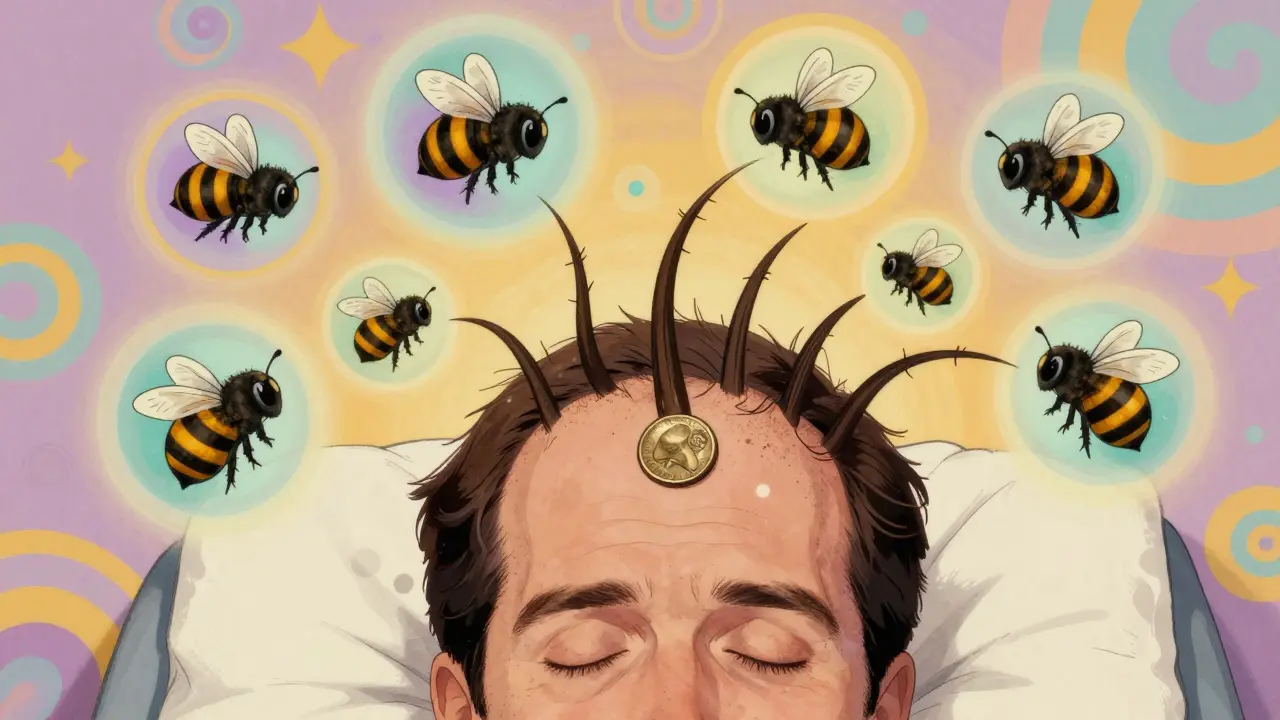
Alopecia areata isn't just about losing hair. It’s about waking up one morning and finding a coin-sized patch gone from your scalp, or your eyebrows disappearing without warning. This isn’t normal shedding. It’s your immune system turning on your own hair follicles, mistaking them for invaders. The result? Sudden, patchy hair loss that can strike anyone-child, adult, or senior-with no warning. And while it doesn’t hurt or threaten your life, it can change how you see yourself forever.
What Actually Happens in Alopecia Areata?
Your hair grows in cycles: anagen (growth), catagen (rest), and telogen (shedding). In alopecia areata, something breaks down in the anagen phase. Immune cells, mostly CD8+ T cells, swarm around the base of the hair follicle like a swarm of bees. They attack the follicle, forcing it into early rest mode. The follicle doesn’t die. It’s still there. That’s why regrowth is possible-even after years of total scalp loss.
Unlike male pattern baldness, where follicles shrink over time, alopecia areata leaves the structure intact. No scarring. No permanent damage. Just a temporary shutdown. This is why dermatologists call it a non-scarring alopecia. It’s a glitch in the system, not a destruction.
The classic sign? Smooth, round bald patches, usually about the size of a quarter. No redness. No flaking. Just bare skin. But it doesn’t always look like that. Some people lose hair all over their scalp (alopecia totalis). Others lose every hair on their body, including eyelashes and eyebrows (alopecia universalis). A few experience diffuse thinning-like their whole head is thinning out at once. And some develop a band of hair loss around the lower scalp, called ophiasis.
It’s Not Just About Your Head
Many don’t realize alopecia areata can affect nails. About 1 in 3 people with this condition notice changes in their fingernails or toenails. Tiny dents-like pinpricks-called pitting. Nails that feel rough or crumbly. Redness around the half-moon area (lunula). These signs often appear before hair loss, but they’re rarely checked.
And before the patches show up? Some people feel tingling, itching, or burning on the scalp. It’s not common, but it happens. Around 20% of patients report this prodrome. It’s your immune system whispering before it shouts.
How Common Is It?
About 6.8 million Americans will develop alopecia areata in their lifetime. Globally, it affects 0.1% to 0.2% of people. That sounds small, but think about it: in a crowd of 1,000, you’re likely to find one person with it. Half of all cases start before age 40. Men and women get it equally, but women often face more emotional strain due to societal pressure around appearance.
It’s the second most common cause of hair loss in the world-after androgenetic alopecia (pattern baldness). But unlike pattern baldness, which is genetic and hormone-driven, alopecia areata is autoimmune. That means it’s not about testosterone or aging. It’s about your immune system going rogue.
Why Is It So Hard to Treat?
Here’s the cruel twist: the same thing that makes it reversible also makes it unpredictable. Your follicles are still alive. So regrowth can happen on its own. About 80% of people with a few patches get their hair back within a year-even without treatment. But for others, it’s a rollercoaster. Hair comes back, then falls out again. Sometimes in new spots.
And the worse the loss, the harder the recovery. Only about 10% of people with alopecia universalis ever get full regrowth. Even with treatment.
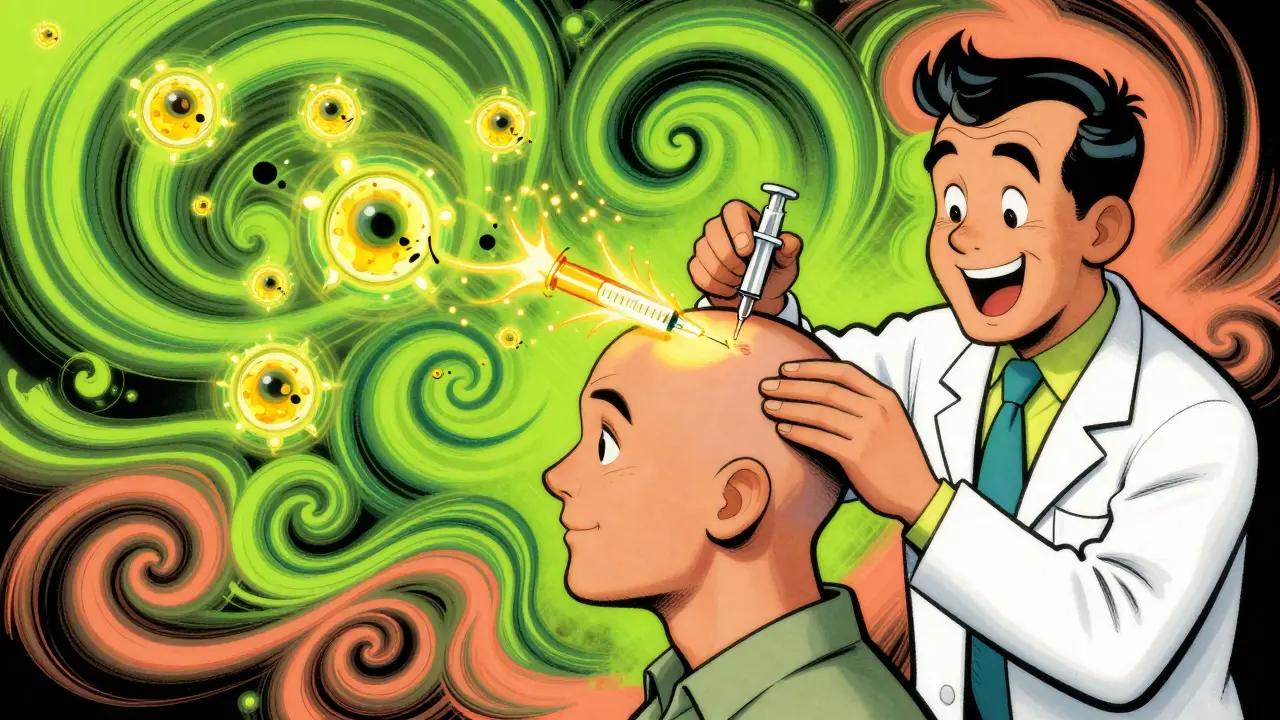
Current therapies? They’re hit-or-miss. Corticosteroid injections into the scalp work well for small patches-60% to 67% of patients see regrowth. But if you’ve lost all your scalp hair? That same injection drops to 13% effectiveness. Topical steroids? They take 6 to 12 months. And even then, only 25% to 30% respond.
What Treatments Actually Work?
Intralesional Corticosteroid Injections
This is still the gold standard for patchy alopecia areata. A dermatologist injects a diluted steroid-usually triamcinolone acetonide-directly into each bald patch. It suppresses the immune attack right where it’s happening. Treatments happen every 4 to 6 weeks. You’ll usually see new fuzz in 4 to 8 weeks. It’s not fun-those needles sting-but for many, it’s the only thing that gets results fast.
Topical Treatments
For milder cases or kids, doctors often start with creams or lotions. Betamethasone valerate (0.1%) or clobetasol (0.05%) are common. You apply them daily. But patience is required. It can take 6 months to see anything. And even then, results are weak. Only about 1 in 4 people get meaningful regrowth.
Contact Immunotherapy (DPCP)
This one sounds extreme. You apply a chemical called diphenylcyclopropenone (DPCP) to your scalp weekly. It doesn’t regrow hair. It causes a controlled allergic reaction-redness, itching, peeling. That inflammation somehow tricks the immune system into leaving the follicles alone. Success rates? 30% to 60%. But it’s not for everyone. The side effects can be brutal. And it takes 6 to 12 months. Many quit before seeing results.
JAK Inhibitors: The New Hope
The biggest breakthrough in decades came in 2022 with the FDA approval of baricitinib (a JAK inhibitor approved for severe alopecia areata). It’s an oral pill originally used for rheumatoid arthritis. In clinical trials, 35.6% of patients regained 80% of their scalp hair after 36 weeks. That’s huge.
Then came ritlecitinib (a second JAK inhibitor approved in June 2023 for severe cases). In the ALLEGRO trial, nearly 30% of patients hit the 80% mark in just 24 weeks. Faster. Stronger. More consistent.
These drugs block the immune signals that attack follicles. They don’t cure the disease. But they quiet it down. The catch? They cost $10,000 to $15,000 a month. Insurance rarely covers them unless you’ve tried everything else. And even then, many patients get denied.
What Doesn’t Work
Minoxidil (Rogaine)? It’s marketed for pattern baldness. For alopecia areata? It works in maybe 0% to 15% of cases with extensive loss. Most dermatologists won’t recommend it unless you have mild, patchy hair loss.
Essential oils? Aloe vera? Scalp massages? No solid evidence supports them. They’re not harmful, but they won’t stop the autoimmune attack. Don’t waste money hoping they will.
The Emotional Toll
Here’s the truth no one talks about: alopecia areata is one of the most psychologically devastating skin conditions. The NIH says it has the highest quality-of-life burden of any dermatological disease-even worse than psoriasis or eczema.
Studies show 30% of patients have moderate to severe anxiety. 28% meet the clinical criteria for depression. 68% report social anxiety. Some avoid swimming. Others stop dating. One Reddit user wrote: “I haven’t worn a hat in public since I was 16. I’m 32 now.”
And the treatment process? It adds to the stress. Injections. Daily creams. Months of waiting. Insurance battles. Side effects. One woman on a support forum said: “I got 80% regrowth with baricitinib. Then I stopped because of cost. Two months later, I lost it all again. I cried for a week.”
What’s Next?
Research is moving fast. Scientists at Columbia University are developing biomarker panels to predict who will respond to which drug. The goal? Personalized treatment. No more guessing.
Genetic studies have identified key markers like ULBP3/6 genes that help the immune system recognize hair follicles. Targeting those could lead to true cures.
And the pipeline? Four new JAK inhibitors are in late-stage trials. Two from Pfizer. Two from Eli Lilly. The market for alopecia treatments is growing at over 7% a year. Big pharma is finally taking this seriously.
The National Alopecia Areata Foundation predicts a 50% reduction in disease burden by 2030 through combination therapies. That means using steroids, JAK inhibitors, and maybe even light therapy together. Not just one drug at a time.
What Should You Do?
If you notice sudden patchy hair loss:
- See a dermatologist ASAP. Don’t wait. Early treatment improves outcomes.
- Get a scalp biopsy if needed. It rules out other causes.
- Ask about corticosteroid injections if you have small patches.
- If you’ve lost more than half your scalp hair, ask about JAK inhibitors. Ask your doctor about clinical trials.
- Join a support group. Talking to others who get it makes a difference.
Don’t believe in miracle cures. Don’t blame yourself. This isn’t stress. It’s not your fault. It’s not contagious. It’s an autoimmune glitch-and science is catching up.
Can alopecia areata be cured?
There is no permanent cure yet. But many people experience full regrowth, especially with early treatment. For some, hair returns on its own. For others, medications like JAK inhibitors can restore hair. However, relapse is common-about 75% of people who stop JAK inhibitors lose hair again within a year. The goal is control, not cure.
Is alopecia areata hereditary?
Yes, genetics play a role. About 20% of people with alopecia areata have a close family member with it. Certain genes, like ULBP3 and ULBP6, increase risk. But having the genes doesn’t mean you’ll get it. Environmental triggers-like infections, stress, or trauma-are needed to turn the disease on.
Can children get alopecia areata?
Yes. About half of all cases start before age 40, and many begin in childhood. Children often respond better to treatment than adults. Intralesional steroids and topical treatments are commonly used. JAK inhibitors are approved for patients 12 and older, but pediatric use is still being studied.
Do JAK inhibitors have serious side effects?
Yes. JAK inhibitors can increase the risk of infections, blood clots, and certain cancers. That’s why they’re only approved for severe cases and require monitoring. Blood tests are needed before and during treatment. They’re not for mild hair loss. The benefits must outweigh the risks.
Will my hair grow back the same color?
Often, the first hair to regrow is white or gray. This happens because pigment-producing cells (melanocytes) take longer to recover than the follicle itself. Over time, many people see their natural color return. But not everyone. Some hair stays lighter permanently, especially after long-term or total loss.
Can stress cause alopecia areata?
Stress doesn’t cause alopecia areata, but it can trigger it in people who are genetically prone. Many report a major life event-death, divorce, illness-just before hair loss began. Managing stress won’t cure it, but it may help reduce flare-ups. It’s one piece of a bigger puzzle.

Robert Petersen
Just wanted to say this post hit different. I’ve had patchy alopecia for 5 years now. Started with one spot, ended up losing half my scalp. Didn’t think I’d ever see regrowth. Intralesional steroids saved me. Yeah, the needles suck, but that first fuzz? Pure magic. Keep going, people. It’s not over until you say it is.
Alyssa Williams
baricitinib changed my life. 80% regrowth in 6 months. then insurance denied renewal. lost it all again. now im back on trial. dont give up. its not a miracle its science. and science is catching up
Pat Mun
Reading this made me think about my cousin who lost all her eyebrows and eyelashes at 22. She wore fake lashes for years. Then she tried DPCP. It was brutal. Itchy, peeling, red as hell. Took 10 months. But when the lashes came back? She cried. Not because she looked pretty. But because she felt like herself again. Hair isnt just hair. Its identity. And yeah, the cost is insane. But if it gives you back your reflection? Worth every penny. Just wish more people knew this wasn’t vanity. It’s survival.
Sophia Nelson
So let me get this straight. You’re telling me we’re paying $15k a month for a drug that stops your immune system from attacking hair follicles… but you’re not fixing the root cause? That’s not treatment. That’s band-aiding a nuclear reactor. And now big pharma is making bank on people’s insecurity. Wake up. This isn’t medicine. It’s exploitation disguised as hope.
Neha Motiwala
Did you know the government is hiding the real cause? It’s 5G radiation. And glyphosate in your food. And the vaccines. They target the follicles because hair is connected to the nervous system. And the NIH? They’re paid by Big Pharma to hide this. I’ve read 37 studies. All of them suppressed. The only thing that helped me? Cold laser therapy. And cutting out gluten. And drinking distilled water. No one wants you to know this. But now you do.
athmaja biju
In India we have natural remedies that work better than these expensive drugs. Amla oil. Neem. Curry leaves. These have been used for centuries. Why are we blindly following Western medicine? Our ancestors knew. We forgot. Now we are paying thousands for what our grandmothers did for free. Shame on us.
Craig Staszak
I’ve been on JAK inhibitors for a year. Hair came back. Then I got a bad cold. Lost 30% in two weeks. Turns out your immune system doesn’t just forget to attack your hair-it remembers. And it doesn’t forgive. I’m not mad at the science. I’m mad that we don’t have better long-term answers. This isn’t a cure. It’s a pause button. And someone’s got to hold it forever.
alex clo
As a medical professional, I appreciate the depth of this post. The distinction between scarring and non-scarring alopecia is critical for diagnosis. The data on JAK inhibitors is indeed promising, though long-term safety profiles remain under evaluation. I encourage patients to consult board-certified dermatologists and consider enrollment in clinical trials where available. Evidence-based medicine remains the cornerstone of care.
Carla McKinney
You all sound like you’re celebrating a placebo. Let’s be real: 80% regrowth sounds great until you realize 75% of people relapse within a year. And you’re ignoring the fact that JAK inhibitors increase lymphoma risk. This isn’t hope. It’s a gamble with your life. And the emotional toll? It’s not just about hair. It’s about being told you’re broken and then sold a $15k/month fix. You’re not healing. You’re being monetized.
Ojus Save
just got my first jakt treatment last week. its wild. my scalp tingles like its alive again. i lost my eyebrows in 2021. now im seeing tiny black hairs. its not much. but its something. i dont care if its 5% or 95%. its mine again.