
If you’re taking antidepressants and using hormonal birth control, you’re not alone. Around 10.4% of women in the U.S. between 18 and 39 are on antidepressants, and nearly 90% of women use some form of birth control during their reproductive years. For many, these two medications are essential - one to manage mood, the other to prevent pregnancy. But when you take them together, questions arise: Do they interfere with each other? Could one make the other less effective? Or worse - cause unexpected side effects?
Most Antidepressants Don’t Break Birth Control
The good news? For most people, antidepressants and hormonal birth control can be taken safely together. The most commonly prescribed antidepressants - SSRIs like sertraline (Zoloft), escitalopram (Lexapro), and fluoxetine (Prozac) - show no meaningful impact on how well birth control works. A 2024 review of 15 clinical studies involving over 3,800 women found no statistically significant drop in contraceptive effectiveness when SSRIs were used alongside combined oral contraceptives. Unintended pregnancy rates stayed near zero, matching those of women not taking antidepressants.
Why does this matter? Because birth control relies on steady hormone levels. If a drug speeds up or slows down how your body breaks down estrogen or progestin, it could lead to breakthrough bleeding or, in rare cases, pregnancy. But SSRIs don’t do that. They don’t significantly affect the liver enzymes (CYP3A4, CYP2C19) responsible for metabolizing birth control hormones. That’s why Lexapro’s prescribing info says: “No dose adjustment is necessary when co-administered with oral contraceptives.”
The Real Risk: Tricyclic Antidepressants
Not all antidepressants are created equal. Tricyclics like amitriptyline (Elavil), nortriptyline, and imipramine are older medications still used for chronic pain, migraines, or treatment-resistant depression. But they come with a hidden risk when paired with birth control.
Oral contraceptives can slow down how your body clears these drugs. Studies show birth control can reduce TCA metabolism by 30-50%, causing blood levels to rise. That might sound harmless - until you consider the side effects: dizziness, dry mouth, blurred vision, and worse, heart rhythm changes. One 2019 study found 12% of patients on TCAs plus birth control showed QT interval prolongation - a heart rhythm abnormality that can trigger dangerous arrhythmias.
If you’re on amitriptyline and birth control, your doctor should monitor your heart function. Baseline EKGs and liver enzyme tests are often recommended, especially in the first month. Many providers now switch patients from TCAs to SSRIs when starting hormonal contraception - not because SSRIs are “better” for depression, but because they’re safer in this combo.
Bupropion: The Exception That Works Well
Bupropion (Wellbutrin) stands out as one of the few antidepressants that doesn’t cause sexual side effects - and doesn’t interfere with birth control either. Unlike SSRIs, which can lower libido or delay orgasm in 30-70% of users, bupropion affects sexual function in only about 20% of people. That’s why it’s often chosen for women who notice a drop in desire or arousal after starting an SSRI.
Studies show bupropion causes less than 5% variation in ethinyl estradiol levels when taken with the pill. It doesn’t inhibit or induce liver enzymes involved in hormone breakdown. If you’re struggling with low sex drive from your current antidepressant, switching to bupropion could fix two problems at once: your mood and your sexual health.
Birth Control Type Matters Too
Not all birth control is the same. Combined methods - pills, patches, rings - contain estrogen and progestin. Progestin-only methods - the mini-pill, implants (Nexplanon), or the hormonal IUD (Mirena) - contain only progestin.
Estrogen can influence how your liver processes certain drugs. That’s why some interactions are more likely with combined contraceptives. But even then, SSRIs still show minimal risk. Progestin-only methods have even fewer interactions because they don’t contain estrogen. If you’re on a TCA and want to minimize risk, a progestin-only IUD or implant may be a safer choice than the pill.
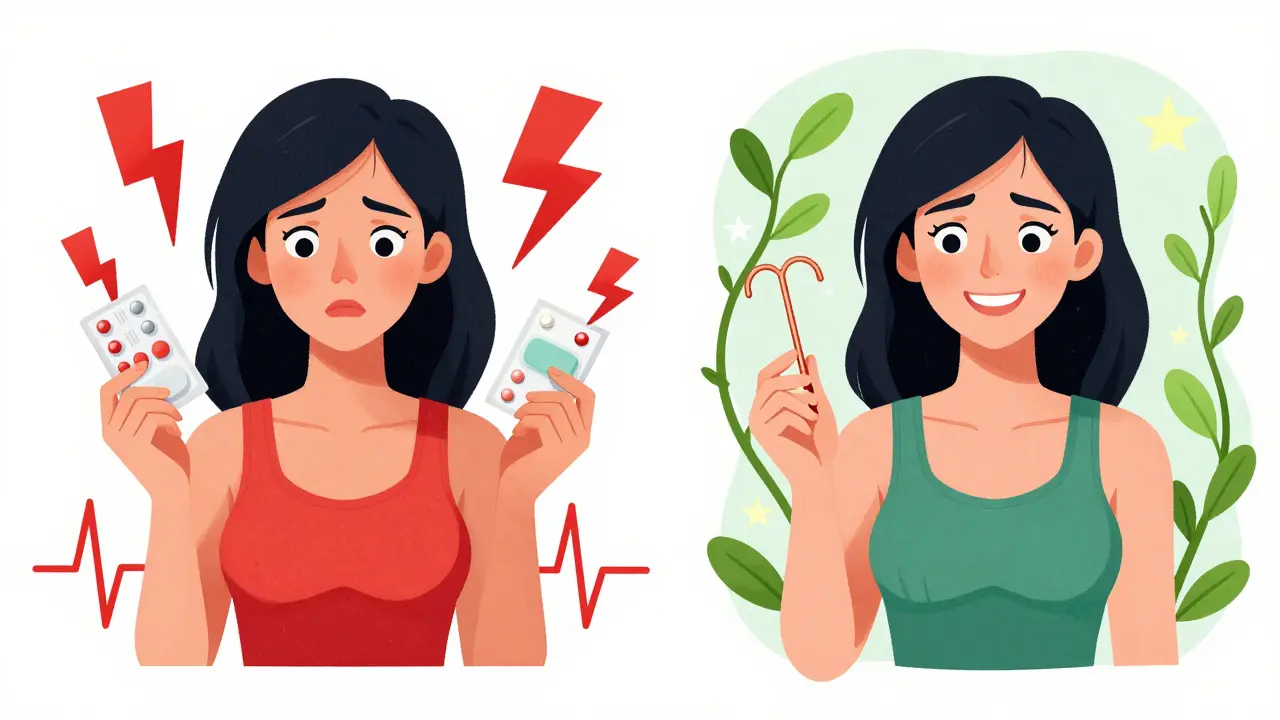
And if you’re worried about hormones altogether? The copper IUD (Paragard) is completely non-hormonal. It doesn’t interact with any antidepressant, and it’s over 99% effective. For women with severe depression or anxiety who also struggle with hormone-related side effects - mood swings, bloating, headaches - the copper IUD is often the best long-term solution.
Sexual Side Effects: The Overlapping Problem
Here’s one issue no one talks about enough: both SSRIs and hormonal birth control can lower libido. Up to 70% of women on SSRIs report reduced sexual desire. Hormonal birth control lowers desire in 15-25% of users. When you take both, the effect can pile up.
A 2022 survey of 1,243 women taking both medications found 10% reported significantly worse sexual dysfunction. One woman on Reddit wrote: “I was on Zoloft and the pill. I stopped wanting sex altogether. It felt like my body wasn’t mine anymore.” She switched to bupropion and a copper IUD - and within three months, her sex drive returned.
This isn’t just about pleasure. It’s about mental health. Low libido can worsen depression. If you’re feeling emotionally numb or disconnected from your body, your meds might be part of the problem. Talk to your provider about alternatives. You don’t have to accept this as normal.
What About Other Medications?
It’s not just antidepressants. Some antibiotics, like rifampin (used for tuberculosis), can slash birth control effectiveness by 60% by speeding up hormone breakdown. But common ones like amoxicillin or azithromycin? No effect.
Antipsychotics like risperidone can raise prolactin levels, which may affect your cycle - but this is mostly seen in case reports, not large studies. If you’re on multiple psychiatric meds, your provider should review all of them together. Don’t assume one drug is safe just because it’s “common.”

What Should You Do?
Here’s what actually works in real life:
- Don’t stop either medication without talking to your doctor. Stopping antidepressants suddenly can trigger withdrawal or worsen depression. Stopping birth control can lead to unplanned pregnancy.
- Track your symptoms. Keep a simple log: mood, bleeding patterns, libido, sleep, and any new side effects. Bring it to your next appointment.
- Ask about alternatives. If you’re on a TCA, ask if switching to an SSRI or bupropion is an option. If you’re on the pill and having side effects, consider an IUD or implant.
- Get lab tests if needed. If you’re on a TCA, ask for liver enzymes and an EKG before starting birth control.
- Use backup protection if you’re on rifampin or other enzyme-inducing drugs. Condoms or a copper IUD are reliable backups.
What’s New in 2026?
Research is moving fast. In 2024, a major review confirmed that SSRIs and birth control are safe together - but also pointed out how little we know about newer antidepressants like vortioxetine or levomilnacipran. A $2.4 million study launched in late 2024 is now looking at how your genes affect how you process these drugs. Some people have a genetic variant (CYP2D6 poor metabolizer) that makes them process SSRIs slower - which could mean higher side effects even without birth control.
ACOG is updating its guidelines in early 2025 to include clearer advice on this combo. Until then, rely on providers who know the data - not just the old warnings.
Final Thoughts
You deserve to feel stable - mentally and physically. Managing depression and preventing pregnancy shouldn’t be a trade-off. For most women, antidepressants and birth control work well together. But not all combinations are equal. The real risks are hidden in older antidepressants and overlapping sexual side effects.
If you’re feeling off - whether it’s low mood, weird bleeding, or no interest in sex - speak up. Your provider should help you adjust, not just tell you it’s “normal.” You’re not overreacting. You’re paying attention. And that’s exactly what you should be doing.
Can antidepressants make birth control less effective?
For most common antidepressants - like SSRIs (sertraline, escitalopram, fluoxetine) and bupropion - no, they do not reduce the effectiveness of hormonal birth control. Studies show no significant drop in contraceptive success rates. However, tricyclic antidepressants (like amitriptyline) can increase blood levels of birth control hormones, which doesn’t make birth control less effective but can raise the risk of side effects. Always check with your provider if you’re on an older antidepressant.
Do birth control pills make depression worse?
Some women report mood changes after starting hormonal birth control, especially in the first few months. But research doesn’t support a direct link between birth control and causing clinical depression. In fact, for women with premenstrual dysphoric disorder (PMDD), birth control can actually improve mood. If you notice worsening depression after starting the pill, talk to your provider - it might mean you need a different type of birth control or a change in antidepressant.
Is it safe to take Lexapro with the pill?
Yes, it’s considered safe. Lexapro (escitalopram) has been studied extensively with combined oral contraceptives. No significant interaction has been found in terms of effectiveness or side effects. The prescribing information for Lexapro confirms no dose adjustment is needed. Many women take both without issues, and it’s one of the most commonly prescribed combinations.
Why do I have breakthrough bleeding on both antidepressants and birth control?
Breakthrough bleeding is common in the first 3-6 months of starting birth control, regardless of antidepressants. But some women on SSRIs report increased spotting. This isn’t because the pill stopped working - it’s likely due to how SSRIs affect serotonin in the uterine lining, which can make it more fragile. If bleeding continues beyond six months or is heavy, talk to your provider. Switching to a progestin-only IUD or adjusting your antidepressant may help.
Should I switch from an SSRI to bupropion if I’m on birth control?
It depends on your symptoms. If you’re happy with your mood but struggling with low libido, weight gain, or emotional numbness, switching to bupropion could help. It’s just as effective for depression as SSRIs but has fewer sexual side effects and doesn’t interact with birth control. However, if your SSRI is working well and you’re not having side effects, there’s no need to switch. Don’t change meds just because you think you should - change them because you’re not feeling well.
Is the copper IUD better than the pill if I’m on antidepressants?
If you’re concerned about hormone-related side effects - mood swings, low libido, bloating - the copper IUD is an excellent option. It’s non-hormonal, 99% effective, and doesn’t interact with any antidepressant. Many women on SSRIs choose it specifically to avoid compounded side effects. It doesn’t fix depression, but it removes one variable from the equation. If you want long-term, hassle-free birth control without hormones, it’s one of the best choices.

Crystel Ann
This is such a needed conversation. I was on Zoloft and the pill for years and thought my low libido was just part of being a woman. Turns out it was the combo. Switching to bupropion and a copper IUD changed everything.
Niki Van den Bossche
Let’s be real-modern medicine is just pharmaceutical theater. We’re told to take two pills to fix one problem, then three more to fix the side effects of the first two. The real solution? Stop treating bodies like machines and start listening to them. Hormones aren’t variables-they’re symphonies. And we’re conducting them with a spatula.
Nat Young
SSRIs don’t interfere with birth control? Sure, according to the 2024 study funded by Big Pharma. Meanwhile, real women are getting breakthrough bleeding, mood crashes, and zero sex drive. Science is just a story we tell ourselves to feel safe.
Jan Hess
So many of us are just trying to survive and nobody talks about how hard it is to balance mental health and reproductive autonomy. I switched from the pill to Nexplanon after my SSRIs made me feel like a ghost. Best decision I ever made. You’re not broken-you’re just on the wrong combo.
Iona Jane
They don’t want you to know this but birth control is designed to make women docile. SSRIs make you numb. Together? You’re a perfect citizen. Quiet. Compliant. No cravings. No rage. Just… quiet. Wake up.
Jaspreet Kaur Chana
I’m from India and my doctor here told me the same thing-SSRIs and pills are fine together. But my cousin in the US switched to copper IUD because she was crying every day and couldn’t orgasm. Turns out, it’s not just her. We need to stop normalizing this suffering. Your body isn’t broken. The system is.
Haley Graves
If you’re on an SSRI and your sex drive is gone, don’t accept it. Don’t wait six months. Don’t tell yourself it’s ‘just how it is.’ Talk to your doctor. Try bupropion. Try the copper IUD. You deserve to feel alive-not medicated into stillness.
Diane Hendriks
Why are we letting pharmaceutical companies dictate women’s health? In America, we’re told to pop pills for everything. In Europe, they use therapy first. In Asia, they use herbs. We’ve become a nation of chemical zombies. This isn’t medicine-it’s control.
ellen adamina
I’ve been on Lexapro and the patch for three years. No bleeding issues. No libido loss. But I also have a high pain tolerance and don’t talk about my feelings. Maybe that’s why I’m fine. Others aren’t. It’s not one-size-fits-all.
Gloria Montero Puertas
Oh, please. You’re all acting like this is revolutionary. I’ve been telling my patients for years: TCAs + birth control = ticking time bomb. And SSRIs? They’re not harmless-they’re just less obviously dangerous. You think your brain is fine because you’re not screaming? That’s not wellness. That’s dissociation.
Tom Doan
How many of these ‘studies’ were funded by the same companies that manufacture both antidepressants and birth control? The ‘no interaction’ conclusion feels less like science and more like corporate PR. I’d love to see a 10-year, independent, longitudinal study. But I doubt that’ll ever happen.
Sohan Jindal
Women are too emotional to handle hormones. That’s why we need pills to fix them. And if they’re depressed, they need more pills. It’s not complicated. Stop overthinking. Just take what the doctor says.
Frank Geurts
As a physician with over 20 years of clinical experience in reproductive psychiatry, I must emphasize: the data is unequivocal. SSRIs demonstrate no clinically significant pharmacokinetic interaction with combined hormonal contraceptives. However, clinicians must remain vigilant regarding pharmacodynamic synergies-particularly in patients exhibiting serotonergic sensitivity or CYP2D6 polymorphisms. Individualized care remains paramount.
Annie Choi
Progestin-only = lower metabolic load. Copper IUD = zero drug interactions. Bupropion = dopamine-friendly. This isn’t just medical advice-it’s harm reduction 101. If you’re juggling multiple meds and feeling like a lab rat, you’re not wrong. The system is broken. But you can still optimize your personal stack.
RUTH DE OLIVEIRA ALVES
Thank you for this comprehensive, evidence-based overview. The clinical nuance regarding TCAs and QT prolongation is particularly critical and under-discussed in primary care settings. I appreciate the inclusion of patient-reported outcomes alongside pharmacokinetic data, as this bridges the gap between empirical research and lived experience. It is imperative that healthcare providers recognize that contraceptive efficacy is only one dimension of safety-quality of life, sexual autonomy, and psychological well-being must be equally prioritized in therapeutic decision-making.