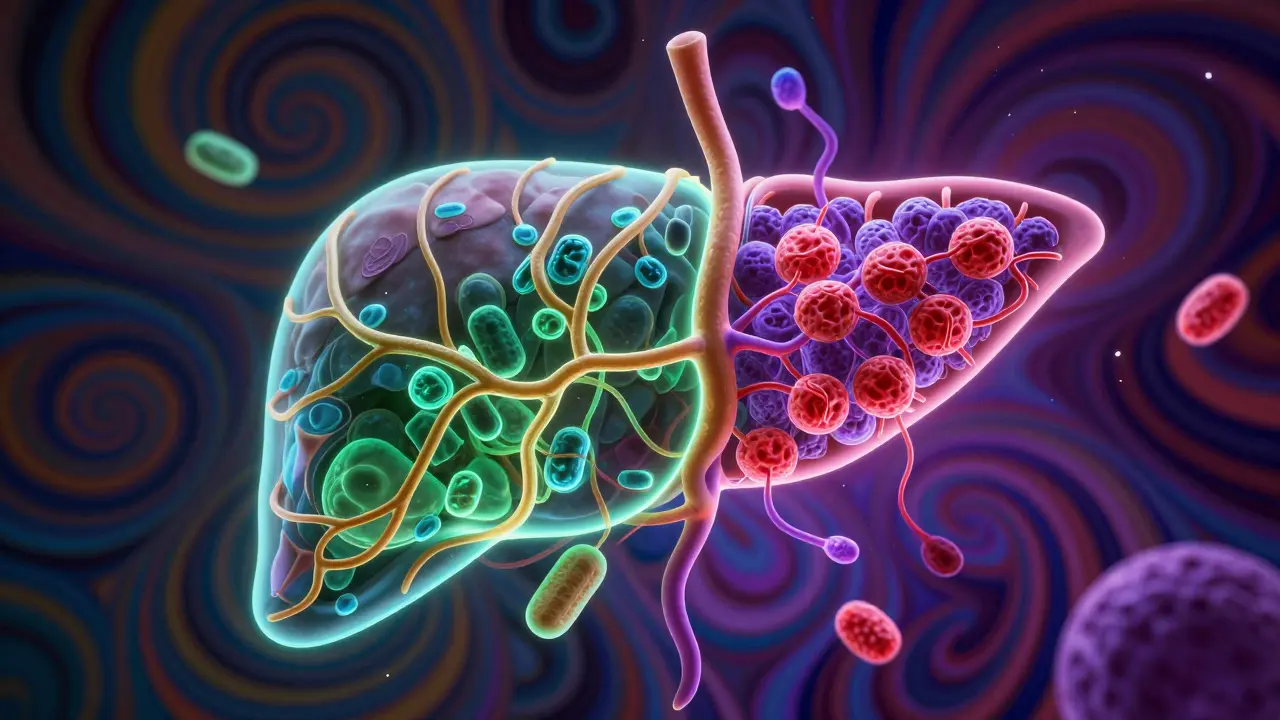
Most people think of liver diseases as either one thing or another - hepatitis, fatty liver, cirrhosis. But what if your liver is fighting more than one autoimmune attack at once? That’s not rare. In fact, autoimmune overlap syndromes - where features of Primary Biliary Cholangitis (PBC), Primary Sclerosing Cholangitis (PSC), and Autoimmune Hepatitis (AIH) show up together - are more common than you’d expect, especially in people already diagnosed with one of these conditions.
What Exactly Is an Autoimmune Liver Overlap?
Imagine your immune system gets confused. Instead of just attacking bile ducts (like in PBC) or liver cells (like in AIH), it starts hitting both - and sometimes even the bile ducts inside and outside the liver (like in PSC). This isn’t a new disease. It’s a mix. And it’s messy to diagnose because the symptoms, blood tests, and even liver biopsies don’t fit neatly into one box.
The most common overlap is AIH-PBC. Studies show that between 1% and 7% of people with AIH also have clear signs of PBC. In people already diagnosed with PBC, up to 19% develop features of AIH. That’s not a fluke. It’s a pattern. PSC-AIH overlaps happen too, but less often. And despite a few case reports, there’s still no solid proof that PBC and PSC can truly overlap as a distinct syndrome.
How Do You Tell Them Apart?
Each disease has its own fingerprint in the blood and liver tissue:
- AIH usually spikes your ALT and AST - the enzymes that tell you liver cells are getting damaged. Your IgG levels go high, and you’ll likely test positive for ANA or SMA antibodies.
- PBC makes your ALP and γ-GT skyrocket - signs of bile duct trouble. Over 90% of patients have AMA antibodies. IgM is often elevated too.
- PSC looks like PBC on blood tests (high ALP, γ-GT), but it’s tied to inflammation in larger bile ducts. It’s often linked to IBD, especially ulcerative colitis. No single antibody like AMA points to it.
When you see a patient with high ALT and high ALP? That’s your first red flag. Same if someone with known PBC suddenly develops high IgG or positive SMA. Or if an AIH patient has AMA-positive results. That’s when overlap gets suspected.
Diagnosis Isn’t Just One Test - It’s a Puzzle
You can’t diagnose AIH-PBC overlap with a single blood draw. You need to piece together:
- Lab work: Both cholestatic (ALP, γ-GT) and hepatocellular (ALT, AST) markers elevated.
- Serology: AMA positive (for PBC) and ANA or SMA positive (for AIH).
- IgG levels: Elevated beyond normal, especially if over 2x the upper limit.
- Liver biopsy: This is often the clincher. You need to see both interface hepatitis (AIH hallmark) and bile duct damage (PBC hallmark) in the same sample.
There’s no official checklist yet, but most experts agree: if you meet at least two diagnostic criteria for both diseases, you’re likely looking at an overlap. A 2020 study of 130 PBC patients found 9% met this combined criteria - and they needed different treatment than those with pure PBC.
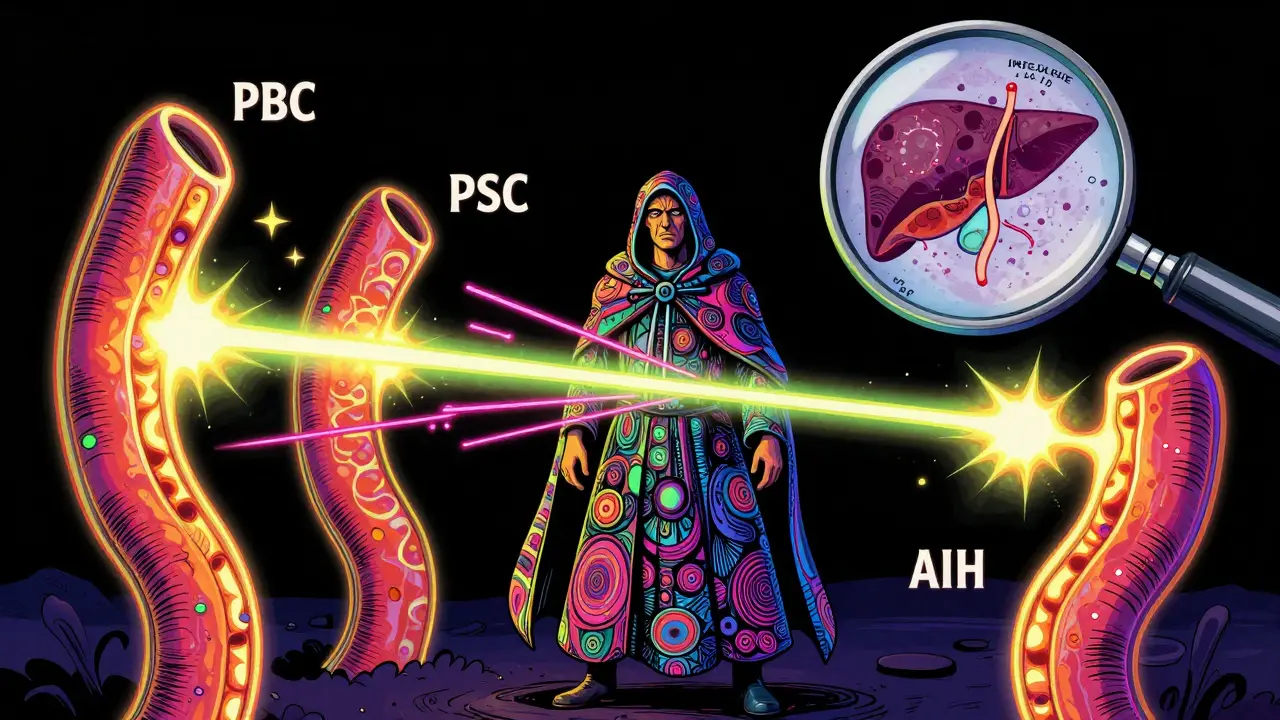
Why Does This Matter for Treatment?
Treating AIH-PBC overlap isn’t like treating either disease alone. If you give someone with overlap only ursodeoxycholic acid (UDCA) - the standard for PBC - they might still keep getting liver damage because the AIH part isn’t being touched.
Here’s what actually works:
- UDCA for the bile duct damage (PBC component).
- Corticosteroids (like prednisone) and/or azathioprine for the immune attack on liver cells (AIH component).
Studies show 30-40% of overlap patients don’t respond to UDCA alone. They need both. One 2008 review found that 8% of patients with either AIH or PBC had overlap - and they all needed dual therapy to avoid progression to cirrhosis.
But here’s the catch: steroids can make PBC worse if used alone. That’s why you can’t just treat the AIH part and ignore the PBC. You need balance. And monitoring. Constantly.
What About PSC Overlap?
PSC is trickier. It’s often diagnosed with MRCP or ERCP - imaging that shows the bile ducts are scarred and narrowed. But unlike PBC, there’s no reliable antibody test. If someone with PSC also has high IgG, positive ANA, and interface hepatitis on biopsy? That’s a PSC-AIH overlap. It’s rare, but it happens.
And what about PBC and PSC together? The data says no. Despite a handful of case reports, experts agree: true PBC-PSC overlap doesn’t exist as a defined syndrome. The features are too different. What looks like overlap might just be misdiagnosed PSC with secondary bile duct changes.
Long-Term Risks - It’s Not Just Fatigue
People with overlap syndromes aren’t just tired. They’re at risk for the same outcomes as pure autoimmune liver disease - but faster.
- 30-40% of untreated overlap patients develop cirrhosis within 10 years.
- There’s a higher chance of liver failure or needing a transplant.
- Even after transplant, outcomes aren’t always the same. Some studies suggest higher recurrence rates in overlap patients.
And unlike PBC, which progresses slowly over decades, overlap syndromes can accelerate damage. That’s why early detection matters. A patient who thought they had “just PBC” might be missing the AIH component - and losing liver function silently.

Why Do These Overlaps Happen?
No one knows for sure. But experts think it’s about genetics and immune system quirks. People with one autoimmune disease often have others - thyroiditis, rheumatoid arthritis, lupus. The same genes that make someone prone to PBC might also make them more likely to develop AIH. It’s not random. It’s a pattern in the immune system’s wiring.
Some cases are even triggered by drugs. One case report linked hydralazine - a blood pressure medication - to sudden AIH-PBC overlap. That’s rare, but it shows how environmental triggers can push a hidden risk into full-blown disease.
What Should You Do If You’re Diagnosed?
If you have PBC or AIH - and you’re not responding as expected to treatment - ask your doctor about overlap. Don’t assume one diagnosis is the whole story.
Ask for:
- A full autoimmune panel: AMA, ANA, SMA, IgG, IgM.
- A repeat liver biopsy if your enzymes don’t match your diagnosis.
- A specialist in autoimmune liver disease - not just a general hepatologist.
And don’t stop monitoring. Even if you’re on treatment, you need regular blood tests, imaging, and clinical reviews. Many patients with overlap live normal lives - but only if their treatment is tailored.
The Future: A Spectrum, Not Separate Diseases
Researchers are moving away from thinking of these as three distinct diseases. Instead, they’re seeing them as points on a spectrum. Some people have pure PBC. Others have pure AIH. And some? They land right in the middle - with features of both.
That’s why the International Autoimmune Hepatitis Group and the European Association for the Study of the Liver are working on new diagnostic criteria. Final guidelines are expected by 2025. Until then, doctors have to rely on experience, not checklists.
One thing’s clear: if your liver is showing mixed signals, don’t ignore them. The right treatment can change your outcome - completely.
Can you have PBC and AIH at the same time?
Yes. AIH-PBC overlap is the most common autoimmune liver disease overlap. It occurs in 1-19% of PBC patients and up to 7% of AIH patients. Diagnosis requires meeting key criteria for both diseases - like elevated ALP and AMA (for PBC) alongside high IgG, ANA/SMA, and interface hepatitis on biopsy (for AIH).
Is PBC-PSC overlap a real condition?
No. Despite occasional case reports, major liver societies agree there’s no clear evidence that PBC and PSC can truly overlap as a distinct syndrome. Their underlying mechanisms are too different. What looks like overlap is often misdiagnosis or secondary changes from one disease mimicking the other.
What blood tests suggest an autoimmune liver overlap?
The red flag is a mix of cholestatic and hepatocellular markers: high ALP and γ-GT (from bile duct damage) plus high ALT and AST (from liver cell injury). Add to that: AMA (for PBC) and ANA/SMA (for AIH), along with elevated IgG. If all these are present, overlap is likely.
Do you need a liver biopsy to diagnose overlap?
Not always, but it’s often necessary. For PBC, biopsy isn’t required if AMA is positive and ALP is elevated. But in suspected overlap, seeing both bile duct destruction (PBC) and interface hepatitis (AIH) in the same sample is the strongest confirmation. Many experts consider it essential for diagnosis.
Can medications cause autoimmune liver overlap?
Yes. Rarely, drugs like hydralazine, minocycline, or nitrofurantoin can trigger autoimmune liver injury that mimics overlap syndromes. These are called drug-induced autoimmune hepatitis with cholestatic features. Stopping the drug may help, but some patients still need long-term immunosuppression.
What happens if overlap is left untreated?
Untreated overlap syndromes progress faster than single-disease forms. Around 30-40% of patients develop cirrhosis within 10 years. Without proper treatment, the risk of liver failure, portal hypertension, and liver cancer increases significantly. Early, combined therapy can slow or even halt progression.

phyllis bourassa
Okay but let’s be real - if your liver’s throwing a three-way fight, who’s even paying attention to the guest list? I’ve been on UDCA for years and my ALT just kept climbing. My doc shrugged like it was a glitch in the Matrix. Then I found this post and went back to my records - AMA positive, ANA positive, IgG through the roof. Turns out I had AIH-PBC and nobody told me. I’m 37. I should’ve been on steroids 5 years ago. 😔
Sean Callahan
so i had this one dr who said 'your liver's just being dramatic' and i was like ok cool but then my bilirubin went up and i started itching like a dog with fleas and i was like wait a second this isnt just 'dramatic' its like... a full on rebellion??
Ferdinand Aton
Overlap syndromes? Nah. This is just Big Pharma’s way of selling two drugs instead of one. PBC and AIH are basically the same thing with different labels. If you’re getting two prescriptions, you’re being upsold. I’ve seen 3 people ‘diagnosed’ with overlap - all ended up on placebo. Coincidence? I think not.
William Minks
Man this is wild 😮 I’ve got PBC and my IgG was borderline high but my doc didn’t blink. Then I read this and went back to my old biopsy report - there it was: interface hepatitis. I didn’t even know what that meant. Now I’m on prednisone and azathioprine and I feel like a new person. I’m so glad I didn’t just take ‘PBC’ as the whole story. Thanks for the clarity! 🙌
Susan Purney Mark
I work as a nurse in hepatology and I’ve seen this too many times. Patients get labeled with PBC, put on UDCA, and told ‘it’s slow, just monitor.’ But when their ALT spikes and they start feeling exhausted again - that’s not progression. That’s AIH creeping in. We push for full serology panels and repeat biopsies if there’s any mismatch. It’s not overdiagnosis - it’s underdetection. And it’s costing people their livers.
One patient, 52, was told she’d live 15 more years. She had overlap. We started steroids + UDCA. Five years later, her enzymes are normal. She’s hiking. She’s alive. Because someone listened.
Bridget Verwey
So let me get this straight - we have a disease that’s literally two diseases in a trench coat, and the medical system still acts like it’s one puzzle piece? 😂 I love how we’re all supposed to be ‘diagnosed’ but the diagnostic criteria is a spreadsheet written in crayon. Also, why does no one ever mention that steroids make you look like a pufferfish? Just saying.
Weston Potgieter
Ugh this is why medicine sucks. You get one test, one label, one drug. But your body? It’s a goddamn symphony of chaos. I had PBC. Then my IgG jumped. Then my ALT went nuclear. Doc said ‘maybe you ate too much gluten.’ I went to a second opinion and they said ‘you’ve got AIH-PBC overlap.’ I’ve been on dual therapy for 2 years. My liver’s stable. My doc still thinks I’m ‘overreacting.’
Also PSC-PBC overlap doesn’t exist? Cool. So if my ducts are scarred and my AMA is positive, I’m just hallucinating? Yeah right.
Vikas Verma
From a clinical perspective, the diagnostic criteria for overlap syndromes require integration of serological, biochemical, and histological parameters. The presence of AMA with ANA/SMA and elevated IgG in conjunction with cholestatic and hepatocellular enzyme elevation constitutes a high probability of AIH-PBC overlap. Liver biopsy remains the gold standard for confirmation. Early initiation of combination therapy significantly improves long-term outcomes. Delayed diagnosis leads to accelerated fibrosis progression. Therefore, systematic screening in all PBC and AIH patients is imperative.
Jeff Mirisola
Hey everyone - I’m the author of this post. I’ve been living with AIH-PBC for 8 years. I was misdiagnosed as pure PBC for 4. I lost 30 lbs. Couldn’t sleep. Felt like I was dying. Then I found a specialist who looked at my whole picture - not just the numbers. I’m on UDCA + azathioprine. My liver’s calm. My life’s back. This isn’t just theory. It’s survival. If you’re out there wondering if you’re ‘just’ one thing - you might not be. Ask. Push. Demand the full picture. You deserve it.