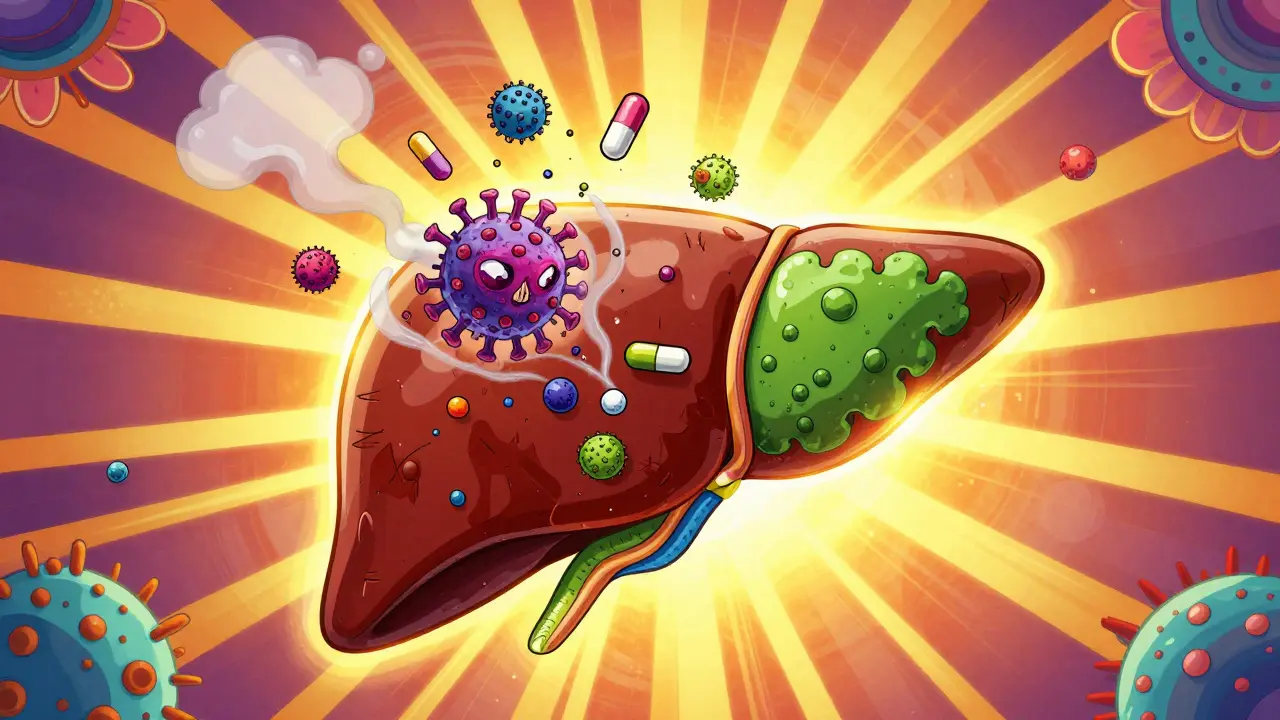
For decades, chronic hepatitis C was a silent killer. People could live with it for years, even decades, without knowing. No symptoms. No warning. Just slow, steady damage to the liver - until one day, cirrhosis, liver cancer, or liver failure hit. Then came the drugs that changed everything. Today, a simple 8- to 12-week course of oral pills can cure more than 95% of people with hepatitis C. No injections. No hospital stays. Almost no side effects. This isn’t science fiction. It’s real, and it’s happening right now.
How Hepatitis C Destroys the Liver
Chronic hepatitis C is caused by the hepatitis C virus (HCV), which attacks liver cells and tricks the immune system into ignoring it. Over time, the virus causes inflammation. Scar tissue builds up. This is fibrosis. Left unchecked, fibrosis turns into cirrhosis - a hard, lumpy liver that can’t function properly. About 20% of people with untreated hepatitis C develop cirrhosis within 20 years. And once cirrhosis sets in, the risk of liver cancer jumps dramatically.
Before 2014, treatment was brutal. Patients got weekly interferon shots and daily ribavirin pills for up to 48 weeks. Side effects? Severe fatigue, depression, anemia, even suicidal thoughts. And even then, only 40% to 80% were cured - depending on their virus genotype. Many gave up. Others couldn’t tolerate the treatment at all. The disease was manageable, but not curable for most.
The DAA Revolution: What Changed Everything
The game changed in 2013 and 2014 with the arrival of direct-acting antivirals (DAAs) oral medications that target specific parts of the hepatitis C virus to stop it from replicating. These drugs don’t just suppress the virus - they wipe it out. The cure rate? Over 95% across all patient groups, including those with cirrhosis, HIV co-infection, or prior treatment failure.
Three drug classes make up modern DAA regimens:
- NS3/4A protease inhibitors - block the virus from cutting its proteins into working pieces. Examples: glecaprevir, voxilaprevir.
- NS5A inhibitors - disrupt how the virus assembles and moves inside liver cells. Examples: velpatasvir, pibrentasvir.
- NS5B polymerase inhibitors - stop the virus from copying its RNA. Example: sofosbuvir.
These are combined into single-pill regimens. You take one or two pills a day. No shots. No interferon. No ribavirin (in most cases). Treatment lasts 8 to 12 weeks for most people. For those with advanced cirrhosis, it may stretch to 24 weeks. But even then, the side effects are mild - maybe a headache or a bit of fatigue. Most people keep working, driving, exercising. One Reddit user wrote: "Cured in 12 weeks with Epclusa - only side effect was mild fatigue first week."
How DAAs Protect the Liver - Beyond Just Killing the Virus
Getting rid of the virus doesn’t just prevent future damage. It reverses it. When the virus is cleared, the liver begins healing. Studies from the Mayo Clinic show that after successful DAA treatment:
- 95% of patients stop progressing in liver scarring (fibrosis).
- 70% show actual regression of fibrosis within five years.
- Liver cancer risk drops by 70% compared to untreated patients.
- The risk of liver failure and death falls by more than 80%.
That’s not just survival. That’s recovery. One man in a Mayo Clinic survey said he finally felt comfortable dating again - even thinking about marriage - after being cured. For someone who spent years fearing they’d pass the virus to a partner, or that their liver would fail, that’s life-changing.
Even transplant patients benefit. Before DAAs, only 25% of liver transplant recipients with hepatitis C were cured after treatment. Now, 94% are. That’s not just saving lives - it’s saving transplants.
Why DAAs Beat the Old Treatments - Side by Side
| Feature | Interferon + Ribavirin (Pre-2014) | Modern DAA Regimens (2026) |
|---|---|---|
| Treatment Duration | 24-48 weeks | 8-12 weeks (up to 24 for cirrhosis) |
| Cure Rate (SVR12) | 40-80% | 95-99% |
| Side Effects | Severe: depression, anemia, flu-like symptoms | Mild: headache, fatigue (rarely serious) |
| Administration | Weekly injections + daily pills | 1-2 oral pills daily |
| Genotype Coverage | Varied by genotype | Pan-genotypic (works for all 6 genotypes) |
| HIV Co-infection Success | 25-30% | 95% |
There’s no contest. The old treatment was a last resort. Today’s DAAs are the gold standard. In fact, since 2017, 100% of new hepatitis C prescriptions are for DAAs. Interferon is no longer used anywhere in the developed world.
Who Can Get Treated - And How Easy Is It Now?
It’s not just adults. Since 2022, the World Health Organization recommends DAAs for children as young as 3. That’s huge. It means we can stop hepatitis C before it ever damages a child’s liver.
And you don’t need a liver specialist anymore. Primary care doctors can now manage 85% of cases. No need to wait months for a hepatologist. Just test for HCV RNA. If it’s positive, start treatment. No more waiting for genotype results - modern regimens like Epclusa (sofosbuvir/velpatasvir) and Mavyret (glecaprevir/pibrentasvir) work on all six major genotypes.
Training for doctors? Minimal. A four-hour course is enough for clinicians to prescribe correctly 95% of the time. That’s not a complex protocol. It’s simple. Clean. Effective.
The Real Problem Isn’t the Drugs - It’s Access
Here’s the hard truth: the drugs work. But millions still don’t get them. Only 20% of people with hepatitis C globally know they’re infected. And in low- and middle-income countries, only 15% of diagnosed patients receive treatment. Why? Cost. Screening gaps. Stigma. Lack of healthcare infrastructure.
In the U.S., a 12-week course of DAAs cost $74,700 in 2023 - down from $94,500 in 2013. Still expensive. But in countries using generic versions, the same treatment costs as little as $50. Gilead and other manufacturers are expanding access through tiered pricing. By 2025, they aim to treat 1 million more people in poorer countries.
Insurance denials are still a problem. One in four patients in the U.S. had their first prescription denied. But with appeals, 90% eventually get approved. Patient assistance programs cover 70% of uninsured people.

What About People Who Fail Treatment?
Most people - 95% - are cured on the first try. But 1% to 5% don’t respond. Maybe they’ve tried multiple DAAs before. Maybe they have rare viral mutations. For them, there’s Vosevi (sofosbuvir/velpatasvir/voxilaprevir), a three-drug combo designed for retreatment. It’s not first-line, but it works where others failed. Research is ongoing for even more powerful options.
What’s Next? Elimination by 2030
The World Health Organization wants to eliminate hepatitis C as a public health threat by 2030. That means reducing new cases by 90% and deaths by 65%. We have the tools. We have the drugs. What we need now is screening, awareness, and access.
Some places are already leading. The U.S. Veterans Health Administration treats 95% of diagnosed patients. Australia has cut new infections by 80% since 2016 through free public access to DAAs. If every country did the same, we could end this disease in less than a decade.
For those living with chronic hepatitis C today - you have options. You have hope. The cure is here. It’s simple. It’s safe. And it works.
Can hepatitis C come back after being cured?
Once you achieve a sustained virologic response (SVR) - meaning no detectable virus 12 weeks after finishing treatment - the virus is gone. It doesn’t hide or come back. However, you can get reinfected if you’re exposed again. That’s why people who inject drugs need ongoing support and harm-reduction services. Reinfection rates are 5-10% per year in this group.
Do I still need liver scans after being cured?
Yes - if you had cirrhosis before treatment. Even after the virus is gone, your liver remains at higher risk for cancer. You’ll still need ultrasound scans every 6 months for life. If you didn’t have cirrhosis, your risk drops dramatically, and routine scans aren’t usually needed.
Are DAAs safe for people with kidney disease?
Most DAAs are safe, even for people on dialysis. Mavyret (glecaprevir/pibrentasvir) and Epclusa (sofosbuvir/velpatasvir) are approved for use in advanced kidney disease. But some regimens must be avoided. Always check with your doctor - kidney function affects how drugs are cleared from the body.
Can I drink alcohol after being cured?
Moderate alcohol use is generally okay if your liver has healed. But heavy drinking still damages the liver - even without hepatitis C. If you had cirrhosis before, your doctor will likely advise complete abstinence. The liver is healing, but it’s still vulnerable.
How do I know if I have hepatitis C?
Get tested. A simple blood test checks for HCV antibodies. If positive, a second test - HCV RNA - confirms active infection. The CDC recommends one-time screening for all adults, especially those born between 1945 and 1965. Many people were infected decades ago through blood transfusions or needle sticks before modern safety standards.
Next Steps If You’re Diagnosed
If you’ve been told you have chronic hepatitis C:
- Don’t panic. You’re not alone. Millions have been cured.
- Ask for an HCV RNA test to confirm active infection.
- Find a provider who prescribes DAAs - your primary care doctor can handle it.
- Ask about drug interactions - especially if you take statins, seizure meds, or HIV drugs.
- Check patient assistance programs. You may qualify for free or low-cost treatment.
- Once cured, follow up with liver checks if you had cirrhosis.
The cure is here. The liver can heal. The future doesn’t have to be what it used to be. All it takes is one test - and one pill a day for a few weeks.

Marie Crick
This isn't a medical breakthrough-it's a moral failure. We have a cure, yet millions are left to rot because of profit-driven healthcare systems. The fact that a single pill costs $74,700 in the U.S. while generics cost $50 abroad is obscene. This isn't science. It's capitalism with a stethoscope.
James Roberts
Wow. Seriously? You’re mad because the cure isn’t free? Let’s be real: drug development costs billions. Gilead didn’t just wave a magic wand-they spent 15 years and $10B+ to get here. And now? They’re offering tiered pricing, patient assistance, and generics are flooding the market. You’re blaming the cure because you hate the system. Fair. But don’t hate the cure.
Also-side note-why is everyone acting like DAAs are new? They’ve been standard of care since 2014. If you’re still on interferon, you’re not being treated-you’re being neglected.
Ellen Spiers
While the therapeutic efficacy of direct-acting antivirals (DAAs) is statistically robust, with sustained virologic response (SVR12) rates exceeding 95%, the underlying structural inequities in global access remain inadequately addressed. The conflation of clinical success with public health equity is a fallacy. Furthermore, the assertion that primary care providers can adequately manage 85% of cases presumes a level of diagnostic infrastructure and pharmacovigilance capacity that is non-existent in low-resource settings. The data, while compelling, are contextually myopic.
Additionally, the omission of pharmacokinetic variability in patients with renal impairment-particularly those on hemodialysis-represents a critical gap in the discourse. While Mavyret and Epclusa are approved, their off-label use in advanced CKD remains poorly documented in longitudinal studies. This is not merely an oversight-it is an epistemological blind spot.
Greg Scott
I got cured in 2018 with Epclusa. Took two pills a day. Felt tired for a week. No drama. Now I hike, travel, even kiss my girlfriend without worrying. It’s not magic. It’s medicine. And yeah-it saved my life.
Amrit N
so i just got tested last month and turns out i have hcv... i thought it was just a cold at first lol. but now im reading all this and honestly? i feel hopeful. i live in india, and my doc said we can get generic sofosbuvir for like 3k rupees. thats like $35. i cant believe it. thanks for sharing this, i finally feel like i can move on with my life. no more hiding.
Scott Dunne
Let’s not pretend this is some grand humanitarian victory. The Irish healthcare system still refuses to cover DAAs for non-cirrhotic patients under 50. We’re told to ‘wait and monitor’ while the virus quietly destroys our livers. Meanwhile, the U.S. cures 95% of its diagnosed population. It’s not about the science-it’s about who gets to be considered worthy of healing.
Caleb Sciannella
It’s worth noting that the historical trajectory of hepatitis C treatment mirrors broader patterns in virology: from brutal, low-yield interventions to elegant, targeted molecular therapies. The shift from interferon-based regimens-characterized by systemic immunomodulatory toxicity-to DAAs, which inhibit viral replication with exquisite specificity, represents a paradigmatic evolution in antiviral pharmacology. The pan-genotypic coverage of modern combinations like sofosbuvir/velpatasvir and glecaprevir/pibrentasvir eliminates the need for genotype-specific algorithms, thereby streamlining clinical decision-making. Moreover, the observed regression of fibrosis post-SVR12 underscores the liver’s remarkable regenerative capacity when the inciting agent is removed. This is not merely therapeutic success-it is biological redemption. The challenge now lies not in efficacy, but in implementation: ensuring that this level of precision medicine reaches populations historically excluded from the healthcare continuum.
Jeremy Williams
As someone who grew up in rural Kenya, I’ve seen what happens when you don’t have access to these drugs. I remember a woman in my village-42, mother of three-dying of liver failure in 2016. She never knew she had HCV. No screening. No pills. Just pain. And silence. Now, I work with NGOs to bring point-of-care HCV testing to remote clinics. It’s not glamorous. But it’s real. And it’s working. The science is brilliant. But the humanity? That’s what changes lives.