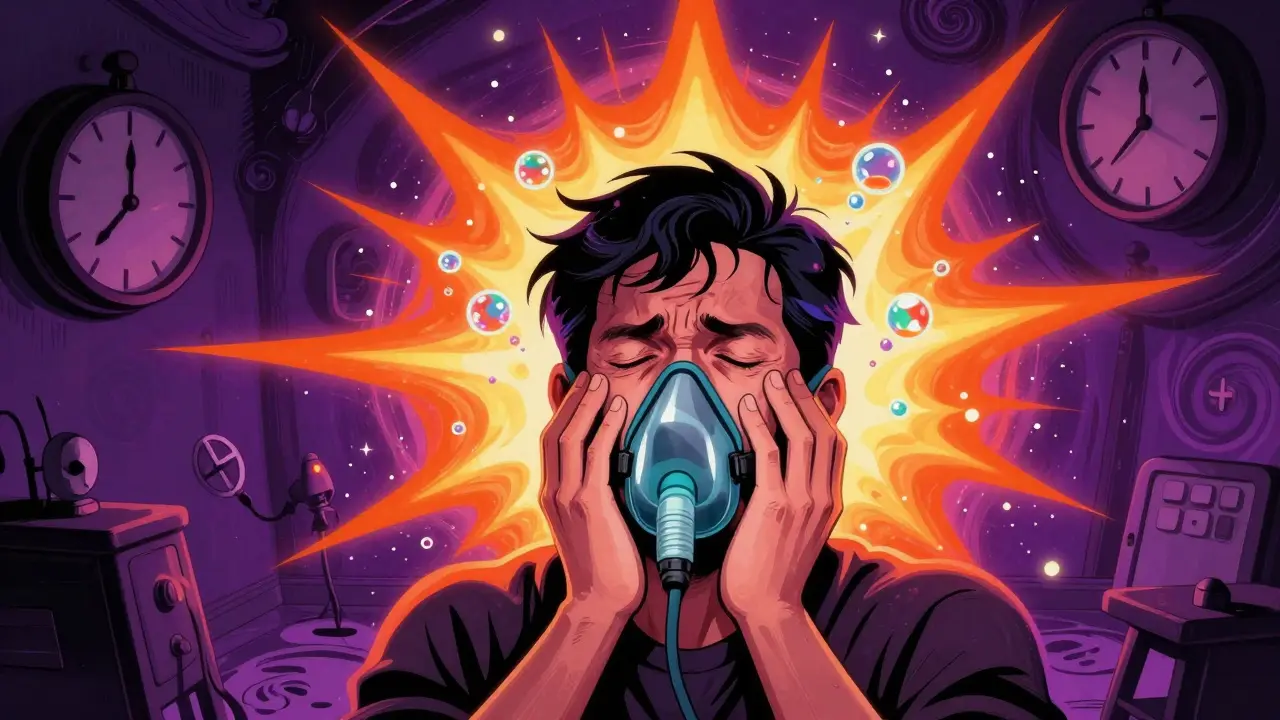
Cluster headaches aren’t just bad headaches. They’re among the most painful conditions known to medicine - so intense that many patients call them "suicide headaches." Unlike migraines or tension headaches, cluster headaches strike like clockwork, often at the same time each day, and hit with a ferocity that leaves people pacing, rocking, or screaming. The pain is sharp, burning, and focused behind one eye or on one side of the face. Attacks last between 15 and 180 minutes, and during a cluster period, they can happen up to eight times a day for weeks or even months. There’s no warning. No gradual build-up. Just sudden, unbearable agony.
Why Oxygen Therapy Works
Oxygen therapy is the fastest, safest way to stop a cluster headache attack. Breathing 100% pure oxygen through a non-rebreather mask can knock out the pain in as little as 10 minutes. For 78% of people who try it, the headache is gone or dramatically reduced within 15 minutes. That’s faster than most medications, and without the side effects.
How does it work? The exact mechanism isn’t fully understood, but experts believe high-flow oxygen reduces blood flow to the trigeminal-autonomic reflex pathway - the brain circuit that triggers the pain and autonomic symptoms like tearing, nasal congestion, and eyelid drooping. It also helps reset the hypothalamus, the part of the brain thought to control the timing of cluster cycles.
Unlike triptans (the most common migraine drugs), oxygen doesn’t constrict blood vessels. That makes it safe for people with heart disease, high blood pressure, or a history of stroke - conditions that make triptans risky. In fact, about 15% of cluster headache patients can’t use triptans at all because of these risks. For them, oxygen isn’t just an option - it’s the only safe acute treatment.
How to Use Oxygen Therapy Correctly
Getting oxygen right matters. Using it wrong means you won’t get relief. Here’s what works based on clinical guidelines and patient experience:
- Use a non-rebreather mask with a reservoir bag - not a simple nasal cannula. The mask must seal tightly over your nose and mouth.
- Set the flow rate to 12 to 15 liters per minute. Lower flow rates (like 6 L/min) often don’t work. Studies show 12 L/min gives 78% pain-free results at 15 minutes; placebo at the same rate only worked for 20%.
- Start breathing oxygen as soon as you feel the headache begin. Waiting even 10 minutes reduces effectiveness. Many patients keep their oxygen setup next to their bed so they can start treatment the moment they wake up - a common time for attacks.
- Breathe deeply and steadily for 15 to 30 minutes. Don’t stop just because the pain eases. Keep going to prevent a rebound.
- Sit upright or lean forward. Lying down can reduce oxygen delivery to the brain.
Some people switch to demand-valve masks - devices that release oxygen only when you inhale. These are lighter, more portable, and cut treatment delay by over 4 minutes on average. They’re especially useful if you’re away from home during an attack.
What Doesn’t Work
Oxygen therapy isn’t a magic bullet. About 20% of people don’t respond to it at all. Research shows certain factors predict poor results:
- You’ve never smoked (oddly, former smokers respond better than lifelong non-smokers)
- Your attacks last longer than 180 minutes
- You have ongoing pain between attacks (called persistent interictal headache)
Also, don’t rely on oxygen tanks from your local pharmacy. Medical-grade oxygen concentrators are required. Household oxygen units sold for COPD or general use often can’t deliver the high flow rates needed. You need a device that can sustain 12-15 L/min continuously. Popular models include the Invacare Perfecto2 or the newer Inogen One G5, which weighs just 4.8 pounds and fits in a backpack.
Comparing Oxygen to Other Treatments
Here’s how oxygen stacks up against other acute treatments:
| Treatment | Pain-Free at 15 Min | Side Effects | Cardiovascular Risk | Portability |
|---|---|---|---|---|
| Oxygen (12-15 L/min) | 78% | None reported | None | Medium (with portable units) |
| Subcutaneous Sumatriptan (6 mg) | 74% | 34% (chest tightness, dizziness) | High | High (injection pen) |
| Intranasal Zolmitriptan (5 mg) | 50% | 22% (bitter taste, nasal irritation) | Medium | High |
| Generic Painkillers (Ibuprofen, etc.) | <5% | Stomach upset, kidney strain | Low | High |
Oxygen wins on safety and speed. Triptans work almost as well, but their side effects - especially chest pressure and dizziness - are common. And they’re off-limits for many patients. Oxygen has no drug interactions, no addiction risk, and doesn’t cause rebound headaches. It’s also cheaper long-term. A portable oxygen concentrator costs $1,200-$2,500 upfront, but monthly rental is $150-$300. Triptan injections cost $20-$50 per dose, and many patients need multiple per day during a cluster cycle.
Getting Oxygen: Insurance, Access, and Barriers
Here’s the hard truth: many people who need oxygen therapy can’t get it.
In the U.S., Medicare only covers oxygen for cluster headaches if you’ve tried and failed two triptans and have at least one attack per week. Even then, 41% of initial claims were denied in 2022. Private insurers vary wildly - UnitedHealthcare approves 68% of requests, but Aetna only approves 42%. Rural patients face even bigger hurdles: only 28% have immediate access, compared to 63% in cities.
Patients often wait weeks or months to get approved. During that time, attacks continue. Some people buy units out-of-pocket. Others borrow from friends or use hospital-grade equipment in emergency rooms - but that’s not sustainable.
Advocacy groups like Clusterbusters have pushed for change. Between 2020 and 2023, 22 U.S. states passed laws requiring insurers to cover oxygen therapy for cluster headaches. Australia and the UK have better coverage, but access still depends on your doctor’s persistence and local health policies.
Real Stories: What Patients Say
On Reddit’s r/ClusterHeadaches community, with over 14,500 members, users share their experiences daily. One person wrote: “12 L/min non-rebreather mask gets me pain-free in 8-10 minutes if I catch it early - game changer from my previous 9/10 pain scores.” Another said: “I used to cry for hours. Now I just put on the mask and breathe. It’s not perfect, but it’s the only thing that works.”
But not everyone succeeds. Some struggle with mask fit. Others forget to turn on the machine during the chaos of an attack. A few try oxygen too late - waiting until the pain peaks. The key is preparation: keep your mask and concentrator in your bedroom, your car, your office. Practice putting it on before an attack hits. Set alarms to remind you to check your equipment.
One patient in Melbourne reported cutting her attack frequency from eight per day to two after starting oxygen therapy consistently. She didn’t stop the attacks - but she stopped the suffering.
What’s Next? New Tech on the Horizon
The FDA cleared the O2VERA portable concentrator in May 2023 - a device designed specifically for cluster headaches, delivering 15 L/min in a 5.2-pound unit. In Europe, a new nasal cannula system showed 89% effectiveness in trials, which could make oxygen easier to use for people who hate masks.
Researchers are also testing demand-valve systems that release oxygen instantly when you inhale. Early results suggest they could cut treatment time to under 7 minutes. That’s the new target: faster, quieter, more reliable delivery.
For now, though, oxygen remains the gold standard. It’s not new. It’s not flashy. But it’s the only treatment that’s proven, safe, and effective for most people - right now, today.
What to Do If Oxygen Doesn’t Work
If you’ve tried oxygen correctly and it doesn’t help, you’re not alone. About 1 in 5 patients don’t respond. Talk to a headache specialist. Other options include:
- Subcutaneous sumatriptan (injection)
- Intranasal zolmitriptan
- Neuromodulation devices like gammaCore (a handheld stimulator for the vagus nerve)
- Preventive medications like verapamil or lithium (used during cluster cycles to reduce frequency)
But oxygen should always be your first try. It’s the most reliable tool you have.
Can I use oxygen from a medical tank at home for cluster headaches?
Yes, but only if it delivers 100% oxygen at 12-15 liters per minute through a non-rebreather mask. Standard nasal cannulas or low-flow oxygen units won’t work. Medical-grade oxygen concentrators or high-flow tanks are required. Check with your DME provider to ensure the equipment meets clinical standards.
Is oxygen therapy safe if I have heart problems?
Yes. Unlike triptans, oxygen doesn’t constrict blood vessels or raise blood pressure. It’s the only acute treatment recommended for cluster headache patients with cardiovascular disease. There are no known serious side effects when used correctly.
How long should I use oxygen during an attack?
Use oxygen for 15 to 30 minutes, even if the pain stops early. Stopping too soon can lead to rebound attacks. Most people feel relief within 10-15 minutes, but continuing the full treatment reduces the chance of the headache returning.
Why does oxygen work better than painkillers like ibuprofen?
Cluster headaches aren’t caused by inflammation - they’re neurological. Painkillers like ibuprofen target inflammation and are ineffective for this type of pain. Oxygen works by altering brain activity in the trigeminal-autonomic pathway, directly interrupting the attack mechanism. Ibuprofen has less than a 5% success rate for cluster headaches.
Can I use oxygen therapy every day during a cluster cycle?
Yes. Oxygen therapy has no cumulative side effects and can be used multiple times a day. Many patients use it 4-8 times daily during active cluster periods. It’s safe for long-term, frequent use. The only limit is access and convenience.
Do I need a prescription for oxygen therapy?
Yes. In most countries, medical oxygen is regulated. You need a prescription from a neurologist or headache specialist, typically with an ICD-10 code of G44.0 (cluster headache). Durable medical equipment providers require this before supplying oxygen concentrators or tanks.
Final Thoughts
Cluster headaches are rare, but they’re devastating. And for most people, oxygen therapy is the most effective, safest, and fastest way to stop the pain. It’s not a cure - but it’s a lifeline. If you or someone you know suffers from these attacks, don’t wait. Talk to a specialist. Get the right equipment. Learn how to use it. And don’t let insurance barriers or misinformation stop you. You don’t have to suffer in silence. Relief is possible - and it’s just a breath away.

Astha Jain
oxygen therapy?? lmao i thought this was a joke at first. like, u just breathe air?? and it stops pain?? my cousin tried this and said it felt like a dragon breathing on his face. but honestly? it worked. like, WTF.
Erwin Kodiat
Man, this is one of those posts that makes you realize how much we take basic medical knowledge for granted. Oxygen isn't magic-it's biology. But it's also one of the most underused tools in pain management. Seriously, if this helps even 78% of people, why isn't every ER and neurologist pushing this first?
I’ve seen people in pain so bad they’re crying and rocking. Then they put on the mask... and 10 minutes later, they’re sipping coffee like nothing happened. That’s not just treatment-that’s dignity restored.
Lydia H.
It’s wild how something so simple-breathing air-can be the most powerful tool against one of the most brutal conditions known to medicine. We chase fancy drugs, expensive implants, laser treatments… and the answer’s been sitting in tanks and concentrators all along.
I used to think cluster headaches were just ‘bad migraines.’ Now I know they’re a different species of suffering. And oxygen? It’s the quiet hero no one talks about. Hats off to the people who’ve fought for access to it. This isn’t just medicine-it’s justice.
Josh Kenna
Y’all act like oxygen is some miracle cure, but I’ve been doing this for 5 years and half the time it doesn’t work. I got the mask, the concentrator, the whole damn setup. But if I’m not sitting upright, or if the mask leaks even a little? NOTHING. Zero. Zilch. And don’t even get me started on insurance. I paid $2k out of pocket because UnitedHealthcare said ‘try triptans first’-like I’m gonna wait 3 weeks to get a shot that makes me feel like I’m having a heart attack?
So yeah, oxygen’s great… when it works. But don’t act like it’s perfect. It’s not. It’s just the least terrible option.
Valerie DeLoach
Thank you for writing this with such clarity and compassion. I’m a nurse who works in neurology, and I’ve watched patients go from sobbing on the floor to sitting up, breathing calmly, within minutes of starting oxygen. It’s the most transformative thing I’ve seen in clinical practice.
But I also see the gaps: the rural patients without transport, the ones whose doctors don’t know the protocol, the ones who can’t afford the equipment. This isn’t just a medical issue-it’s a systemic failure. We need policy changes, not just better patient education.
If you’re reading this and you have access to oxygen therapy-use it. And if you don’t-keep fighting. You deserve relief.
Christi Steinbeck
Stop waiting for permission to feel better. If you have cluster headaches and oxygen is an option-GET IT. Don’t wait for insurance. Don’t wait for your doctor to ‘recommend it.’ Go to a DME supplier, show them this post, and say ‘I need this.’ They’ll help you. If they don’t, find someone who will. Your life isn’t a paperwork maze.
I used to think I had to suffer through 8 attacks a day. Now? Two. And I’m not even trying hard. Just breathe. Just do it. You’re worth it.
Jacob Hill
Just to clarify-because I’ve seen so many people get this wrong-the mask MUST be a non-rebreather with a reservoir bag. I’ve seen people use nasal cannulas at 10 L/min and think they’re ‘doing oxygen therapy.’ They’re not. They’re just breathing faster. It’s like trying to put out a wildfire with a water bottle.
And yes, the flow rate matters. 12 L/min is the minimum. 15 is better. If your machine can’t do it, it’s not medical-grade. Don’t waste your time. Get the right gear. Your brain will thank you.
Lewis Yeaple
It is worth noting that the efficacy of oxygen therapy in the treatment of cluster headaches is supported by multiple randomized controlled trials, including those published in The Lancet Neurology and Headache: The Journal of Head and Face Pain. The physiological mechanism involves hyperoxia-induced vasoconstriction of the internal carotid artery and suppression of the trigeminal-autonomic reflex arc, as demonstrated via functional MRI studies.
Furthermore, the assertion that former smokers respond better than lifelong non-smokers may be correlated with neuroplastic changes induced by prior nicotine exposure, though this hypothesis remains under investigation.
Jackson Doughart
I’ve been living with this for 11 years. I’ve tried everything. Triptans gave me chest pain so bad I thought I was dying. Lasers, nerve blocks, even that weird headset that zaps your head. Nothing worked like oxygen.
But here’s the thing no one says: it’s not about the machine. It’s about the ritual. I keep my mask on my nightstand. I practice putting it on before bed. I’ve trained myself to react before the pain hits-like a reflex. And when it does? I breathe. Not panic. Not scream. Just breathe.
It’s not a cure. But it’s my peace. And after all this time? That’s enough.