
Creatine Impact Calculator
Check Your Kidney Function Test Results
Enter your recent creatinine reading and basic health info to see how creatine might affect your results.
Your Adjusted Results
Measured eGFR
Adjusted eGFR (accounting for creatine)
Why This Matters
Creatine supplementation can increase your serum creatinine levels by 10-30%, which artificially lowers your eGFR (estimated glomerular filtration rate). This calculator adjusts for that effect to give you a more accurate picture of your kidney function.
If your measured eGFR is in the CKD range (below 60 mL/min/1.73m²) but your adjusted eGFR is normal, it's likely due to creatine use rather than actual kidney damage.
When you take creatine to build strength or recover faster from workouts, you’re not just adding a supplement-you’re changing how your kidneys are measured. That’s a problem if you’re also on medication for kidney disease. Many people don’t realize that creatine can make your blood test look like your kidneys are failing-even when they’re working perfectly.
Why Creatine Tricks Kidney Tests
Creatine breaks down into creatinine, a waste product your kidneys filter out. That’s why doctors use creatinine levels to estimate how well your kidneys are working. But when you take creatine supplements, your body makes more creatinine than normal. That’s not because your kidneys are damaged-it’s because you’re feeding them extra raw material.Studies show that taking 3 to 5 grams of creatine daily can raise your serum creatinine by 10% to 30%. In one trial, healthy adults saw creatinine jump by 15 to 25 µmol/L without any change in actual kidney function. This is a big deal because labs automatically plug creatinine into formulas to calculate eGFR-the number doctors use to diagnose chronic kidney disease. A false drop in eGFR can lead to a wrong diagnosis of stage 2 or even stage 3 kidney disease.
One Reddit user, FitMedStudent, was told they had stage 2 CKD with an eGFR of 78. They were on 5 grams of creatine daily. After stopping the supplement, their eGFR bounced back to 95. No treatment. No damage. Just a misleading lab result.
What Happens When You’re on Kidney Medications
If you’re taking drugs like ACE inhibitors, ARBs, diuretics, or NSAIDs for kidney disease, your kidneys are already under stress. These medications are designed to protect kidney function, but they also interact with how your body handles waste. Creatine adds more creatinine to filter, which might seem harmless-but it’s not just about volume. It’s about the system’s ability to keep up.There’s no solid evidence that creatine causes kidney damage in healthy people. But when you’re already on kidney meds, your body’s margin for error shrinks. A 2011 case report in the Clinical Kidney Journal described a person developing acute tubular necrosis while taking just 3 grams of creatine daily-no prior kidney issues, no other toxins. It was rare, but it happened. And that’s enough reason to be cautious.
Experts agree: if you have kidney disease or are on kidney medications, don’t start creatine without talking to your nephrologist. The National Kidney Foundation says creatine should be avoided in people with chronic renal disease. The risk isn’t that creatine harms your kidneys-it’s that it hides what’s really going on.
How to Tell Real Kidney Problems From Fake Signals
Not all kidney tests are created equal. Serum creatinine is the most common, but it’s the most easily fooled. Here’s what you need to know to spot the difference:- True kidney dysfunction shows up in multiple ways: rising creatinine, rising BUN (blood urea nitrogen), protein in urine, abnormal electrolytes, swelling, fatigue.
- Creatine-induced elevation only raises creatinine. BUN stays normal. Urine output doesn’t change. No proteinuria. No electrolyte shifts.
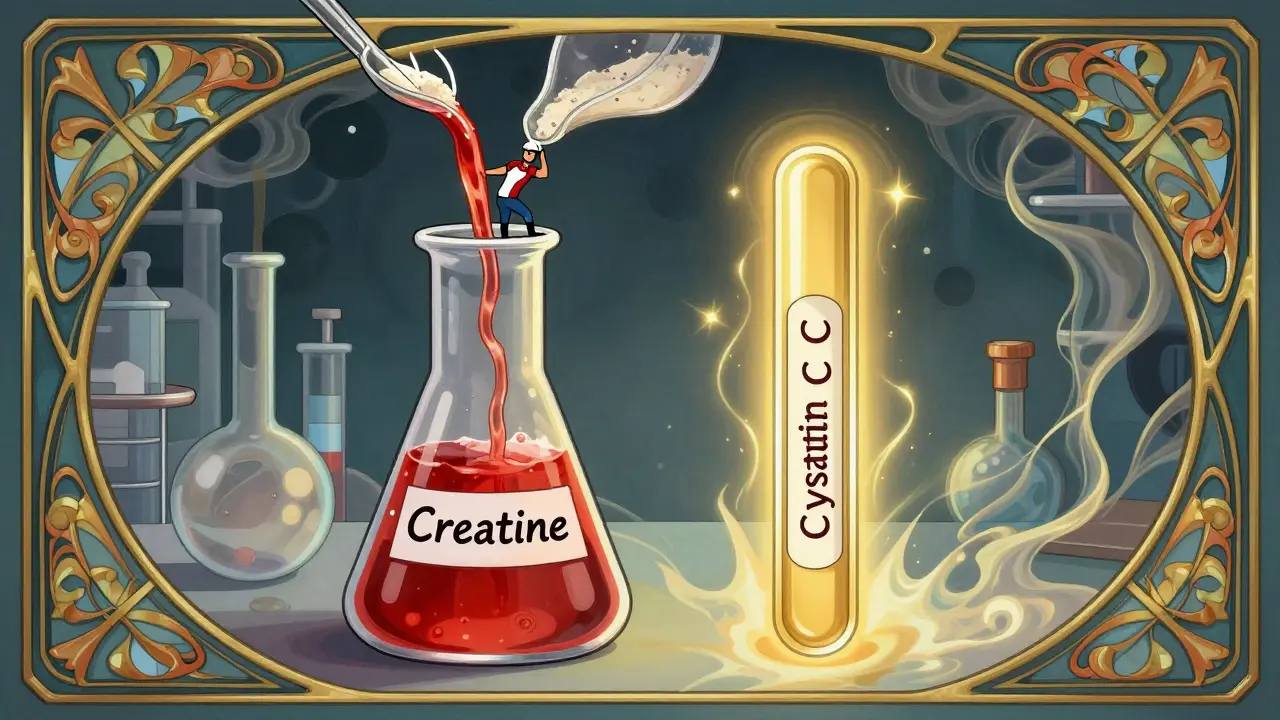
That’s why doctors need to look beyond creatinine. The best alternative is cystatin C, a protein that filters through the kidneys but isn’t affected by creatine. Studies show cystatin C-based eGFR equations match true kidney function with 95% accuracy-even in people taking creatine.
If cystatin C isn’t available, a 24-hour urine creatinine clearance test gives a clearer picture. One study followed older men on 5 grams of creatine daily for a year. Their creatinine blood levels rose, but their urine creatinine output stayed the same. That means their kidneys were filtering just fine-they were just processing more creatine.

What You Should Do Before and During Creatine Use
If you’re healthy and want to try creatine, here’s how to stay safe:- Get a baseline test before starting. Ask for serum creatinine, BUN, and ideally cystatin C.
- Tell your doctor you’re taking creatine-don’t assume they’ll ask. A 2021 survey found 67% of primary care doctors don’t routinely ask about supplements.
- Use 3-5 grams daily. Avoid loading phases (20g/day) if you have any kidney concerns. Higher doses increase creatinine spikes.
- Monitor with cystatin C every 3-6 months if you’re on long-term creatine.
- Stop creatine if your eGFR drops suddenly and you’re not sure why. Re-test after 2-4 weeks off.
If you’re already on kidney disease meds, don’t start creatine without approval. Your doctor may suggest skipping it entirely. There’s no proven benefit for people with kidney disease, and the risk of misdiagnosis is too high.
What the Latest Research Says
A major 2024 Mendelian randomization study in Renal Failure looked at genetic data from over 100,000 people. It found no causal link between creatine levels and kidney damage. The study’s authors concluded: “Concerns about creatine triggering kidney issues may not be justified.”That’s reassuring-but it doesn’t mean you can ignore monitoring. The problem isn’t creatine causing damage. It’s creatine making it look like damage is happening. And that can lead to unnecessary stress, extra tests, even wrong treatments.
Researchers at the University of Toronto are working on a fix: a simple multiplier to adjust eGFR calculations for creatine users. Early data suggests multiplying creatinine-based eGFR by 0.9 gives a much more accurate result. If adopted, this could prevent thousands of false diagnoses each year.
What’s Not Working
Some supplement brands now sell “kidney-safe creatine.” But ConsumerLab.com tested these in early 2024 and found no difference in creatinine output. The label doesn’t change the chemistry. Creatine is creatine. It breaks down into creatinine whether it’s labeled “premium,” “organic,” or “kidney-friendly.”And don’t assume that because you feel fine, your kidneys are fine. Symptoms of early kidney disease are often silent. That’s why blood tests matter-but only if they’re interpreted correctly.
Bottom Line: Creatine Isn’t the Enemy-Misunderstanding Is
Creatine is one of the most studied supplements on the planet. Over 500 participants across dozens of studies show no harm to kidney function in healthy people. The American College of Sports Medicine, UCLA Health, and the European Food Safety Authority all agree: it’s safe when used as directed.But if you have kidney disease or take kidney medications, creatine becomes a diagnostic wildcard. It doesn’t hurt your kidneys. But it can make your doctor think they’re failing. And that’s dangerous.
The solution isn’t to avoid creatine entirely. It’s to test smarter. Ask for cystatin C. Tell your doctor you’re using it. Don’t let a lab number dictate your health story.
For millions of people, creatine helps them move better, train harder, and live stronger. But if you’re managing kidney disease, your health isn’t just about performance-it’s about accuracy. And accuracy starts with the right test.
Can creatine cause kidney damage if I have kidney disease?
There’s no strong evidence that creatine causes kidney damage, even in people with kidney disease. But if you already have impaired kidney function, your body may struggle to handle the extra creatinine load. Most experts advise against using creatine if you have chronic kidney disease, especially while on nephrotoxic medications like NSAIDs or ACE inhibitors. The bigger risk is misdiagnosis-creatine can make your blood tests look worse than they are.
Why does my eGFR drop when I take creatine?
Your eGFR drops because creatine increases your blood creatinine levels. Lab formulas use creatinine to estimate kidney function, so higher creatinine = lower eGFR. But this doesn’t mean your kidneys are worse. It just means the formula is being fooled. Your actual kidney filtration rate hasn’t changed. To get a true reading, ask for a cystatin C-based eGFR test instead.
Should I stop creatine before a kidney blood test?
Yes-if you’re being tested for kidney function and you take creatine, stop it for at least 2-4 weeks before the test. This lets your creatinine levels return to baseline. If you can’t stop, tell your doctor you’re taking it. They can order a cystatin C test or a 24-hour urine creatinine clearance, which aren’t affected by creatine supplementation.
Is cystatin C testing widely available?
Cystatin C testing is not yet routine in most clinics, but it’s becoming more common in nephrology practices. If your doctor doesn’t offer it, ask for a referral to a nephrologist or request the test specifically. It’s more expensive than creatinine, but it’s the most reliable way to monitor kidney function if you’re using creatine. Some hospitals now use it as a standard for athletes and supplement users.
Are there any creatine supplements that don’t raise creatinine?
No. All forms of creatine-monohydrate, HCl, nitrate, buffered-break down into creatinine the same way. Labels like “kidney-safe” or “low-creatinine” are marketing claims, not science. ConsumerLab.com tested these products in 2024 and found no difference in creatinine output. The only way to avoid the effect is to not take creatine at all.
Can I take creatine if I’m on dialysis?
No. If you’re on dialysis, your kidneys are no longer filtering waste effectively. Creatine adds more creatinine to your system, which dialysis may not fully remove. This can lead to unpredictable buildup and interfere with your treatment plan. There’s no proven benefit for dialysis patients, and the risks outweigh any potential gains. Always consult your nephrologist before adding any supplement.

Angela Goree
So let me get this straight-you’re telling me I’ve been freaking out over my eGFR dropping for years, and it’s just because I take creatine? I’ve been told I have "early-stage kidney disease" since 2021, and I’ve been on ACE inhibitors since then… but if I stop creatine, my numbers go back to normal? This is insane. I’ve been avoiding protein, drinking 3 liters of water daily, and now I find out I was never sick? I’m canceling my nephrologist appointment tomorrow.
Vincent Sunio
It is, indeed, a matter of considerable concern that the medical community continues to rely upon creatinine-based eGFR estimations without accounting for exogenous creatine intake. The biochemical principle is unambiguous: creatine → creatinine, and creatinine is the marker. The failure to adjust for this confounder is not merely negligent-it is a systemic failure of diagnostic rigor. One must wonder how many patients have been subjected to unnecessary interventions due to this oversight.
JUNE OHM
OMG I KNEW IT 😤 I told my doctor last year "this is a scam" and she laughed at me. Now I’m like-what if the whole kidney thing is just a big pharma lie to sell more meds?? 😳 I’ve been taking creatine for 5 years, my eGFR dropped to 68, and now I’m supposed to believe I’m "diseased"?? What if they’re just hiding the truth?? I’m going to start a TikTok campaign: #CreatineIsntTheEnemyTheLabIs 😈
Philip Leth
Yo, I’m from India, and creatine is basically the new chai here. Everyone’s popping it-bodybuilders, old guys trying to climb stairs, even my aunt who’s 62 and does yoga. Nobody checks labs. But this post? Game changer. I’m telling my cousin who’s on dialysis to skip it. No joke. He was thinking about trying "the muscle stuff". Now he knows better. Thanks for the clarity.
Shanahan Crowell
This is the kind of info that changes lives. Seriously. I’ve been on creatine for 8 years, and I’ve had 3 different doctors tell me I had "mild kidney decline". I stopped for 6 weeks last year-eGFR jumped from 74 to 91. No meds. No diet changes. Just stopped the creatine. I wish I’d known this 5 years ago. You’re not broken-you’re just being misread. Keep sharing this. We need more of this, not less.
Kerry Howarth
Baseline test before starting creatine. Tell your doctor. Use cystatin C if possible. Stop if eGFR drops. Simple. Clear. No drama. Do this, and you’re golden. No need to fear creatine. Just respect the science.
Tiffany Channell
Let’s be real. The people who take creatine are the same ones who believe in quantum healing crystals and eat kale for "detox." You’re not protecting your kidneys-you’re fooling yourself into thinking you’re invincible. And now you want the medical system to bend over backward to accommodate your supplement habit? Wake up. If you’re on kidney meds, you’re not an athlete. You’re a patient. Stop treating your body like a lab experiment.
Joy F
Here’s the ontological rupture: creatine doesn’t harm the kidney-it harms the epistemology of renal medicine. The algorithmic reduction of kidney function to a single biomarker, unadjusted for anthropogenic inputs, is a symptom of biomedical colonialism. We’ve outsourced diagnosis to a spreadsheet. The body is no longer a lived experience-it’s a data point. And when the data is skewed by the neoliberal supplement industrial complex, we mistake the map for the territory. Cystatin C isn’t a test-it’s a rebellion.
Haley Parizo
They’re not just lying to you-they’re lying to themselves. The medical system is terrified of admitting that their gold-standard tests can be fooled by a $10 powder. That means they’ve been wrong for decades. That means malpractice. That means lawsuits. That means they’ll bury this truth under 10 more guidelines. Don’t trust the system. Trust your own labs. Get cystatin C. Demand it. Or keep being misdiagnosed while they profit from your fear.
Ian Detrick
I’ve been coaching athletes for 15 years. I’ve seen creatine change lives-hips, knees, shoulders, everything. But I’ve also seen people panic over eGFR numbers. This post? Perfect. It’s not about stopping creatine. It’s about knowing how to read the numbers. I’ve started telling every client: "If you’re on meds or have kidney history, get cystatin C before you even open the tub." Simple. Smart. Saves so much stress.
Angela Fisher
Did you know that the FDA doesn’t regulate supplements? That means the creatine you buy could be laced with heavy metals or worse. And now you’re feeding your kidneys more junk? And they’re telling you to just "stop"? What if you stop and your creatinine doesn’t drop? What if it’s not creatine at all? What if it’s the water you drink? The air? The 5G towers? I’ve been researching this for months. I think Big Pharma is using creatine as a cover to push more kidney meds. They’re scared people will figure out the truth. I’ve started a petition: #FreeCreatine #StopTheKidneyScam
Neela Sharma
In India, we call creatine "power powder"-used by wrestlers, farmers, even grandmas walking uphill. No one checks eGFR. But this post? It’s a gift. My brother has stage 3 CKD. He took creatine for 2 years. His doctor never asked. Now I’ll take him for cystatin C. No drama. No fear. Just truth. Sometimes the simplest thing-telling your doctor-is the bravest.
Shruti Badhwar
While the biochemical mechanism is well-established, the clinical implications require a nuanced approach. The National Kidney Foundation’s caution is not arbitrary; it reflects a precautionary principle grounded in patient safety. Even if creatine does not directly induce nephrotoxicity, the potential for diagnostic misclassification introduces significant risk. Physicians must be empowered with diagnostic tools such as cystatin C, and patients must be educated to disclose supplementation. This is not an attack on creatine-it is a call for precision medicine.