
Key Takeaways
- Crossover designs reduce the number of participants needed by using people as their own controls.
- The 2×2 design is the gold standard for most standard bioequivalence tests.
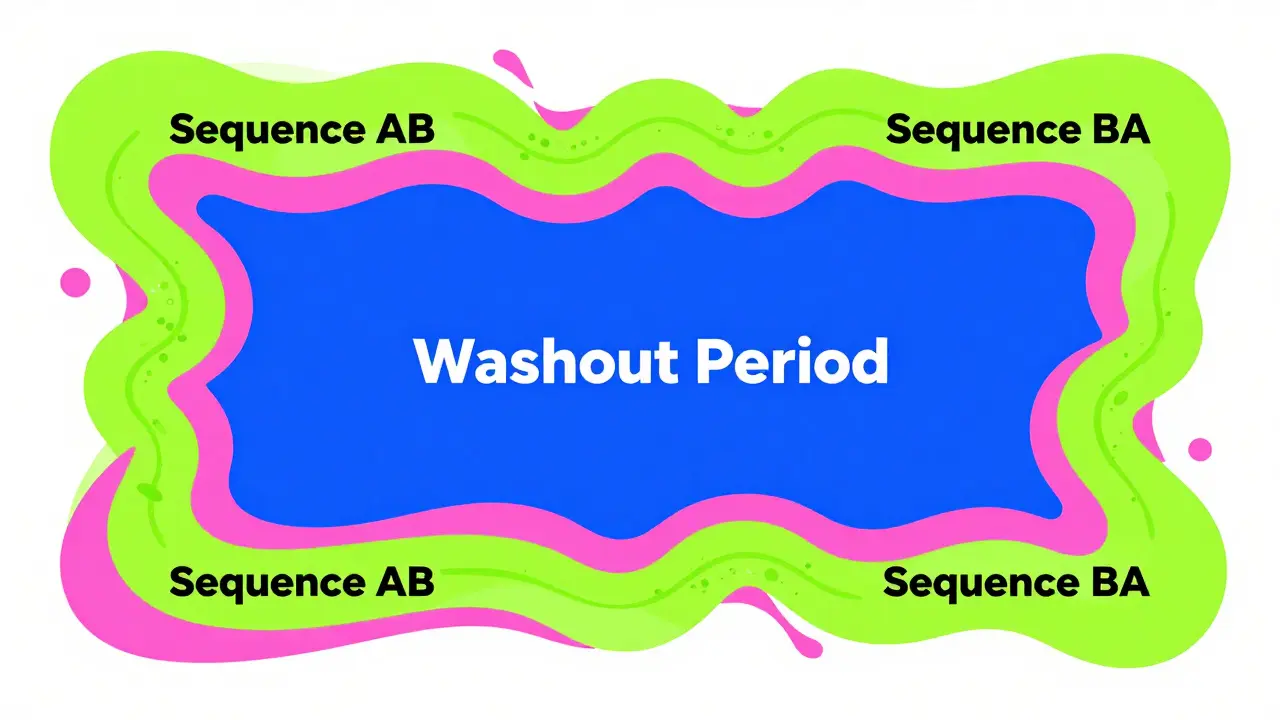
- A critical "washout period" prevents the first drug from interfering with the second.
- Replicate designs are used for "highly variable drugs" to ensure statistical accuracy.
- Regulatory success depends on the 90% confidence interval falling between 80% and 125%.
The Blueprint: How a Standard 2×2 Crossover Works
In most Bioequivalence Studies, the 2×2 crossover (also called AB/BA) is the go-to structure. Instead of splitting 100 people into two groups, you might only need 24. You divide your participants into two sequences:- Sequence AB: Participants take the Test product (Generic), wait, and then take the Reference product (Brand).
- Sequence BA: Participants take the Reference product first, wait, and then take the Test product.
When Things Get Messy: Handling Highly Variable Drugs
Not all drugs behave the same. Some are "highly variable," meaning the drug's concentration in the blood fluctuates significantly even within the same person (an intra-subject coefficient of variation over 30%). For these, a simple 2×2 design isn't enough; the statistical noise is too loud. This is where Replicate Crossover Designs come in. Instead of two periods, you use four. In a full replicate design (TRTR/RTRT), each person takes both the test and reference products twice. This gives researchers multiple data points for the same person, allowing them to calculate a more precise variance. There are also partial replicate designs, like TRR/RTR/TTR, which are a bit more efficient. These are essential for using Reference-Scaled Average Bioequivalence (RSABE). RSABE allows for widened acceptance limits (75% to 133.33% instead of the usual 80% to 125%) if the reference drug itself is naturally volatile. Without this specialized design, you'd need a massive-and likely impossible-number of participants to prove the drugs are equivalent.| Feature | Standard 2×2 | Replicate (4-Period) |
|---|---|---|
| Best For | Low to moderate variability drugs | Highly variable drugs (CV > 30%) |
| Sample Size | Typically 12–48 subjects | Typically 24–72 subjects |
| Complexity | Low; two treatments per person | High; four treatments per person |
| Cost | Lower | 30–40% higher due to more periods |
The Math: How Success is Measured
Once the blood samples are collected, biostatisticians use a Linear Mixed-Effects Model to analyze the results. They aren't just looking at a simple average; they're checking for the effect of the sequence, the period, and the treatment. To get a "pass" from the FDA or EMA, the study must meet two primary criteria based on the ratio of geometric means between the test and reference products:- AUC (Area Under the Curve): This measures the total drug exposure over time. The 90% confidence interval must fall within 80.00% to 125.00%.
- Cmax (Maximum Concentration): This is the peak level the drug reaches in the blood. This also typically needs to be within the 80% to 125% range.
Crossover vs. Parallel: Why Not Just Use Two Groups?
In a parallel design, you give Group A the test drug and Group B the reference drug. This is necessary for drugs with incredibly long half-lives (like some antidepressants or biologicals that stay in the body for weeks) because you can't wait months for a washout period. However, for almost everything else, crossover is the winner. Why? Efficiency. If between-subject variance is twice as large as the measurement error, a crossover trial needs only one-sixth the number of participants to reach the same statistical power as a parallel trial. For example, a clinical trial manager might find that a generic warfarin study only needs 24 people in a crossover design, whereas a parallel design would require 72. That's a massive saving in recruitment costs, pharmacy spend, and time. The trade-off is that you have to keep the same participants for a longer duration, and you have to be absolutely sure your washout period is long enough.
Common Pitfalls and How to Avoid Them
Even with a solid plan, things can go wrong. The most frequent disaster is the underestimated washout. If a researcher assumes a drug's half-life is 24 hours but it's actually 48, the residue from the first dose will skew the second dose's results. This often leads to the study being rejected, forcing the company to start over at a cost of hundreds of thousands of dollars. Another mistake is improper randomization. You must randomize by sequence, not by treatment. If you just assign people to "Treatment A" or "Treatment B" without accounting for the order (AB vs BA), you introduce bias that the FDA will spot immediately. Finally, handling missing data is a minefield. Because the power of a crossover trial relies on the "self-controlled" aspect, losing a participant halfway through the study (e.g., they drop out after Period 1) removes the comparison point. If too many people drop out, the statistical advantage of the crossover design vanishes.What exactly is a carryover effect?
A carryover effect happens when the first drug administered in a crossover study is still present in the body or is still affecting the body's physiology when the second drug is given. This contaminates the second period's data, making it impossible to tell if the observed effect is from the second drug or a lingering interaction from the first. This is why a washout period of at least five half-lives is mandatory.
Why is the 80-125% range used for bioequivalence?
This range is a regulatory standard designed to ensure that the difference in bioavailability between a generic and a brand-name drug is clinically insignificant. By requiring the 90% confidence interval to fall within this window, regulators ensure that the vast majority of patients will experience nearly identical drug exposure and efficacy.
When should I use a parallel design instead of a crossover?
Parallel designs are used when crossover is impractical or unethical. The most common reason is a very long drug half-life; if a drug takes weeks to leave the system, a washout period would be too long for participants to reasonably commit to. They are also used for drugs that cure a condition (meaning the patient cannot return to their baseline state for the second period) or for drugs with severe side effects where a second dose would be risky.
How does a replicate design differ from a standard 2×2 design?
While a standard 2×2 design gives each participant the test and reference drug once, a replicate design gives them each drug twice (or more). This allows researchers to measure the within-subject variability of both the generic and the brand drug separately, which is critical for passing the RSABE (Reference-Scaled Average Bioequivalence) criteria for highly variable drugs.
What software is typically used for this analysis?
Most industry professionals use SAS (specifically PROC GLM or PROC MIXED) for the heavy lifting of linear mixed-effects models. Phoenix WinNonlin is also widely used because it provides specialized templates specifically for bioequivalence and pharmacokinetic analysis. Some experts use R with packages like 'bear' for more complex, custom designs.
