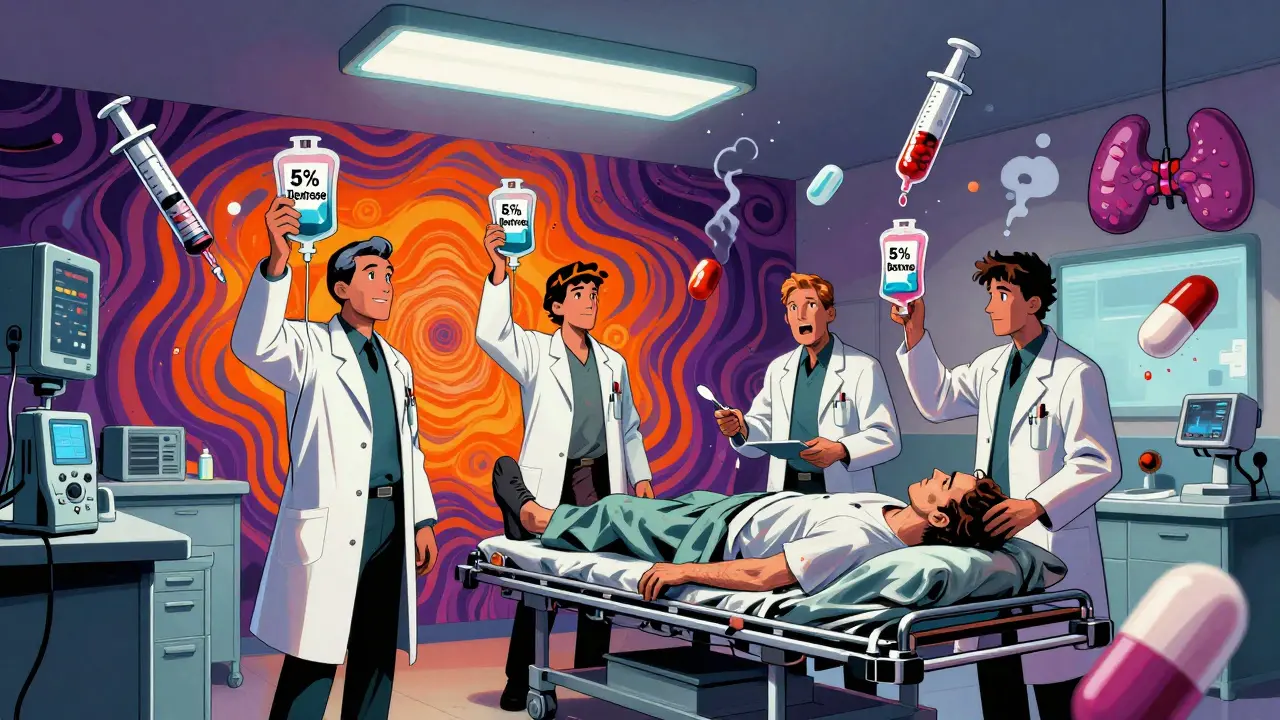
Right now, in hospitals and pharmacies across the U.S., doctors are making tough calls. A cancer patient might get a delayed treatment. A diabetic might be handed a different insulin brand. A child with an infection could be given an older, less effective antibiotic. This isn’t a worst-case scenario-it’s everyday reality in 2026. Drug shortages are still widespread, and the list of missing medications is longer than most people realize.
What’s Actually Missing Right Now?
As of early January 2026, over 260 drugs remain in shortage across the U.S., according to the American Society of Health-System Pharmacists. The most critical gaps are in medications that are hard to make, cheap to produce, or rely on overseas ingredients. Here’s what’s still hard to find:
- 5% Dextrose Injection (small bags) - Used for hydration and delivering other IV meds. Shortage started in February 2022, expected to last until August 2026.
- 50% Dextrose Injection - Critical for treating low blood sugar in emergencies. Shortage since December 2021, resolution not expected until September 2026.
- Cisplatin - A cornerstone chemotherapy drug for testicular, ovarian, and lung cancers. Production halted after a 2022 FDA inspection found quality issues at an Indian plant that supplied half of U.S. demand.
- Levothyroxine - The most common thyroid hormone replacement. Demand has surged 25% since 2023, and manufacturing delays have kept shelves thin.
- Vancomycin - A last-resort antibiotic for serious infections. Shortages have returned after a brief improvement in late 2025.
- Epinephrine auto-injectors - Used for severe allergic reactions. Supply issues stem from raw material delays, not just demand.
- GLP-1 agonists (like semaglutide and tirzepatide) - Used for weight loss and type 2 diabetes. Demand jumped 35% yearly since 2020, overwhelming production capacity.
- Amoxicillin and azithromycin - Common antibiotics. Shortages spike during flu season, and 2025-2026 saw unusually high demand from pediatric clinics.
These aren’t rare drugs. They’re the ones people rely on daily. A shortage of IV fluids means ERs can’t start IVs for dehydration. A lack of cisplatin means cancer treatments get postponed. And when pharmacies run out of levothyroxine, patients go without thyroid control for weeks.
Why Is This Happening?
It’s not one problem-it’s a chain reaction.
First, most of the raw ingredients for U.S. drugs come from just two countries: India and China. About 45% of active pharmaceutical ingredients (APIs) come from India, 25% from China. When a factory in Hyderabad fails an FDA inspection-or when trade tensions spike between the U.S. and China-production stops. And there’s no backup.
Second, these drugs are mostly generics. They’re cheap. A bottle of amoxicillin might cost $5. The manufacturer barely makes a profit. Why invest in building a new factory or upgrading equipment for such low returns? Most companies choose to cut corners instead. That’s why quality issues keep popping up.
Third, demand keeps rising. More people are using weight-loss drugs like Ozempic. More seniors need thyroid meds. More kids are being diagnosed with ADHD. But production hasn’t kept up. And when demand spikes, the system cracks.
Finally, the FDA can’t force companies to make more. They can inspect, warn, and nudge-but they can’t require a company to restart a line or increase output. In 2025, the FDA prevented about 200 potential shortages by stepping in early. But that’s reactive. The system is still broken.
Who’s Getting Hurt?
It’s not just patients. It’s everyone in the system.
Doctors report that 78% have delayed treatments because of drug shortages. One oncologist in Ohio told a Reddit thread that her team had to ration cisplatin-giving it only to patients with testicular cancer, because that’s where it works best. Other cancer patients? They got alternative drugs that were less effective and more toxic.
Pharmacists are spending over 10 hours a week just tracking down substitutes. In 67% of hospitals, medication errors have increased because staff are switching to unfamiliar drugs under pressure. A patient gets metformin instead of insulin? That’s not just a mix-up-it’s a safety risk.
Patients with chronic conditions are the hardest hit. One cancer patient in Texas told a support group she waited 21 days for her next chemotherapy cycle. Her tumor grew during that time. She didn’t get a refund. She didn’t get an apology. She just got scared.
What’s Being Done?
Some fixes are in motion-but they’re slow.
The FDA launched a new public reporting portal in January 2025. It lets doctors and pharmacists report shortages that aren’t yet on the official list. In its first three months, it received over 1,200 reports. Nearly 9 out of 10 led to FDA action.
Forty-seven states now let pharmacists swap in similar drugs during shortages. But only 19 states let them do it without calling a doctor first. That means delays. In an emergency, that delay can be deadly.
Some states are getting creative. New York is building an online map showing which pharmacies still have scarce drugs in stock. Hawaii’s Medicaid program now allows drugs approved in Canada or the EU as temporary alternatives.
The U.S. Pharmacopeia is pushing for three big changes: financial incentives for U.S.-based API manufacturing, mandatory stockpiles of critical drugs, and a national early-warning system that connects manufacturers, distributors, and hospitals in real time.
But progress is fragile. Proposed tariffs on Chinese and Indian pharmaceuticals could make shortages worse, not better. If tariffs hit 50-200%, the cost of raw ingredients could skyrocket-and manufacturers might just stop making the cheapest drugs altogether.
What Can You Do?
If you take a medication that’s in shortage, here’s what to do:
- Check the ASHP Drug Shortages Database - It’s free, updated daily, and lists what’s out, why, and when it might return.
- Don’t panic-switch - Never swap your meds without talking to your doctor. A substitute might look similar, but it’s not always safe.
- Call ahead - If you’re running low, call your pharmacy before your refill is due. Ask if they have stock or know where to get it.
- Ask about alternatives - Your doctor might have a different formulation, dosage, or brand that works. For example, if you’re out of levothyroxine, sometimes Synthroid or Tirosint are available even when generics aren’t.
- Join patient advocacy groups - Organizations like Patients for Affordable Drugs track shortages and push for policy changes. Your voice matters.
And if you’re a caregiver, parent, or someone managing a chronic condition-keep a 30-day supply on hand if possible. Not because you’re hoarding, but because the system is still unreliable.
What’s Next?
Without major policy changes, the number of drug shortages will stay above 250 through 2027. If tariffs go through, it could jump to 350+.
The truth is, we’ve known about this problem for over 20 years. The system hasn’t changed because the people who benefit from the status quo-big pharma, overseas suppliers, and distributors-aren’t the ones feeling the pain. The patients are. The nurses are. The oncologists are.
Until we treat drug shortages like the public health emergency they are-until we invest in domestic production, demand transparency, and protect the most vulnerable-we’ll keep seeing the same headlines. Another drug gone. Another delay. Another patient left waiting.
This isn’t just about pills. It’s about access. It’s about fairness. And it’s about whether we’re willing to fix what’s broken-or just accept it as normal.

Kunal Majumder
Man, I’ve seen this firsthand in Hyderabad - our API plants churn out half the world’s generics, but the FDA inspections? Total nightmare. One minor lab error and suddenly the whole U.S. is scrambling for IV fluids. We’re not the problem - we’re the backbone. But nobody wants to pay for quality when $5 amoxicillin is the norm.
Dwayne Dickson
It is not merely a supply chain anomaly; it is a systemic failure of market-driven pharmaceutical policy predicated upon the commodification of life-sustaining therapeutics. The absence of strategic stockpiling, coupled with the deindustrialization of domestic API manufacturing, constitutes a bioethical crisis of monumental proportions.
Ted Conerly
Look, I get it - generics are cheap. But if you’re not investing in quality control and domestic capacity, you’re gambling with lives. The FDA can’t fix this alone. Congress needs to give real incentives - tax breaks, grants, guaranteed contracts - to any U.S. plant that ramps up production of critical meds. No more waiting for a crisis to act.
Faith Edwards
It is profoundly disheartening that we have allowed our nation’s pharmacopeia to be outsourced to jurisdictions with lax regulatory oversight and a cavalier attitude toward human health. One wonders whether the same laxity would be tolerated if we were importing baby formula or insulin from a country with a 30% poverty rate. Hypocrisy is the new American pastime.
Christine Milne
China and India are stealing our medicine. We built this industry. We invented these drugs. Now we’re begging foreigners to make our insulin? Pathetic. Build the factories here. Ban imports. End the shortages. It’s not rocket science - it’s patriotism.
chandra tan
Bro, we make half the world’s meds in India. You think we don’t feel the pressure? One FDA inspection shuts down a whole plant. We’re not lazy - we’re stretched thin. But yeah, the U.S. pays peanuts, then acts shocked when the product’s shaky. It’s a mess.
Ian Cheung
glp-1 agonists are the new gold rush and now we’re paying for it with IV bags and antibiotics… like we traded lifesaving meds for weight loss hype. i mean… come on. we’re a society that treats diabetes like a lifestyle choice and then gets mad when the drug runs out
Mario Bros
My mom’s on levothyroxine. She waited six weeks last year. No joke. She cried. We called every pharmacy in the county. The system is broken. We need to treat meds like water - not luxury items. 😔
Jake Nunez
Been a pharmacist for 18 years. This isn’t new. We’ve been patching holes since 2012. The only thing that’s changed? More people are aware now. But awareness doesn’t refill a shelf. We need real policy, not just hashtags.
Bradford Beardall
So if we start making APIs in the U.S., won’t the cost of meds skyrocket? And if they do, won’t that just make them unaffordable for the same people who need them? Is there a middle ground here?
McCarthy Halverson
Check ASHP daily. Call ahead. Don’t swap meds. Talk to your doc. Simple. Done.
Michael Marchio
It’s not just about manufacturing - it’s about the entire moral decay of American healthcare. The CEOs who pocket billions while patients wait for insulin? They’re the real villains. The FDA is just a figurehead. The system was designed to fail the poor, and now we’re all paying the price. You think this is an accident? It’s not. It’s policy.
Jake Kelly
There’s hope in states like New York and Hawaii. Local solutions are working. Maybe we don’t need a federal fix - maybe we need a thousand local ones. Let communities build their own safety nets.
Ashlee Montgomery
What does it say about us that we can send humans to Mars but can’t guarantee a child gets an antibiotic when they need it? We measure progress in tech, not in care. Maybe we’ve got the wrong metrics.
neeraj maor
Let’s be real - this is all a psyop. The FDA, Big Pharma, and the WHO are in cahoots. They want you dependent on imported meds so they can control supply, manipulate prices, and push mandatory vaccines. Cisplatin shortages? They’re engineered. The real cure is in natural remedies. Google ‘turmeric cancer cure’. They don’t want you to know that.