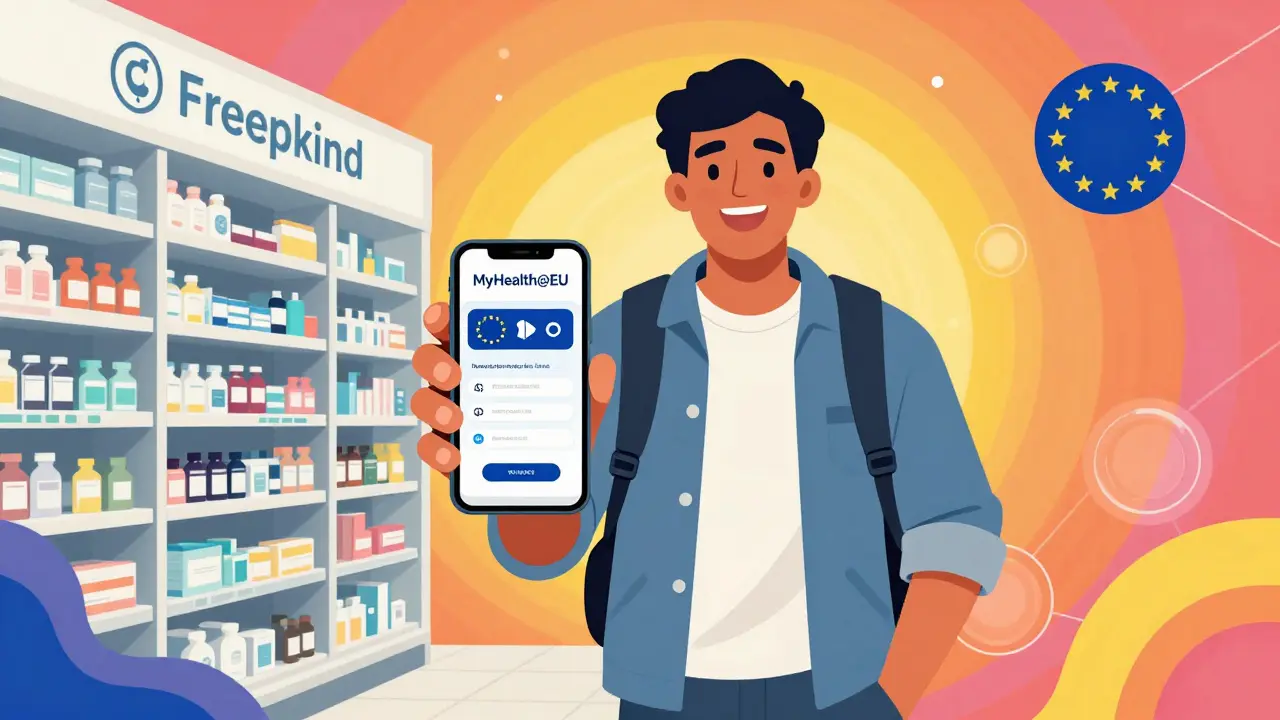
Imagine standing in a pharmacy in Berlin with a prescription from your doctor in Paris. In the past, this scenario often meant starting over-getting a new consultation, paying out of pocket, or risking health complications by skipping doses. Today, thanks to evolving Cross-border pharmacy services within the European Union, that friction is disappearing. For millions of travelers, expats, and border residents, accessing generic drugs across national borders is no longer a legal gray area but a structured, digital-first reality.
The landscape shifted dramatically in 2025 and 2026. With the rollout of the 'MyHealth@EU' infrastructure and new regulations like the Critical Medicines Act, the EU has moved from theoretical rights to practical tools. But how does it actually work? What happens if your medication isn't available abroad? And are there hidden traps for patients relying on these systems?
How MyHealth@EU Connects Your Prescription to Foreign Pharmacies
At the heart of modern cross-border healthcare lies the eHealth Digital Service Infrastructure (eHDSI), branded as MyHealth@EU. This isn't just a website; it's a secure communication portal connecting national health systems. As of late 2025, this system is operational in 27 EU and EEA countries, including Iceland, which completed its integration in August 2025.
The magic happens through two primary services:
- ePrescription and eDispensation: This allows you to present an electronic prescription issued in your home country at a pharmacy in another member state. The pharmacist can verify the validity, check for interactions, and dispense the medication securely.
- Patient Summaries: These provide critical context-your allergies, current medications, and medical history-in the language of the treating practitioner. This solves the linguistic barrier that often leads to dangerous errors.
To use this, you don't need to register for a separate app. You log into your national health portal (like island.is in Iceland) using electronic identification. From there, you authorize specific time periods or countries for health data sharing. The system requires strict patient consent protocols, ensuring your data isn't broadcasted freely but shared only when necessary for care.
| Service | Function | Availability (2026) |
|---|---|---|
| ePrescription | Transfer valid prescriptions across borders | 27 EU/EEA countries |
| Patient Summary | Share allergies, meds, and history | 27 EU/EEA countries |
| Telepharmacy Support | Remote consultation verification | Varies by Member State |
The Reality of Generic Drug Availability and Substitution
One of the biggest hurdles in cross-border mobility is the difference in brand names and availability. A generic drug for hypertension might be called "Ramipril" in Germany but have a different manufacturer or dosage form in Spain. Under EU law, pharmacists are generally allowed to substitute generics, but rules vary wildly.
In some countries, substitution is automatic unless the doctor explicitly forbids it. In others, the patient must give explicit consent. When traveling, this ambiguity can cause delays. The European Association of E-Pharmacies (EAEP) highlights that addressing medicine shortages through flexible cross-border supply chains is a top priority. If your specific brand is out of stock, a competent pharmacist should offer a bioequivalent generic. However, you must ensure the active ingredient and dosage match exactly.
It’s crucial to know that while the *right* to access care exists, the *reimbursement* process can be tricky. The European Health Insurance Card (EHIC) covers necessary medical treatment during temporary stays, but it doesn't always cover pre-existing chronic conditions fully, especially if you're not seeking emergency care. Always check with your national health insurance provider before traveling long-term.
Navigating Regulatory Fragmentation and New Rules
Despite the unified vision of MyHealth@EU, the ground reality is fragmented. As of early 2026, only eight EU countries have adopted comprehensive rules governing pharmacists' conduct in e-pharmacies. This creates an uneven playing field where your experience depends heavily on which border you cross.
Recent regulatory changes have added complexity:
- Italy’s GS1 DataMatrix Codes: Since February 2025, Italy replaced traditional pharmaceutical stickers with GS1 DataMatrix codes on prescriptions. This enhances traceability but requires pharmacies to have updated scanning hardware.
- The Critical Medicines Act: This mandate requires marketing authorization holders to report supply and demand data proactively. It aims to tackle shortages but adds administrative burdens that can slow down cross-border orders if data isn't synced correctly.
- UK Prescriptions: Be careful here. Prescriptions issued outside the EU/EEA, including those from UK-based telehealth services, are often invalid in countries like Ireland. Pharmacists must screen these and may reject them entirely, requiring a local consultation.
This fragmentation means that while the technology works, the legal frameworks haven't fully caught up. The General Pharmaceutical Council (GPhC) emphasizes local compliance over cross-border harmonization, which can lead to confusion for patients expecting seamless service.
Online Pharmacies and the Rise of Digital Health
The line between physical and digital pharmacies is blurring. The EAEP launched an Action Plan in June 2025 to integrate online pharmacies into Europe's health systems. Their goal includes pan-European prescription delivery, which is already legally permitted in eight member states, including Germany, France, and Austria.
Digital pharmacy services aren't just about convenience; they’re about safety. Studies cited by Copenhagen Economics show that digital pharmacy services reduce medication errors by 22% and improve chronic disease management compliance by 17%. By accessing Electronic Health Records securely, online pharmacists can spot dangerous interactions that a rushed face-to-face interaction might miss.
However, caution is still needed. Ensure any online pharmacy displays the common EU logo for verified e-pharmacies. Unverified sites may sell counterfeit generics. The market is projected to grow at a 14.3% CAGR through 2030, driven by aging populations and chronic disease prevalence, making regulation tighter than ever.
Practical Steps for Patients Traveling in the EU
If you're planning to travel within the EU and rely on regular medication, here is a checklist to ensure smooth access:
- Activate Your MyHealth@EU Access: Before you leave, log into your national health portal and ensure your Patient Summary is up to date. Check that your consent settings allow data sharing in your destination country.
- Carry Physical Backup: While digital prescriptions are powerful, technical glitches happen. Carry a printed copy of your prescription and a list of your medications in both your native language and English.
- Verify Reimbursement Rights: Contact your health insurer to understand what portion of cross-border pharmacy costs will be reimbursed. Keep all receipts and invoices.
- Check for Shortages: Use the European Shortages Medicines Platform (ESMP) to see if your specific drug is experiencing supply issues in your destination country. If so, ask your doctor for an alternative generic beforehand.
- Know the Local Pharmacist’s Role: In many EU countries, pharmacists have significant autonomy. Don’t hesitate to ask them to verify the equivalence of a generic substitute.
Future Outlook: Toward Full Integration
The trajectory for 2026 and beyond points toward greater integration. The European Commission plans to expand shared health data to include medical images, lab results, and hospital discharge reports by 2027. Complete electronic health records are the next step.
Industry experts warn that without swift action, digital inclusion will remain uneven. Border regions like the Netherlands-Germany frontier already see high success rates (78% of patients report successful fulfillment), while non-border regions lag behind (42%). Closing this gap requires sustained political commitment and better public awareness. Currently, only 38% of EU citizens are aware of their cross-border prescription rights, though this number jumps to 72% in areas with established networks.
For patients, this means the coming years will bring fewer surprises and more reliability. But until full harmonization is achieved, staying informed and prepared remains your best defense against healthcare disruptions.
Can I use my EU health insurance card to buy generic drugs abroad?
Yes, the European Health Insurance Card (EHIC) covers necessary medical treatment, including prescribed medications, during temporary stays. However, it typically applies to treatments that become medically necessary while you are abroad. For pre-existing chronic conditions, coverage varies by country. You may pay upfront and claim reimbursement later, so keep all receipts.
Is an e-prescription from my home country valid in any EU pharmacy?
In most cases, yes, provided both countries are part of the MyHealth@EU network (currently 27 EU/EEA countries). The pharmacy must be able to read the electronic format and verify the prescriber. Note that prescriptions from outside the EU/EEA, such as the UK or USA, are generally not accepted directly and require a local doctor's consultation.
What if my specific brand of medication is not available in the country I'm visiting?
Pharmacists can usually substitute your medication with a generic equivalent containing the same active ingredient and dosage. EU regulations support generic substitution, but rules on patient consent vary. Always ask the pharmacist to confirm the bioequivalence of the substitute. If no equivalent is available, you may need to consult a local doctor for an alternative treatment plan.
Are online pharmacies safe for buying cross-border prescriptions?
Only if they are verified. Look for the common EU logo for e-pharmacies, which indicates compliance with safety standards. Unverified sites may sell counterfeit drugs. Verified e-pharmacies in countries like Germany, France, and Austria can deliver prescriptions cross-border, offering a convenient and safe option for travelers and remote patients.
How do I activate MyHealth@EU services before traveling?
Log into your national health portal (e.g., via electronic ID) and update your Patient Summary. Ensure your consent settings allow health data sharing with other EU countries. Some countries require explicit activation for cross-border e-prescriptions. Do this well before your trip to avoid last-minute technical issues.
