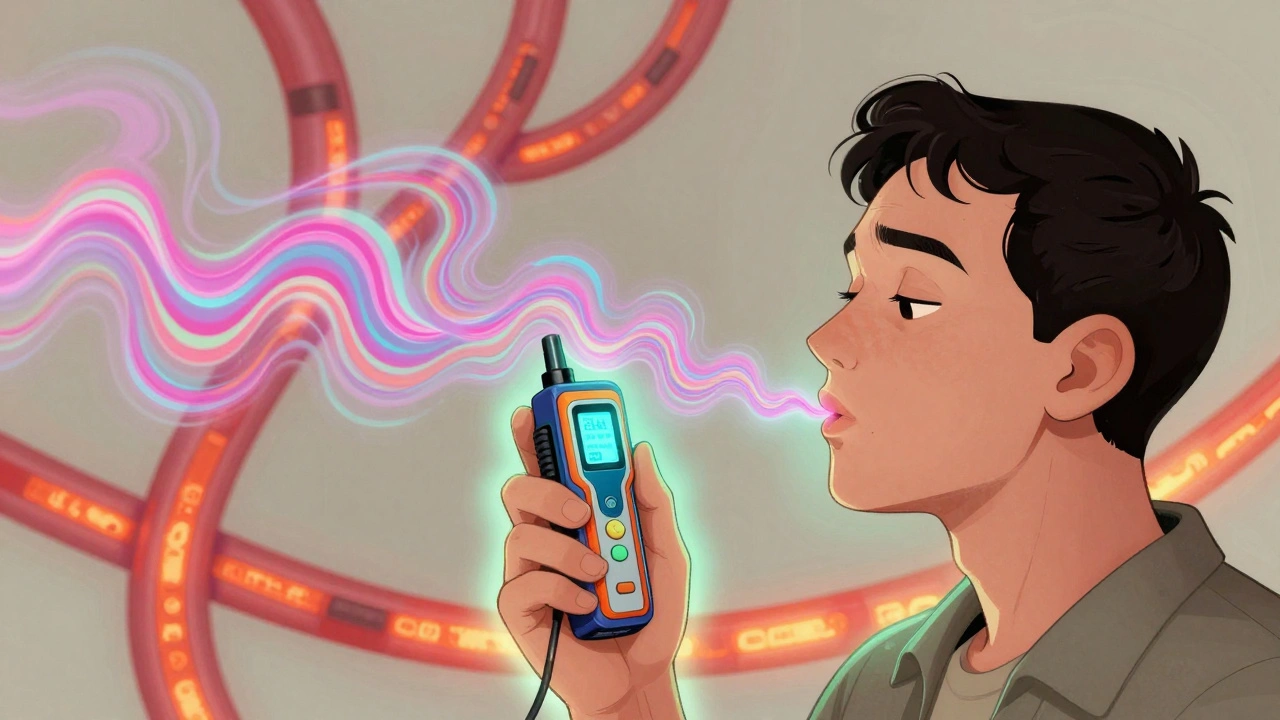
When your asthma isn’t under control, it’s easy to blame yourself-maybe you didn’t take your inhaler enough, or you missed a trigger. But what if the problem isn’t your behavior? What if your body is sending signals that no one’s listening to? That’s where FeNO testing comes in. It doesn’t ask you to breathe hard or struggle through a lung function test. You just breathe out slowly into a small handheld device, and in under a minute, your doctor gets a clear picture of what’s happening inside your airways.
What FeNO Testing Actually Measures
FeNO stands for Fractional Exhaled Nitric Oxide. It’s not measuring your lung capacity or airflow. It’s measuring a gas-nitric oxide-that your body produces when there’s inflammation in your breathing tubes. Think of it like a smoke alarm for your lungs. When your airways are irritated by allergens, pollution, or immune overactivity, your cells make more nitric oxide. That gas gets pushed out when you exhale. The higher the level, the more inflammation is going on.
This isn’t guesswork. FeNO testing gives you a number, measured in parts per billion (ppb). For adults, a reading above 25 ppb strongly suggests eosinophilic airway inflammation-the kind that responds well to inhaled steroids. For kids aged 5 to 12, the cutoff is 20 ppb. These aren’t random numbers. They’re based on years of research from the American Thoracic Society and global asthma guidelines like GINA 2023.
Why It’s Better Than Just Guessing
Many asthma patients go years with poor control because doctors rely only on symptoms. But symptoms lie. One person wheezes badly but has little inflammation. Another feels fine but has high FeNO levels, meaning their airways are quietly swelling, ready to flare up again. That’s why FeNO testing is a game-changer.
Take Sarah, a 32-year-old teacher in Melbourne. She’d been on the same asthma inhaler for five years. She felt okay most days, so her doctor kept her on the same dose. Then her FeNO level came back at 48 ppb-well above the threshold. Her doctor switched her to a higher-dose inhaler with anti-inflammatory medication. Within six weeks, her nighttime cough vanished. She hadn’t changed her routine. Her body just needed a different kind of treatment.
FeNO testing doesn’t replace spirometry. But it adds something spirometry can’t: direct evidence of inflammation. Studies show that using FeNO to guide treatment cuts asthma flare-ups by up to 50%. That’s not just fewer missed days at work or school. It’s fewer ER visits, fewer hospital stays, fewer scary moments when breathing becomes a struggle.
How the Test Works-And What You Need to Do
The test is simple. You sit down, breathe in through a filter (this removes outside air pollution), then exhale slowly and steadily into a tube for about 10 seconds. The device measures the nitric oxide in your breath and gives a number. No needles. No fasting. No pain.
But there are rules to get accurate results:
- Avoid eating, drinking (except water), smoking, or vigorous exercise for at least one hour before the test.
- Don’t use your rescue inhaler right before the test-it can lower the reading.
- Do the test before spirometry. Doing it after can give a false low reading.
Most people find it easier than spirometry. One patient on Asthma + Lung UK’s forum said, “I blew into a tube like blowing up a balloon slowly. Got results in 30 seconds while my spirometry took 20 minutes with multiple attempts.” That’s the kind of feedback doctors hear all the time.

What the Numbers Mean
FeNO levels aren’t just “high” or “low.” They’re broken into ranges with clear clinical meaning:
- Below 25 ppb (adults): Low inflammation. Your asthma is likely well-controlled, or it might be non-eosinophilic (not driven by this type of inflammation).
- 25-50 ppb: Moderate inflammation. Your current treatment might need adjusting. This is often where steroid response is strong.
- Above 50 ppb: High inflammation. Your airways are actively inflamed. You’re at higher risk for a flare-up. This is a strong signal to step up treatment-maybe add a biologic or increase your steroid dose.
These ranges aren’t set in stone. A smoker might have lower FeNO levels even with active inflammation-smoking suppresses nitric oxide production. Allergies, nasal polyps, and even recent infections can raise levels too. That’s why your doctor always looks at FeNO alongside your symptoms, lung function, and medical history.
FeNO vs. Other Tests: What’s the Real Difference?
People often ask: “Why not just check my blood eosinophils or do a sputum test?” Here’s how FeNO stacks up:
| Test | How It Works | Pros | Cons |
|---|---|---|---|
| FeNO Testing | Breath sample measured in ppb | Fast, non-invasive, immediate results, good for kids | Only detects type 2 inflammation; affected by smoking, steroids |
| Spirometry | Measures how fast and how much air you can blow out | Standard for airflow obstruction | Hard for young kids or people with severe asthma; doesn’t show inflammation |
| Blood Eosinophils | Blood test counting white blood cells | Easy to order, widely available | Less specific to airways; can be normal even with lung inflammation |
| Sputum Eosinophils | Spit sample analyzed in lab | Most accurate for airway inflammation | Invasive, uncomfortable, needs lab, low patient acceptance |
FeNO wins on convenience and speed. It’s the only test that gives you real-time insight into airway inflammation without needles or spit jars. And unlike blood tests, it reflects what’s happening right in your lungs-not just your bloodstream.
Who Benefits Most From FeNO Testing?
FeNO isn’t for everyone. But it’s incredibly helpful in these situations:
- You’re on asthma medication but still having symptoms or flare-ups.
- Your doctor suspects your asthma isn’t well-controlled, but your lung tests look okay.
- You’re being considered for biologic therapy (like dupilumab or omalizumab)-FeNO helps predict if you’ll respond.
- You’re a child with asthma. Many kids can’t do spirometry well, but they can blow into a tube.
- You’ve been misdiagnosed before. One case study found a 34-year-old was treated for chronic bronchitis for seven years-until FeNO showed clear asthma inflammation.
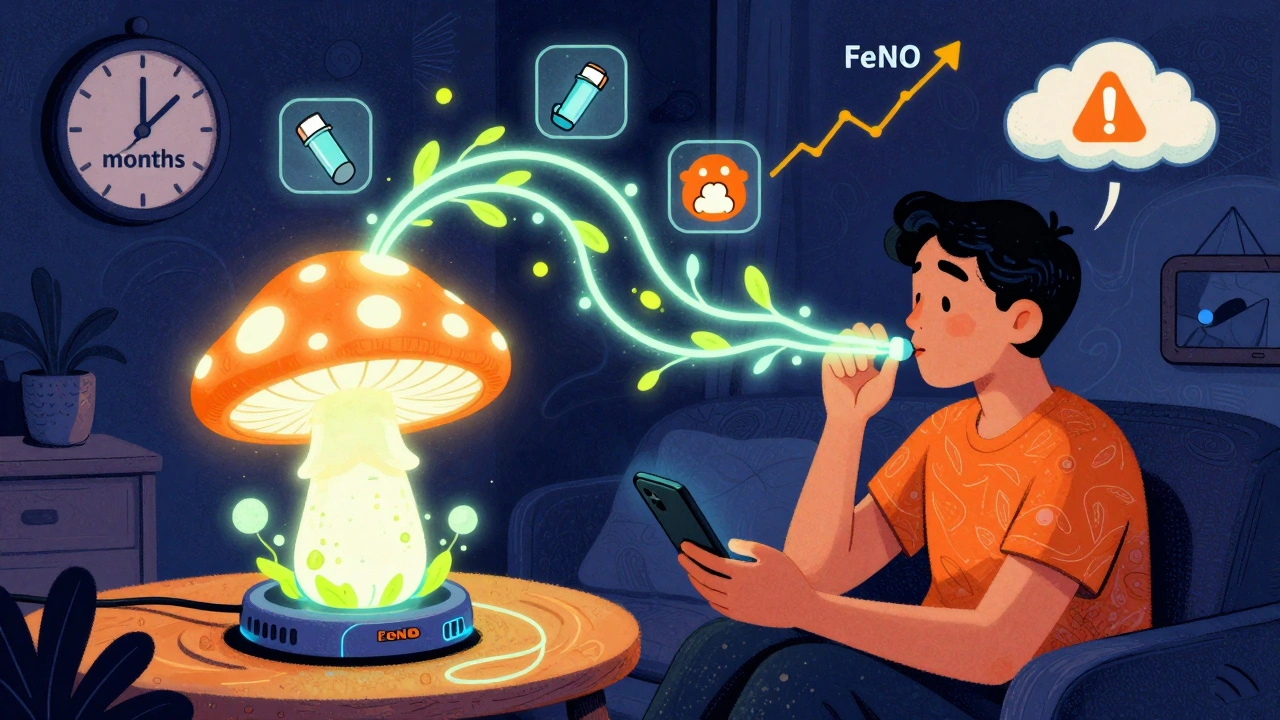
It’s also useful for tracking long-term trends. If your FeNO level has been rising over the last few months-even if you feel fine-it’s a warning sign. That’s why experts recommend testing every 3 to 4 months if you’re on maintenance therapy.
Limitations and Misconceptions
FeNO isn’t a magic bullet. It won’t catch every kind of asthma. If your asthma is triggered by cold air, stress, or exercise without eosinophilic inflammation, your FeNO might be normal-even when you’re struggling. That’s why experts like Dr. Sally Wenzel warn: “FeNO has lower sensitivity. It’s not good for ruling out asthma.”
Also, it’s not always covered by insurance. In the U.S., only 58% of commercial plans cover it without restrictions. Some patients report being denied coverage even after multiple flare-ups. In Australia, Medicare covers FeNO testing under specific criteria, but access varies by clinic. If your doctor recommends it and your insurer says no, ask for a letter of medical necessity-it often works.
And don’t expect perfect results every time. About 15-20% of tests are invalid because the patient didn’t exhale steadily enough. That’s why modern devices like the NIOX VERO® show real-time feedback on a screen-so you know you’re doing it right.
The Future: FeNO at Home
There’s a new wave of FeNO devices hitting the market. In early 2023, the FDA cleared the first smartphone-connected FeNO monitor-Breathometer Asthma. It costs $299 and lets you track your levels at home. No clinic visit needed.
This isn’t just convenience. It’s control. Imagine knowing your FeNO is climbing before you start coughing. You could adjust your inhaler early, call your doctor, or avoid a trigger-before you end up in the ER. Studies show that when patients monitor their own FeNO, they have fewer exacerbations and better adherence to treatment.
It’s still early days. These devices aren’t yet standard in clinical practice. But the trend is clear: asthma care is moving from reactive to proactive. And FeNO is leading the way.
What You Can Do Today
If you’ve been struggling with asthma control, ask your doctor about FeNO testing. Don’t wait until you’re in crisis. If your doctor hasn’t mentioned it, bring it up. Say: “I’ve heard FeNO testing can show if my airways are inflamed-even if I feel okay. Could we check?”
If you’re already getting tested, keep track. Write down your numbers. Look for patterns. Does your FeNO spike after pollen season? After a cold? After skipping your inhaler? That’s information your doctor can use to fine-tune your plan.
Asthma isn’t just about wheezing. It’s about invisible inflammation. FeNO testing gives you a window into that. And for many people, that’s the difference between living with asthma-and finally managing it.

nina nakamura
FeNO testing is literally just a fancy way to measure nitric oxide and yet doctors still treat asthma like it’s a mystery. The fact that we’ve had this tech for over a decade and most clinics still rely on symptoms alone is criminal. If your numbers are above 25 ppb and you’re not on a steroid inhaler, you’re being neglected. End of story.
Hamza Laassili
OMG YES!!! I’ve been saying this for YEARS!!! My doc kept telling me ‘you’re fine’ until my FeNO hit 62!!! I was like BRO I CAN’T BREATHE AND YOU’RE GIVING ME A PAT ON THE BACK???!!! Now I’m on biologics and I can actually RUN!!! #FeNOIsLife #AsthmaIsNotJustWheezing
Casey Mellish
As an Aussie who’s had asthma since I was six, I can tell you FeNO testing changed my life. Back home, Medicare covers it if you’ve had two flare-ups in a year, but not every GP knows how to order it. I had to bring the GINA 2023 guidelines to my appointment. Once they did the test, my dose was adjusted and I haven’t needed an ER visit in three years. Seriously, if you’re struggling-ask for it. It’s not magic, it’s science.
Tyrone Marshall
What this post doesn’t say enough is how FeNO testing gives you back agency. For years, I felt like my asthma was a personal failure-like if I just tried harder, I wouldn’t wheeze. But when my FeNO was 51 and my spirometry looked ‘normal,’ I realized: it wasn’t me. It was my biology. That shift-from blame to understanding-was the real breakthrough. This isn’t just a test. It’s a conversation between your body and your care team. And it’s long overdue.
Emily Haworth
Wait… so you’re telling me the government and Big Pharma don’t want us to know about this because they make more money off ER visits and nebulizers??? 🤔 I’ve been getting this test every 3 months since 2021 and my premiums dropped 40%. Coincidence? I think not. 🚨 #CoverUp #AsthmaIsBigBusiness 😡
Himmat Singh
It is imperative to note that the clinical utility of fractional exhaled nitric oxide testing remains contingent upon a multitude of confounding variables, including but not limited to environmental exposures, pharmacological interventions, and individual physiological variance. The assertion that FeNO constitutes a definitive biomarker for asthma management is, in my view, an oversimplification of a highly complex pathophysiological continuum.
Webster Bull
FeNO saved me. No drama. No fluff. Just a tube, a breath, and a number that finally made sense. I wasn’t lazy. I wasn’t failing. My lungs were screaming. Now I know when to step up. Simple. Smart. Why isn’t everyone doing this?
Donna Hammond
I’m a respiratory nurse and I’ve watched patients cry when they finally get their FeNO results. They’ve been told for years it’s ‘all in their head’ or ‘just anxiety.’ One woman told me, ‘For the first time, someone believed me.’ That’s what this test does-it validates. And if your doctor won’t order it, ask for a referral to an allergist or pulmonologist. You deserve to be heard.
Karen Mccullouch
So you’re telling me the same device that measures my breath can also be used to track my stress levels? And that the government’s using this data to predict who’s ‘non-compliant’ with meds? I’ve seen the leaks. This isn’t medicine-it’s surveillance. 🤫👁️
Shelby Ume
Thank you for writing this. I’m a 14-year-old with asthma and I hated spirometry. FeNO? I blew into it like a kazoo. Got my number. My doctor adjusted my meds. I’m back on the soccer team. No one ever told me this was an option. Please, if you’re a parent reading this-ask your child’s doctor. It’s not scary. It’s just… better.