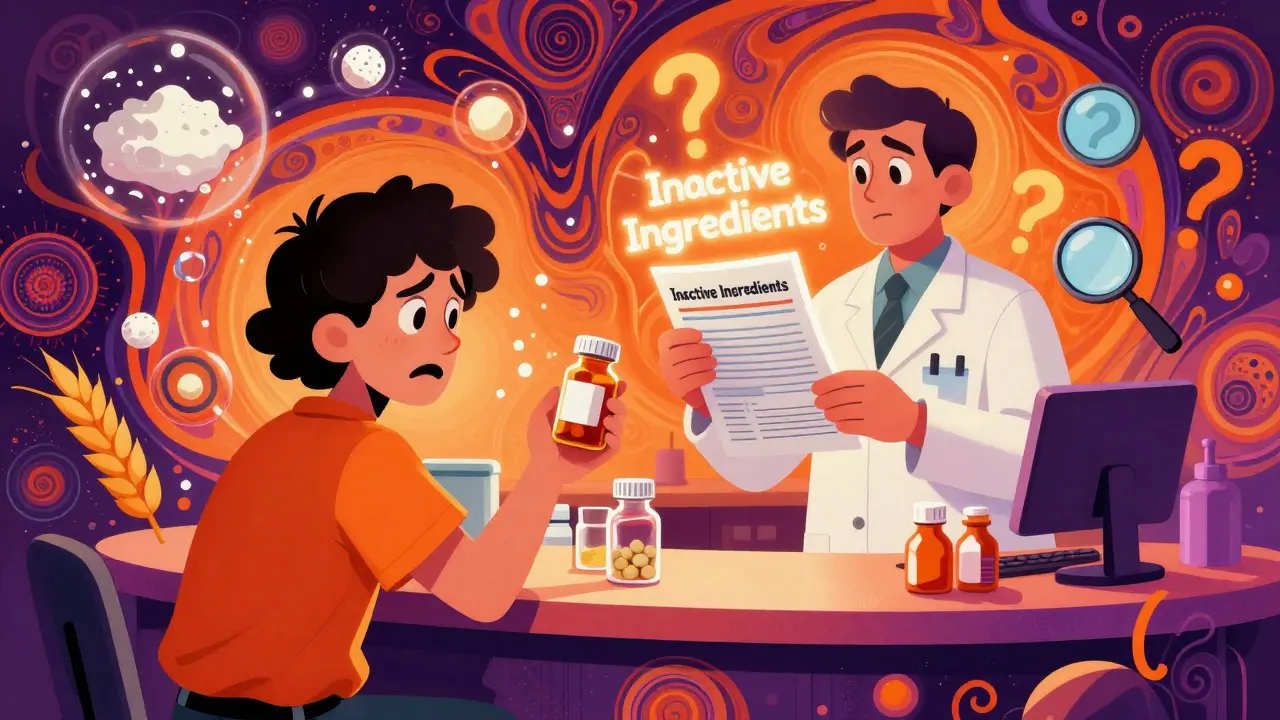
When you pick up a prescription or grab a snack off the shelf, you might assume the label tells you everything you need to know. But for people with allergies, that’s not true-especially when it comes to inactive ingredients. These hidden components can trigger reactions just as serious as the active drug or food allergen itself. And unlike food, medicine labels don’t have to spell them out clearly. That gap can be deadly.
What You’re Really Looking At
On food packages, the rules are strict. Since 2006, U.S. law requires manufacturers to clearly label the nine major food allergens: milk, eggs, fish, crustacean shellfish, tree nuts, peanuts, wheat, soy, and sesame (added in 2023). These must appear either in the ingredient list-like "lecithin (soy)"-or in a separate "Contains" statement right after the list. No exceptions. Even a trace amount must be declared. But prescription labels? Nothing like that. The FDA doesn’t require drug makers to list allergens in inactive ingredients. That means your pill might contain lactose (a milk derivative), peanut oil, soy lecithin, or wheat starch-and you won’t know unless you ask.Why Medicines Are Riskier Than Food
Think about it: you read the label on a cereal box every time you buy it. But you might take the same pill for months without checking the ingredients. And here’s the kicker: generic versions of the same drug can have completely different inactive ingredients depending on the manufacturer. One brand might use cornstarch. Another might use lactose. You could switch brands and have a reaction-even if the active drug is identical. A 2023 study in the Journal of Allergy and Clinical Immunology found that 4% of American adults have a documented allergy to at least one medication ingredient. Many of those reactions come from inactive components, not the drug itself. Yet pharmacists aren’t required to volunteer this info. You have to ask.How to Read a Food Label Correctly
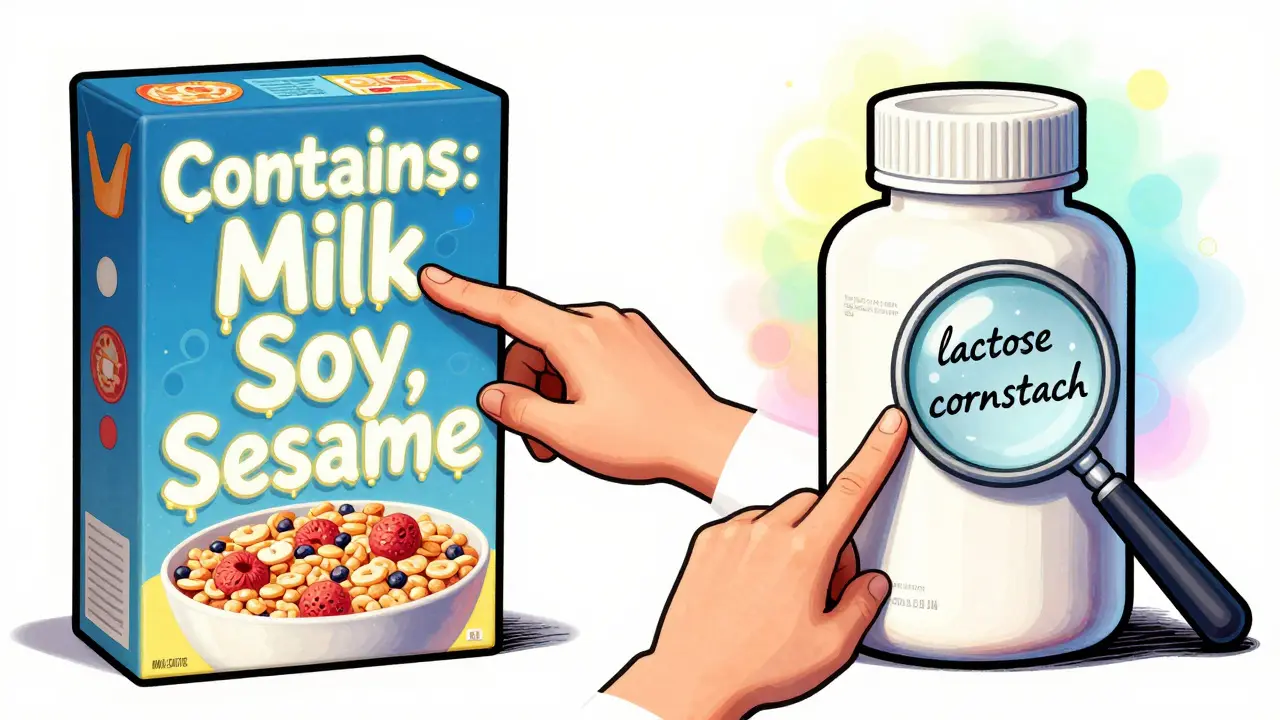
Start with the "Contains" statement. It’s your fastest way to spot the big nine allergens. If it says "Contains: Milk, Soy, Tree Nuts," you’re done. If it doesn’t, scan the ingredient list for allergens in parentheses. Watch for sneaky names:- Milk: casein, whey, lactose, curds
- Eggs: albumin, ovalbumin, ovomucoid
- Peanuts: arachis oil, groundnut
- Soy: textured vegetable protein, hydrolyzed plant protein, miso
- Sesame: tahini, gingelly oil, til
How to Check a Prescription Label
You won’t find allergens listed on the bottle or box. So here’s what to do:- Ask the pharmacist: "What are the inactive ingredients in this pill?"
- Request the full prescribing information (the package insert). It’s usually available online or printed on request.
- Look for the "Inactive Ingredients" section. It’s often near the end.
- Compare generic versions. If you switch brands, check again-even if the name is the same.
- Use a reliable app like AllergyEats’ Scan (launched in early 2024) to photograph and decode ingredient lists. Beta tests showed 92% accuracy.
What to Do If You’ve Had a Reaction
If you’ve ever had swelling, hives, or trouble breathing after taking a pill or eating something you thought was safe, write it down. Include:- Product name and brand
- Batch or lot number (found on the packaging)
- When you took it
- Symptoms and timing
What’s Changing in 2025
The FDA is working on new rules to standardize how allergens are presented on food labels. Proposed changes, published in May 2024, could require all allergens to be in bold and in a consistent location. They’re also considering adding mustard and celery to the major allergen list. For medicines? Nothing official yet. But experts are pushing for change. A 2024 report from Johns Hopkins warned that global supply chains make ingredient transparency harder than ever. Imported drugs are 43% more likely to have incomplete labeling than U.S.-made ones.Real-Life Tips That Work
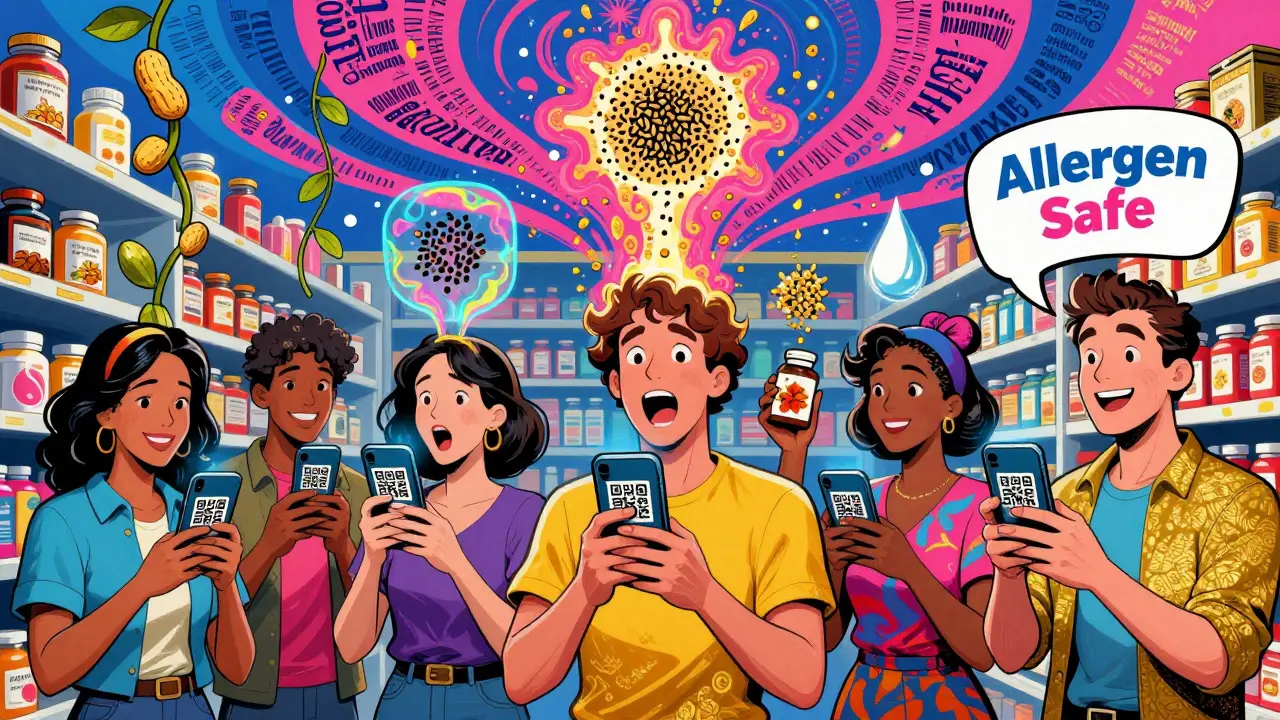
- Keep a printed list of your allergens in your wallet or phone. Show it to pharmacists. It saves time and reduces miscommunication. - Buy from brands that list allergens clearly. FARE’s 2023 survey found that 79% of allergy sufferers prefer products with both "Contains" statements and parenthetical allergens. They’re more reliable. - Don’t trust past experience. About 28% of accidental exposures happen because the formula changed without notice. Even if you’ve eaten it 100 times, check again. - Use QR codes. More than 300% of food companies added them since 2020. Scan it and get full ingredient details, including sourcing. But remember: not all brands use them, and older adults may not be able to.Final Thought: You’re Not Overreacting
You’re not being paranoid. You’re being smart. Food allergen labeling is one of the most effective public health tools we have-it’s why recalls have dropped 15% since 2020. But medicine labeling? It’s still a wild west. Until that changes, you’re your own best defense. Ask questions. Double-check. Don’t rely on assumptions. Your safety depends on it.Are inactive ingredients always listed on prescription labels?
No. Unlike food, U.S. law does not require drug manufacturers to list allergens in inactive ingredients on the bottle or box. You must ask the pharmacist or request the full prescribing information (package insert) to see the complete list.
Can generic drugs have different allergens than brand-name ones?
Yes. Generic drugs must contain the same active ingredient, but the inactive ingredients-like fillers, dyes, or binders-can vary between manufacturers. A generic version of your pill might contain lactose, while the brand-name version uses cornstarch. Always check when switching.
What should I do if I can’t find the ingredient list for my medication?
Call the pharmacy and ask for the FDA-approved package insert. You can also search the drug’s name plus "package insert" or "PI" on the FDA’s website. If you’re still stuck, contact the manufacturer directly-their customer service line is required to provide ingredient details.
Is sesame now required on all food labels?
Yes. Since January 1, 2023, the FASTER Act requires sesame to be labeled as a major allergen on all packaged foods sold in the U.S. It must be clearly listed either in the ingredient list (e.g., "tahini (sesame)") or in a "Contains" statement.
Why do some food labels say "may contain peanuts" but don’t list peanuts in the ingredients?
That’s a precautionary statement about cross-contact during manufacturing. It means the product was made in a facility that also processes peanuts, even if peanuts aren’t an intentional ingredient. These statements aren’t required by law, but they’re common. If you’re allergic, treat them as a warning.
Are imported foods safer or riskier for allergens?
Riskier. In 2023, the FDA found that 43% of imported food products had incomplete or non-compliant allergen labeling compared to U.S.-made products. Labels might use different terms, omit allergens entirely, or not follow U.S. formatting rules. Always check carefully, especially with snacks, spices, or chocolate from overseas.

Joe Bartlett
Why are we still letting pharma get away with this? If your cereal has to spell out peanuts, your pill should too. Simple.
amanda s
Oh my god I had a near-death experience last year because I switched generics and didn’t check. Lactose. In my anxiety med. I thought I was having a panic attack. Turns out my throat was closing. I’m still mad.
Peter Ronai
Oh please. You people act like this is some new conspiracy. I’ve been reading package inserts since the 90s. If you can’t read a 10-page PDF, that’s your problem. The FDA isn’t your babysitter.
Naomi Lopez
It’s not just about allergens-it’s about the lack of standardized nomenclature across manufacturers. One company calls it ‘starch,’ another says ‘corn-derived dextrin.’ If you’re not fluent in pharmaceutical Latin, you’re flying blind. And yes, I’ve seen this ruin lives.
Josh Potter
bro i scanned my inhaler with that new app and it flagged lactose. i’ve been using it for 3 years. i’m never trusting a pill again. also who made this post? legend.
Salome Perez
As someone who works in global public health, I’ve seen how this gap disproportionately impacts low-income communities. Many can’t afford to call pharmacies or request inserts. They rely on pharmacists who are overworked and undertrained. This isn’t just negligence-it’s systemic neglect wrapped in bureaucracy.
And yet, the same people who demand transparency in their avocado toast won’t demand it for their asthma medication. The hypocrisy is staggering.
Radhika M
I’m from India and we don’t have good labeling here either. But I learned to always ask the pharmacist: ‘What is in this tablet besides the medicine?’ They usually tell you if you’re polite. Simple works.
Linda Caldwell
Just check the damn insert. Always. Even if you’ve taken it for ten years. One change. One bad batch. That’s all it takes. Stay sharp. You got this.
Anna Giakoumakatou
Oh, so now we’re treating pharmaceutical companies like they’re toddlers who need to spell out their snacks? Maybe if you didn’t take 17 pills a day you’d have time to actually read the tiny print. Or is that too much to ask?
CAROL MUTISO
I love how this post doesn’t just list the problem-it gives actionable steps. Most people don’t even know package inserts exist. I printed mine out and laminated it. Now I hand it to every pharmacist. It’s awkward, but it’s saved me twice.
Also, the QR code thing? Genius. My mom can’t scan them, but my nephew can. Now he’s her unofficial pill decoder. Technology, when used right, bridges gaps.
Michael Whitaker
It is not merely a matter of regulatory omission; it is a profound epistemological failure in the intersection of consumer autonomy and pharmaceutical opacity. The absence of mandated allergen disclosure constitutes a violation of informed consent, a foundational principle in medical ethics. One cannot consent to an unknown variable.
Furthermore, the proliferation of global supply chains has rendered the concept of ‘national standards’ increasingly anachronistic. A pill manufactured in Shanghai, packaged in Texas, and dispensed in Ohio may contain allergens not recognized by U.S. labeling statutes-yet the patient is still held responsible for their own safety. This is not oversight. It is abandonment.
Evelyn Vélez Mejía
There’s a quiet violence in the assumption that if you’re smart enough to survive, you’re smart enough to navigate this maze. But what about the elderly? The disabled? The non-native speakers? The ones who don’t have time, energy, or access to decode pharmaceutical hieroglyphics? This isn’t about personal responsibility-it’s about institutional accountability. We built a system that punishes the vulnerable for its own laziness.
And yet, we celebrate the person who reads the insert like they won a medal. That’s not bravery. That’s a failure of design.
Erik J
Has anyone looked into whether the FDA tracks which inactive ingredients are most commonly linked to reactions? I’m curious if there’s a pattern beyond lactose and soy. Just wondering.