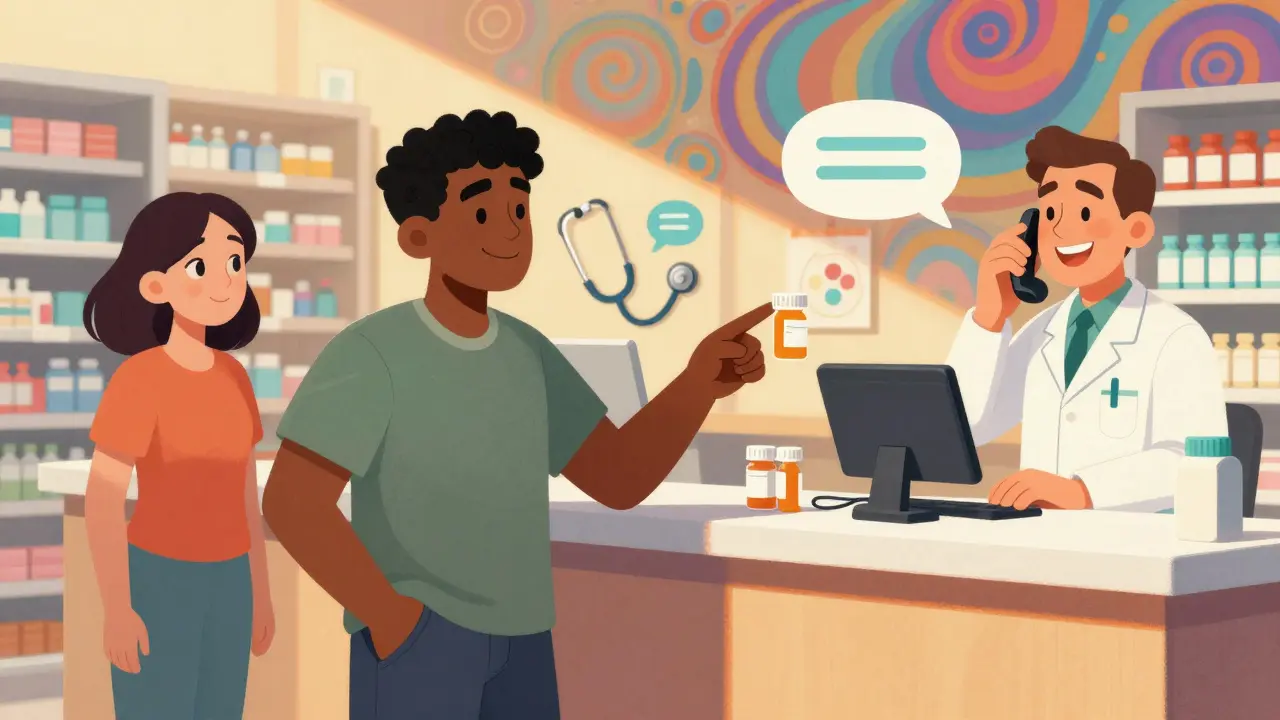
When you or a loved one gets a new prescription, understanding how to take it correctly isn’t just helpful-it’s life-saving. But if English isn’t your first language, the instructions on the label might as well be written in code. That’s where professional translator services for medication counseling come in. By law, pharmacies in the U.S. must provide these services for free. You don’t need to ask twice. You don’t need to beg. You just need to say it clearly.
Why Language Help Isn’t Optional
In 2012, researchers at the University of California, San Francisco found that patients who don’t speak English well are three times more likely to make dangerous mistakes with their medications. Missed doses, wrong amounts, mixing drugs incorrectly-these aren’t just errors. They lead to hospital visits, emergency care, and sometimes death. The fix? Professional interpreters. Not family members. Not a coworker who took high school Spanish. A trained, certified medical interpreter. Federal law, specifically Section 1557 of the Affordable Care Act, says any pharmacy that takes federal money-like Medicare or Medicaid-must offer language help at no cost to you. This isn’t a suggestion. It’s a legal requirement. And it applies to every step: when the pharmacist explains your new medication, when they review your full list of drugs, or when they warn you about side effects or food interactions.What You Can Ask For
You don’t have to guess how to get help. Just say it: “I need a professional interpreter for my medication counseling.” That’s it. You don’t need to explain why. You don’t need to prove you need it. You don’t need to pay a cent. Pharmacies are required to offer three types of interpreter services:- Phone interpreting - Quick, available 24/7, and often used in chain pharmacies like CVS or Walgreens. A pharmacist presses a button, gets connected to an interpreter in seconds, and you talk together.
- Video interpreting - You see the interpreter on a screen. This helps with nonverbal cues-like facial expressions or gestures-which matter when explaining things like “take with food” or “avoid alcohol.”
- On-site interpreters - A person comes to the pharmacy in person. This is best for complex cases, like someone with multiple chronic conditions or hearing difficulties.
What You Should Never Accept
Don’t let a pharmacist say, “My cousin speaks Spanish,” or “My assistant knows some Chinese.” That’s not enough. A 2021 study in JAMA Pediatrics showed using untrained people as interpreters increases the risk of serious medication errors by 49%. Why? Medical terms aren’t simple. “Take once daily” isn’t the same as “take one pill every day.” “Take on an empty stomach” isn’t the same as “don’t eat before.” Without proper training, even fluent speakers get these wrong. The American Translators Association says qualified medical interpreters need at least 40 hours of specialized training, pass certification exams, and keep learning. Only about 12% of bilingual pharmacy staff meet this standard. That’s why the law doesn’t allow shortcuts.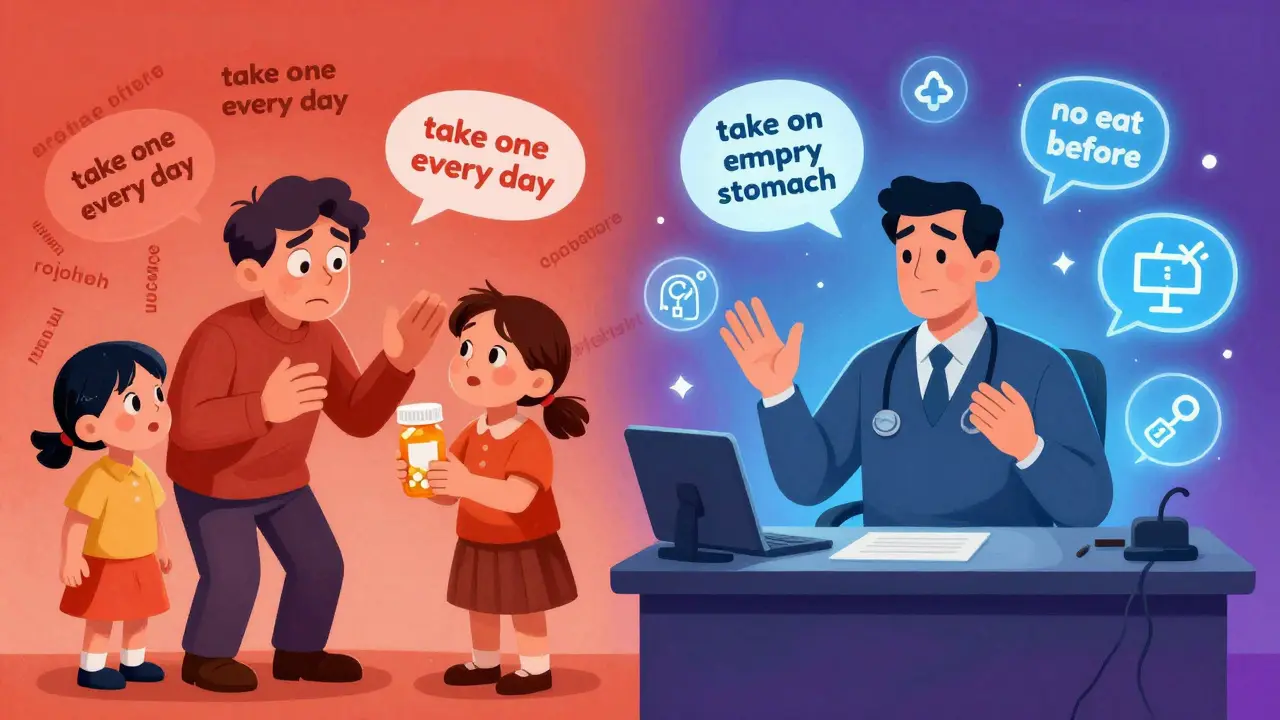
How Chain Pharmacies Handle It
Most big pharmacies use a service called RxTran. It’s one of the few providers that meet all federal and state rules for both written translations and live interpreting. You might not see them using it, but they are. If you ask for help, they’ll pull up a phone, open a video app, or call in someone from their network. In California, the state goes further. All pharmacies there must have pre-translated instructions for five languages: Spanish, Chinese, Korean, Russian, and Vietnamese. These aren’t just generic translations. They’re reviewed by pharmacists and linguists to make sure they match how people actually speak. But even there, problems happen. Some Russian-speaking patients say the dosage instructions sound awkward because the grammar doesn’t match how medical terms are used in Russian.What to Do If You’re Turned Away
Sometimes, pharmacies get busy. Staff might try to skip the interpreter to save time. That’s illegal. If someone says, “We don’t have one right now,” or “Can your daughter help?” say this: “I’m entitled to a professional interpreter under federal law. I need one now.” If they still refuse, write down:- The date and time
- The name of the pharmacy
- The name of the person who refused
- What was said
How Pharmacists Are Supposed to Request Help
If you’re a patient, you don’t need to know this. But if you’re curious, here’s how it works behind the scenes: Pharmacists follow a three-step process:- Identify the need - They ask, “What language do you prefer for medical information?”
- Connect the interpreter - They use an approved system: phone, video, or in-person.
- Document it - They log the language, the type of service, how long it lasted, and that the interpreter was qualified. This is required for Medicaid reimbursement.
What’s Changing in 2025
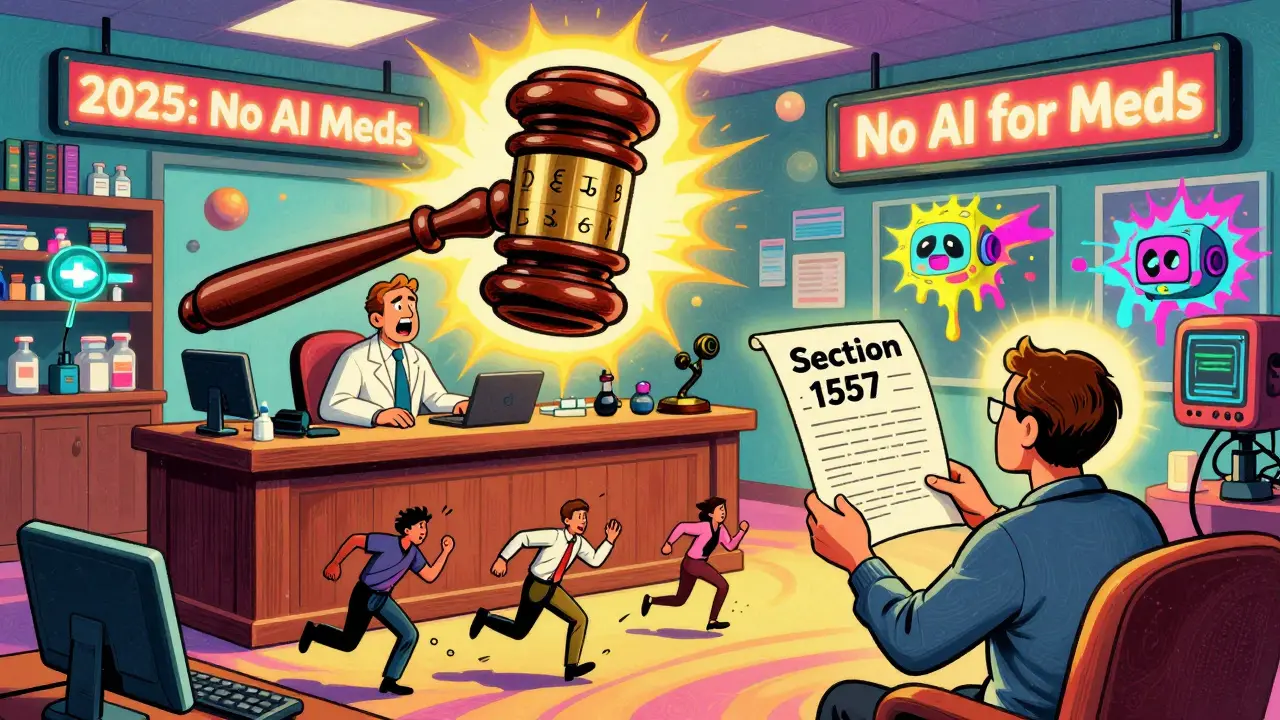
New rules took effect January 1, 2025. AI tools like Google Translate or chatbots are now forbidden for printing directions on prescription labels or giving medical advice. Human review is mandatory. That’s because machine translations get dangerous details wrong-like confusing “twice daily” with “every 12 hours,” or mistranslating “do not crush” as “can be chewed.” Also, Medicaid is now paying more. For children in non-English homes, the government now covers 75% of interpreter costs instead of 50%. That means pharmacies have more money to hire better services. California is adding translations for Tagalog and Arabic this year. Other states are watching closely. Demand is growing fast. The U.S. Census Bureau predicts over 28 million people will be limited in English by 2030.What You Can Do Today
You don’t need to wait for a law to change. You don’t need to hope for better service. You have the right, right now.- When you pick up a new prescription, say: “I need a professional interpreter for my medication counseling.”
- If they offer a family member, say: “I appreciate the help, but I need a trained interpreter for safety.”
- If they say they don’t have one, say: “I know this is required by law. Please get me one.”
- If they still refuse, note the details and report it to HHS.
Do I have to pay for a translator when getting medication counseling?
No. By federal law, pharmacies that accept Medicare, Medicaid, or other federal funds must provide professional interpreter services at no cost to you. This includes phone, video, or in-person interpreters. You cannot be charged for this service.
Can I use my child or friend as an interpreter?
While you can ask them to help, pharmacies are not allowed to rely on family members or untrained staff for medication counseling. Using untrained interpreters increases the risk of serious medication errors by 49%, according to a 2021 JAMA Pediatrics study. Pharmacists must use certified professionals to ensure accuracy and safety.
What languages are covered by law?
The law covers any language. There’s no list of approved languages. If you speak Spanish, Vietnamese, Arabic, Hmong, or any other language and need help understanding your medication, the pharmacy must provide an interpreter in that language. Some states, like California, provide pre-translated materials in specific languages, but your right to an interpreter applies regardless of your language.
Is video interpreting as good as in-person?
Video interpreting is nearly as effective as in-person, especially for complex counseling. It allows interpreters to see your facial expressions and gestures, which helps with understanding. While some patients prefer face-to-face, video is faster and more widely available. A 2023 CMS report found 65% of healthcare facilities use video interpreting, and patient satisfaction is high when the connection is stable.
What if the pharmacy doesn’t have an interpreter right away?
The pharmacy must arrange for an interpreter without delay. Phone interpreting services connect in under 30 seconds in most cases. If they say they can’t get one today, they are violating federal law. You can ask to speak to a manager, or leave and return later. If they refuse repeatedly, document the incident and report it to the Office for Civil Rights at HHS.gov/ocr.
Can pharmacies use AI tools like Google Translate for medication instructions?
No. As of January 1, 2025, federal guidelines prohibit using AI translation tools for prescription labels or medication counseling materials unless a human reviews and approves them. Machine translations often misinterpret medical terms, leading to dangerous errors. Only certified human translators or interpreters are legally acceptable for this purpose.

Julie Chavassieux
Just asked for an interpreter at CVS yesterday. They handed me a printed sheet in Spanish. I don't speak Spanish. I said, 'I need a person.' They sighed and put me on the phone. Took 22 seconds. The interpreter knew what 'anticoagulant' meant. That's more than my cousin who took two years of high school Spanish.
Thank you for this.
Tarun Sharma
Legal obligation is clear. Professional interpretation is non-negotiable in healthcare. Safety must precede convenience. This is a fundamental right.
Jim Brown
There is a quiet dignity in the assertion of linguistic equity. To demand clarity in the language of one’s own body-its ailments, its remedies-is not entitlement; it is existential sovereignty. The pharmacy is not a marketplace of compromise, but a sanctuary of care. When we reduce medical communication to the whims of a bilingual cashier or a Google Translate bot, we do not serve the patient-we serve our own laziness.
And yet, the law, in its cold, bureaucratic grace, insists on dignity. It does not ask for gratitude. It simply requires. And perhaps, in that requirement, lies the most humane form of justice.
Cara Hritz
ok so i just went to walgreens and asked for an interpreter and they said 'we have this app' and showed me deepl. i said no i need a person. they got mad and said 'we dont have one right now' so i left and called hhs. they said theyre supposed to have it in under 30 seconds. also the lady at the counter had a russian last name but said she 'only speaks a little' like that matters. also i think the law is fake because my uncle works for hhs and he said its just for show. also i saw a video of a pharmacist using google translate on a tablet and it said 'take one pill every 12 hours' for a med that was supposed to be twice daily. that's like saying 'eat poison every day'. i think the government is lying to us. also emojis are the future of medicine 🤖💊
Jamison Kissh
What’s interesting is how this isn’t just about language-it’s about power. Who gets to define what ‘clear’ means? The pharmacist? The translator? Or the patient? I’ve seen interpreters who know the words but not the weight behind them. 'Hypertension' isn’t just 'high blood pressure' in every culture. Some see it as divine punishment. Others as a sign of stress in the family. The interpreter has to bridge more than vocabulary. They have to bridge worldviews. And yet, we train them for 40 hours and call it enough.
Is that humility? Or just convenience dressed as compliance?
Jeremy Hendriks
Let’s be real-this whole system is a bureaucratic circus. Pharmacies don’t care. They’ll do the bare minimum to avoid a lawsuit. The law exists because people fought for it. Not because anyone wanted to help. And now? Now we’ve got people acting like it’s a gift to get an interpreter. No. It’s a right. And if you’re still using family members? You’re endangering lives. And if you think AI is the future? You’re not just wrong-you’re dangerous. This isn’t about convenience. It’s about not killing people because you’re too cheap to hire someone who knows what they’re doing.
Ajay Brahmandam
Worked as a med translator in Delhi for 8 years. Even in India, where 22 official languages exist, hospitals have trained interpreters. No one uses kids or Google. Why? Because people die when it’s wrong. The U.S. has the tech, the money, the law. What’s missing is the will. Simple. Just do it. No drama. No excuses.
jenny guachamboza
wait so you’re telling me the government is forcing pharmacies to use interpreters but not requiring them to hire actual humans who speak the language? I’ve heard the phone interpreters are just outsourced to India and they don’t even know what 'anticoagulant' means. Also, I think this is all part of the globalist agenda to erase English. Why can’t we just make everyone learn English? Also, I saw a TikTok where someone said the interpreter said 'take with food' but meant 'take with wine' and the person died. I think this is all a setup to make us distrust the system. Also 🤡💉
Gabriella da Silva Mendes
Look, I’m all for helping people-but this is America. We don’t need to cater to every language under the sun. My grandma came here in 1952 and learned English in six months. She worked two jobs. She didn’t get an interpreter. She didn’t complain. Why should I pay for someone else’s refusal to assimilate? And now we’re banning Google Translate? Are you kidding me? It’s free, fast, and 90% accurate. Who cares if it says 'take every 12 hours' instead of 'twice daily'? It’s close enough. This is just woke nonsense wrapped in a legal blanket. We’re turning pharmacies into UN interpreters. And don’t get me started on the cost. Taxpayers are footing the bill for people who won’t even try. 🇺🇸😤
Johnnie R. Bailey
This is one of those rare moments where policy and humanity align. The law doesn’t just protect the non-English speaker-it protects the entire system from the erosion of trust. A pharmacist who relies on a child’s translation isn’t just cutting corners; they’re surrendering their duty as a healer. And yet, the real victory here isn’t the law-it’s the quiet persistence of people who say, 'No, I need a professional,' and mean it.
Language isn’t a barrier. It’s a bridge. And the interpreter? They’re the architects. We owe them more than compliance. We owe them recognition.
Nader Bsyouni
Let’s not pretend this is about safety. It’s about identity politics dressed in medical jargon. The real issue is that we’ve lost the cultural cohesion to expect people to adapt. Why should a pharmacy in rural Kansas be forced to hire an interpreter for Hmong speakers? Who even is Hmong? And why should I fund this? The answer isn’t more laws-it’s more assimilation. And if you can’t speak English? Maybe you shouldn’t be taking prescription meds. Or maybe you should move to a country that speaks your language. This isn’t compassion. It’s cultural surrender.