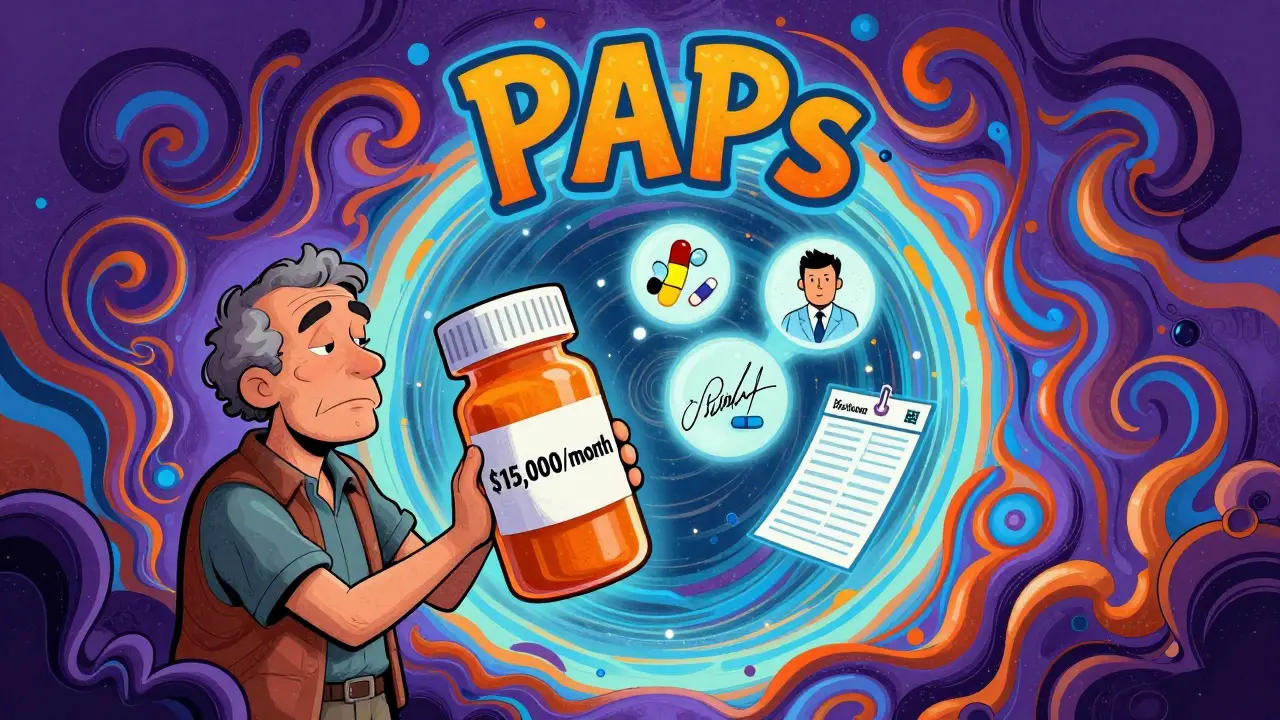
When a life-saving medication has no generic version, the price can feel like a trap. You might be staring at a $15,000 monthly bill for a drug that keeps you alive-no cheaper option exists, no substitute, no workaround. Insurance doesn’t cover it fully. Savings cards barely make a dent. And you’re left wondering: How do I even afford this?
The answer isn’t found in pharmacies or online discount sites. It’s in Patient Assistance Programs (PAPs)-free or low-cost drug programs run by drugmakers, nonprofits, and sometimes state agencies. These aren’t charity handouts. They’re structured, legal, and designed exactly for situations like yours: no generic, high cost, no way out. In 2022, PAPs gave over $4.7 billion in help to 1.2 million people in the U.S. Most of that went to people like you-those stuck with brand-name drugs that cost more than a car payment every month.
Why PAPs Exist When No Generic Is Available
Generic drugs lower prices by competing with the original. But when a drug is new, complex, or treats a rare disease, generics can’t be made for years-sometimes never. Think of drugs like Soliris for paroxysmal nocturnal hemoglobinuria (cost: over $500,000 a year) or Tasigna for chronic myeloid leukemia ($14,000 a month). These aren’t ordinary prescriptions. They’re specialty treatments. And manufacturers know patients have nowhere else to turn.
That’s why drug companies created PAPs. They’re not just altruistic. They’re also a way to keep patients on their drugs without triggering public outrage or government price controls. But for you, it doesn’t matter why they exist-only that they do. And they can cut your out-of-pocket cost to $0.
Who Qualifies for Patient Assistance Programs
Most PAPs don’t care if you have insurance. They care about your income. The standard cutoff is 400% of the Federal Poverty Level. In 2023, that was $60,000 for a single person. If you make less than that, you’re likely eligible-even if you have Medicare or private insurance.
But here’s the catch: not all programs accept everyone. Some only help the uninsured. Others only help people with Medicare Part D (but not with manufacturer copay cards-more on that later). Some require you to be a U.S. citizen or legal resident. And almost all require proof of income: your last tax return, recent pay stubs, or a letter from your employer.
Doctors and pharmacists often help fill out forms. You’ll need a signed prescription on official letterhead. Some programs even require a letter from your doctor explaining why you need the drug and why you can’t afford it. Don’t panic if your office says, “We don’t do that.” Many clinics now have medication access specialists-staff trained to handle PAP paperwork. Ask for them by name.
How to Find the Right Program
You can’t Google your way through this. There are over 1,500 PAPs in the U.S., run by different companies, nonprofits, and state agencies. Start with RxHope’s online screener. It’s free, fast, and covers 92% of manufacturer programs. Just enter your drug name and income. It tells you exactly which programs you qualify for.
Another reliable tool is NeedyMeds.org. It’s nonprofit, ad-free, and updated daily. Type in your drug name, and it lists every PAP that covers it-including contact info, eligibility rules, and application links.
If your drug is made by a big company like Novartis, Gilead, or Eli Lilly, go straight to their website. Most have a “Patient Support” or “Assistance” tab. For example, Gilead’s Advancing Access program helps with HIV drugs. Eli Lilly’s Simple Bridge cuts the application for insulin from 17 steps to just five.
What to Expect When You Apply
Applying isn’t easy. The average PAP application asks for 17 pieces of information and takes 45 minutes to complete. You’ll need:
- Proof of income (tax return, pay stubs, unemployment letter)
- Proof of prescription (your doctor’s letterhead with the drug name and dosage)
- Proof of insurance status (or lack thereof)
- Government-issued ID
- Physician attestation form (signed by your doctor)
Some programs let you upload everything online. Others require mailed forms. Don’t wait until your last pill is gone. Start early. Processing times vary: manufacturer programs usually approve in 7-10 days. Nonprofit foundations take 14-21 days.
And here’s the hard truth: 38% of applications are rejected for small mistakes-a missing signature, an outdated tax form, a typo in the drug name. Double-check everything. If you’re unsure, call the program directly. Most have patient advocates on staff who answer questions.
The Accumulator Trap: Why Your Assistance Might Not Help
If you have commercial insurance, this is critical: your PAP help might not count toward your deductible.
Most insurance companies use something called an “accumulator adjustment.” That means the money your PAP pays for your drug doesn’t count as part of your out-of-pocket spending. So even if your PAP covers your $12,000 monthly drug, your insurance still counts that as $0 paid by you. You’re still stuck paying your full deductible and out-of-pocket maximum.
According to the Employee Benefit Research Institute, 78% of major pharmacy benefit managers (like Express Scripts and Optum) use accumulator programs. That’s over 150 million Americans with commercial insurance.
What can you do? Two options:
- Switch to a foundation-sponsored PAP. These aren’t tied to the drugmaker and aren’t subject to accumulator rules. Examples: Patient Access Network Foundation (PAN), HealthWell Foundation, Chronic Disease Fund.
- Ask your insurer for a “waiver.” Some plans will waive the accumulator if you provide documentation that you’re enrolled in a PAP. It’s rare, but it happens.
Medicare Patients: You Can’t Use Manufacturer Copay Cards
If you’re on Medicare Part D, you’re not allowed to use manufacturer copay cards for brand-name drugs. That rule changed in 2020. But you can still use PAPs from nonprofit foundations.
Medicare patients often get stuck paying thousands out of pocket. That’s where PAN and HealthWell come in. They give direct financial help to Medicare beneficiaries. But they’re limited. Most only cover up to $5,000-$7,000 per year per drug. That’s not enough for a $15,000/month drug.
Some patients combine multiple foundations. Others use state pharmaceutical assistance programs (SPAPs). For example, Pennsylvania’s PACE program helps seniors with incomes under $28,500. But SPAPs vary by state and often have long waiting lists.
What to Do If You’re Denied
Don’t give up. 41% of initial PAP applications are denied-but most of those can be appealed. Common reasons: income documentation was outdated, the form wasn’t signed, or the doctor’s letter was too vague.
Call the program. Ask for the denial reason in writing. Then fix it. Submit a new application with corrected documents. Add a letter from your doctor explaining why the drug is medically necessary. Include any recent lab results or hospital records.
Some organizations, like the Patient Advocate Foundation, offer free appeals help. They’ll review your paperwork and rewrite your doctor’s letter. No cost. No catch.

Real Stories: People Who Got Through
One patient with HIV was paying $15,000 a month for his medication. He lost his job. His insurance dropped him. He was about to move into his car. He applied to Gilead’s Advancing Access program. Within 10 days, he got approved. His copay went to $0. He kept his apartment.
Another, with a rare blood disorder, was denied twice by her drugmaker’s PAP. She didn’t know why. She called the foundation that runs the program. They found her tax return had been scanned upside down. She resubmitted. Got approved. Her monthly drug cost went from $8,000 to $0.
But not everyone wins. A Medicare patient spent three months fighting UnitedHealthcare’s accumulator policy. Even though her PAP paid $12,000 for her cancer drug, her insurance didn’t count it. She ended up paying $20,700 out of pocket before hitting her annual cap.
The difference? Persistence. And knowing where to ask for help.
What You Can Do Right Now
You don’t need to wait. Here’s your action plan:
- Go to RxHope.com and enter your drug name and income.
- Write down the programs you qualify for.
- Call your doctor’s office and ask: “Do you have a medication access specialist?”
- Ask your pharmacist: “Does this drug have a patient assistance program?”
- Start gathering documents: last tax return, prescription, ID.
- Apply to at least two programs. One might be faster. One might have higher limits.
Don’t wait until you’re out of pills. Start today. The process takes time. But if you do nothing, the cost won’t go away.
What’s Changing in 2025 and Beyond
More drugmakers are making PAPs easier. Eli Lilly’s Simple Bridge cuts applications from 17 steps to 5. Some hospitals now have AI tools that auto-fill PAP forms based on your EHR data.
But bigger changes are coming. The Inflation Reduction Act bans manufacturer copay cards for Medicare patients starting in 2025. That means more pressure on nonprofit PAPs. The government is also pushing PBMs to disclose accumulator policies clearly in plan documents-so you’ll know upfront if your assistance will count.
The long-term fix? Lower drug prices. But until that happens, PAPs are your best shield. They’re not perfect. They’re not easy. But for people without generics, they’re the only thing standing between financial ruin and staying alive.
Can I use a patient assistance program if I have insurance?
Yes, most PAPs accept people with insurance. But if you have commercial insurance, check if your plan uses accumulator programs. These prevent PAP payments from counting toward your deductible. If they do, you may need to switch to a nonprofit foundation PAP, which isn’t affected by accumulator rules.
Do I need to be uninsured to qualify for a PAP?
No. Most programs require proof of income, not insurance status. Many help people with Medicare, Medicaid, or private insurance-as long as your income is below 400% of the Federal Poverty Level. Some programs are only for the uninsured, so always check the specific program’s rules.
How long does it take to get approved for a PAP?
Manufacturer-sponsored PAPs usually approve applications in 7-10 business days. Nonprofit foundation programs take longer-14-21 days-because they review more documents. If you’re in urgent need, call the program directly. Some offer expedited reviews for life-threatening conditions.
Can I apply for multiple patient assistance programs at once?
Yes. Many patients apply to two or three programs at the same time. If one takes too long or denies you, another might approve you. Some foundations even let you stack assistance if you qualify for more than one-though total help usually can’t exceed your drug cost.
What if my doctor won’t sign the PAP form?
Ask to speak with a medication access specialist at your clinic or hospital. Many now have staff trained to help with PAP paperwork. If your doctor still refuses, contact the PAP directly. Some programs accept alternative documentation, like a letter from a pharmacist or a hospital discharge summary. You can also reach out to nonprofits like the Patient Advocate Foundation for help.
Are patient assistance programs free to use?
Yes. Reputable PAPs never charge you to apply or receive assistance. If someone asks for a fee, it’s a scam. Legit programs are funded by drugmakers or nonprofit donations. Always use official websites like RxHope, NeedyMeds, or the drugmaker’s own patient support page.
What happens if my PAP approval runs out?
Most PAPs require annual reapplication. You’ll get a reminder, but don’t wait for it. Start gathering documents again 60 days before your approval expires. If your income hasn’t changed, the process is usually faster the second time. If your income increased, you might still qualify under a different tier or switch to a foundation program.
Next Steps and Troubleshooting
If you’re uninsured and struggling: Start with RxHope. Apply to the first two programs that match your drug and income. Call your doctor’s office and ask for the medication access specialist. If they don’t know what you’re talking about, ask to speak with the billing department-they often know who handles PAPs.
If you’re on Medicare: Skip manufacturer copay cards. Go straight to PAN Foundation or HealthWell Foundation. Call them. They’ll walk you through the process. Don’t assume you’re too rich. Their income limits are flexible.
If you’re insured and hit by an accumulator program: Contact your insurer. Ask for a copy of your Summary of Benefits. Look for “accumulator adjustment” or “copay assistance not count toward out-of-pocket.” If it’s there, ask for a waiver. If they say no, apply to a nonprofit PAP.
If you’re overwhelmed: Call the Patient Advocate Foundation at 800-532-5274. They offer free case management. They’ll help you apply, appeal denials, and find hidden resources.
This isn’t a one-time fix. It’s a system you learn to navigate. The first time is the hardest. After that, you’ll know what to do. And you won’t be alone. Thousands of people do this every day. You can too.

Juan Reibelo
I applied for a PAP last year for my dad's cancer med. Took three tries, lost two weeks of meds, but got it. The key? Call the program directly. They have real people who will walk you through it. Don't just rely on the website. I cried when the approval email came. I still keep the screenshot.
Amelia Williams
This post is a lifeline. Seriously. I just got approved for a $12k/month drug through NeedyMeds-$0 copay. I didn’t know where to start until I read this. If you’re reading this and scared? Do the first step. Go to RxHope right now. Don’t wait. You’ve got this.
Viola Li
Let’s be real-these programs exist because Big Pharma knows they can charge $500K/year and still get away with it. They’re not heroes. They’re just avoiding lawsuits. Stop romanticizing corporate charity. We need price caps, not pity.
venkatesh karumanchi
I’m from India. My sister in the US is on a drug that costs $15k/month. I showed her this article. She cried. Then she applied. Got approved in 9 days. I’m so proud of her. This system is broken-but people like you? You make it bearable.
Jenna Allison
Important note: If you're on Medicare, don't waste time with manufacturer copay cards-they're illegal for you now. Go straight to PAN or HealthWell. They're nonprofit, they're legit, and they don't trigger accumulators. Also, ask your pharmacist for the 'PAP navigator' form-they keep those on file.
Kat Peterson
I just got my first PAP approval and I’m SO. HAPPY. 🥹💖 I literally danced in my kitchen. My husband thought I lost my mind. But guess what? I’m alive. And I’m not bankrupt. And that’s worth a dance party. #PAPWin #MedicationMagic
Izzy Hadala
The structural inequities inherent in the current pharmaceutical reimbursement framework necessitate a reevaluation of the moral hazard associated with patient assistance programs. While these initiatives serve as palliative interventions, they do not address the root cause: the absence of regulatory mechanisms to enforce price elasticity in specialty pharmaceuticals.
Elizabeth Cannon
OMG I just applied for my insulin and it was SO EASY. I used Simple Bridge from Lilly-like 5 questions and boom. My doc’s office had a form already filled out! I thought I’d be buried in paperwork but nope. They literally had a checklist. If you’re scared? Just start. One step. Today. You got this.
blackbelt security
I used to work in pharmacy. Saw people skip doses because they couldn’t afford. Saw people cry in the parking lot. PAPs aren’t perfect-but they’re the only thing keeping people alive. If you’re reading this and you’re scared? You’re not alone. Just start the application. I promise, it gets easier.
Patrick Gornik
Let’s deconstruct the myth of benevolent capitalism. The PAP system is a performative alibi-a theatrical gesture to distract from the fact that we’ve commodified survival. The drugmaker doesn’t give you medicine out of kindness; they give it because the alternative-public outrage, congressional hearings, or a 2025 IRA penalty-is costlier than a $0 copay. This isn’t charity. It’s risk mitigation dressed in a heart-shaped sticker. And yet... I’m still grateful. Because while the system is a house of cards, I’m still alive. So I’ll take the card. But I won’t forget who built the house.