You take your morning pill. It looks exactly like the one you took last month. But something feels off. Maybe it’s not working as well. Maybe you have a headache you never had before. You might assume it’s just you, or maybe the weather, or stress. But what if it’s the medication? Specifically, what if it’s the specific version of the generic drug that is a bioequivalent copy of a brand-name prescription medication, often manufactured by different companies with varying inactive ingredients you received this time?
This scenario plays out in pharmacies across the United States every single day. Generic drugs make up roughly 90% of all prescriptions filled here. They are the backbone of our healthcare system, saving billions of dollars annually. Yet, when things go wrong with these medications, tracking down the exact cause can feel like finding a needle in a haystack. That is where MedWatch comes in. Formally known as the FDA Safety Information and Adverse Event Reporting Program, MedWatch is the primary channel through which the U.S. Food and Drug Administration (FDA) collects post-market safety data.
But here is the catch: while MedWatch is robust for brand-name drugs, it has historically struggled to distinguish between different manufacturers of generic drugs. If you’ve ever wondered how safety data is actually collected for the generics you rely on, or why your pharmacist might ask for the National Drug Code (NDC) number during a side effect report, you are in the right place. Let’s break down how this system works, where it falls short, and what changes are coming to protect patients.
The Backbone of Pharmacovigilance: Understanding MedWatch and FAERS
To understand generic drug safety, you first need to understand the machinery behind the scenes. MedWatch is not just a website; it is a voluntary reporting system established in 1993. When a doctor, pharmacist, patient, or manufacturer submits a report about an adverse event, a product quality problem, or a therapy failure, that data flows into the FDA Adverse Event Reporting System (FAERS), which is the database used by the FDA to analyze safety reports submitted via MedWatch, containing over 9 million records as of 2023.
Think of FAERS as a massive library. As of 2023, this library holds more than 9 million reports. Each report is structured according to international guidelines set by the International Conference on Harmonisation (ICH E2B). This structure ensures that data from the U.S. can be compared with data from Europe, Japan, and other regions. The data is broken down into seven key tables:
- Patient demographics (age, sex, weight)
- Drug or biologic reported (name, dose, route)
- Adverse events (what went wrong)
- Patient outcomes (recovery, hospitalization, death)
- Report sources (who sent the info)
- Drug therapy start and end dates
- Indications for use (why the drug was prescribed)
For brand-name drugs, this system works beautifully. The drug name is unique to one manufacturer. If someone reports a heart issue with Brand X, the FDA knows exactly who made it. But generics complicate this picture. A generic version of a common drug like sertraline or levothyroxine can be produced by dozens of different companies. If a report simply says "generic sertraline," the FDA loses the trail to the specific manufacturer responsible for that batch.
The Generic Identification Gap: Why It’s Hard to Track
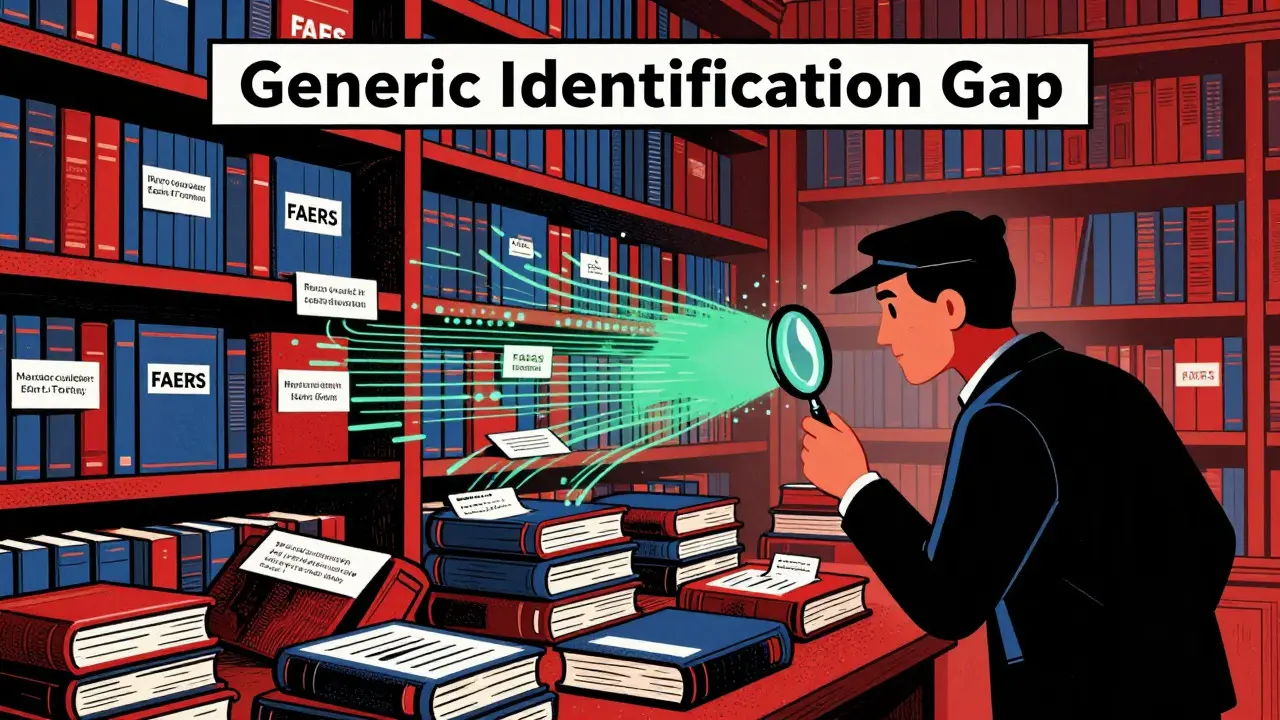
Here is the core problem: distinguishing between brand and generic products in adverse event reports remains one of the FDA’s most persistent data quality challenges. Dr. Robert Reynolds, Director of the FDA's Division of Pharmacovigilance, highlighted this issue in a 2024 Drug Info Rounds session. He noted that without precise identification, it is nearly impossible to determine if a safety signal is isolated to one manufacturer’s production process or widespread across the entire generic class.
Why does this happen? It comes down to how people report issues. Patients rarely know the manufacturer of their generic pill. They see the drug name on the bottle, but the manufacturer’s name is often small, buried in the fine print, or absent entirely. In fact, an analysis of FDA internal data from 2020 to 2024 revealed a stark disparity: only 32.7% of MedWatch reports involving generics included the specific generic manufacturer’s name. Compare that to 89.4% of brand-name reports that correctly identified the maker.
This gap creates a blind spot. If ten patients report dizziness from "generic Drug A," but five are taking versions from Manufacturer X and five from Manufacturer Y, the FDA sees a cluster of dizziness but cannot pinpoint which factory might have a contamination issue or a formulation error. This is particularly critical for drugs with a narrow therapeutic index-medications where a tiny change in dosage effectiveness can lead to serious health consequences.
| Metric | Brand-Name Drugs | Generic Drugs |
|---|---|---|
| Manufacturer Identified in Reports | 89.4% | 32.7% |
| National Drug Code (NDC) Included | High Frequency | 28.3% (Consumer Reports) |
| Primary Reporting Challenge | Underreporting volume | Lack of manufacturer specificity |
| Bioequivalence Standard | N/A (Original Reference) | 80-125% range required |
Therapeutic Inequivalence: When Generics Don’t Feel Like Brands
You might have heard the term "therapeutic inequivalence." This is a fancy way of saying that a generic drug did not work the same way the brand-name version did for a specific patient. While generics are required to meet strict bioequivalence standards-meaning they must deliver 80% to 125% of the active ingredient compared to the brand-they can still differ in inactive ingredients like fillers, binders, or dyes.
For most people, these differences don’t matter. But for some, they do. A 2022 study published in PMC (PMC9239739) found that patient-reported concerns regarding generic medications have increased significantly, with many citing reduced effectiveness or new side effects. MedWatch has a specific category for reporting "therapeutic inequivalence/failure." This allows patients to flag when a switch from brand to generic resulted in a negative outcome.
Consider the case of bupropion XL, an antidepressant. In 2022, multiple MedWatch reports flooded in regarding therapeutic failure with a specific generic version manufactured by Mylan. Because reporters were able to identify the manufacturer, the FDA launched an investigation. Within 11 months, labeling changes were implemented. This is a success story for the system, but it relied on users providing detailed information that is often missing.
Dr. Sarah Thompson, a pharmacovigilance expert at Harvard Medical School, points out a crucial bias in this data. She notes in a 2023 JAMA Internal Medicine commentary that the voluntary nature of MedWatch leads to significant underreporting, especially for generics. Patients may not realize they need to distinguish between brand and generic versions when reporting. They might just say "my depression meds stopped working," leaving the FDA to guess whether it was a physiological tolerance issue or a manufacturing defect.
How to Report Effectively: A Guide for Patients and Professionals
If you suspect a generic drug is causing you harm or isn't working as expected, your report matters. But to make it useful, you need to provide the right details. The learning curve for healthcare professionals is low-the FDA reports that 85% of first-time users complete reports within 15 minutes. However, the critical skill is proper documentation.
Here is what you should do if you are filing a MedWatch report for a generic medication:
- Find the NDC Number: Look at your prescription bottle. There is a string of numbers called the National Drug Code (NDC). This code uniquely identifies the labeler, the product, and the package size. Including this is the single most effective way to ensure the FDA knows exactly which manufacturer’s product you took.
- Note the Manufacturer: If the NDC isn’t available, look for the company name printed on the bottle or the imprint code on the pill itself. Websites like Pillbox can help decode imprints.
- Describe the Event Clearly: Don’t just say "side effects." Specify what happened, when it started relative to taking the pill, and any relevant medical history or lab results.
- Use the Correct Form: For online reporting, use the portal at www.fda.gov/MedWatch. For paper submissions, use Form FDA 3500. The instructions explicitly state: "If reporting a generic product, enter the generic name first followed by 'generic' and the manufacturer name if known."
Pharmacists play a huge role here. In a 2024 survey by the American Society of Health-System Pharmacists (ASHP), 71% of pharmacists reported facing time constraints when completing detailed reports. Yet, their input is vital because they can verify the manufacturer data that patients often miss. If your pharmacist asks for extra details during a complaint, let them dig deep. That data could trigger a recall or a warning that protects thousands of others.
Future Improvements: Algorithms and Digital Integration
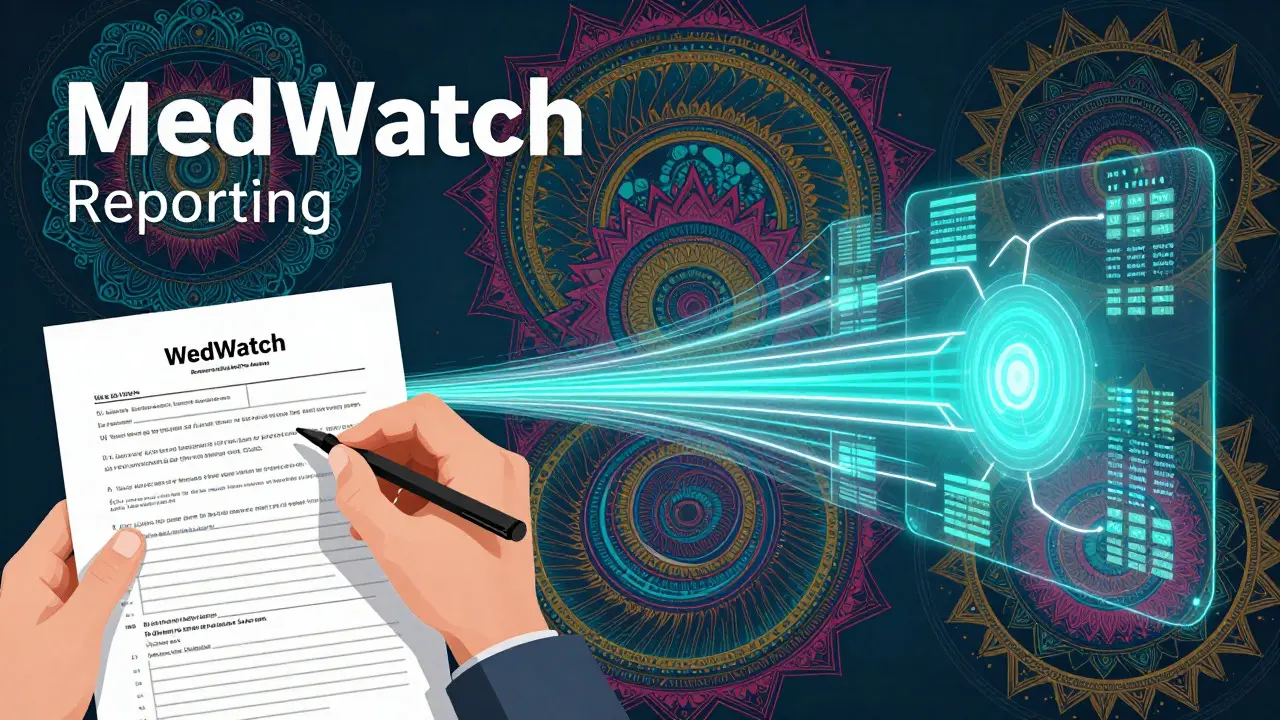
The good news is that the system is evolving. Recognizing the limitations of manual reporting, the FDA has been investing in technology to bridge the gap. A major breakthrough came with the implementation of an enhanced algorithm for identifying generic drugs in FAERS. Developed based on research highlighted in the 2022 PMC study, this algorithm achieved 92.4% sensitivity and 88.7% specificity in distinguishing generic products from brand-name counterparts. Fully integrated into FAERS processing as of January 2024, this tool helps analysts automatically flag and categorize generic-related reports more accurately.
Furthermore, the FDA launched the Generic Drug User Fee Amendments (GDUFA) III action plan in 2023. This plan includes specific commitments to enhance the identification and evaluation of potential safety signals for generic drugs. One of the most exciting developments on the horizon is the planned integration of MedWatch with electronic health record (EHR) systems by 2026. Announced in the FDA's Digital Health Innovation Action Plan 2.0 in October 2024, this integration will allow doctors’ computers to automatically capture NDC codes and manufacturer information directly from your prescription history when an adverse event is logged.
This shift promises to eliminate the human error component of reporting. Instead of relying on a patient to remember the manufacturer name, the system will pull the data from the pharmacy dispensing record. Industry analysts project a 22% increase in generic-specific adverse event reports by 2027 as these identification methods improve. While we still face the challenge of voluntary underreporting, the data that does come in will be far more actionable.
Frequently Asked Questions
What is MedWatch and who can use it?
MedWatch is the FDA's voluntary safety reporting program. Anyone can use it, including healthcare professionals, consumers, and manufacturers. It is used to report adverse events, product quality problems, therapeutic failures, and product use errors for medicines, devices, and other medical products.
Why is it difficult to track safety data for generic drugs?
The main difficulty is that patients often do not know which company manufactured their generic pill. Without the manufacturer's name or the National Drug Code (NDC), the FDA receives reports that simply say "generic [drug name]," making it hard to distinguish between different producers and identify specific manufacturing defects.
What is the difference between brand-name and generic reporting accuracy?
According to FDA data from 2020-2024, 89.4% of brand-name reports correctly identified the manufacturer, whereas only 32.7% of generic reports did. This gap makes it much easier for the FDA to investigate safety signals for brand-name drugs compared to generics.
What should I include in my MedWatch report for a generic drug?
You should include the drug name, a detailed description of the adverse event, and ideally the National Drug Code (NDC) or the manufacturer's name found on your prescription bottle. Providing the date of onset and any relevant medical history also helps the FDA analyze the report effectively.
Are generic drugs as safe as brand-name drugs?
Yes, generics are required to meet strict bioequivalence standards (80-125% of the brand-name drug's active ingredient). However, differences in inactive ingredients can sometimes cause variations in how individual patients react. MedWatch helps monitor these rare instances of therapeutic inequivalence to ensure ongoing safety.
How is the FDA improving generic drug surveillance?
The FDA has implemented advanced algorithms in its FAERS database to better identify generic products in reports. Additionally, the GDUFA III action plan aims to enhance signal detection, and future integrations with electronic health records by 2026 will automate the capture of manufacturer data, reducing reliance on patient memory.
