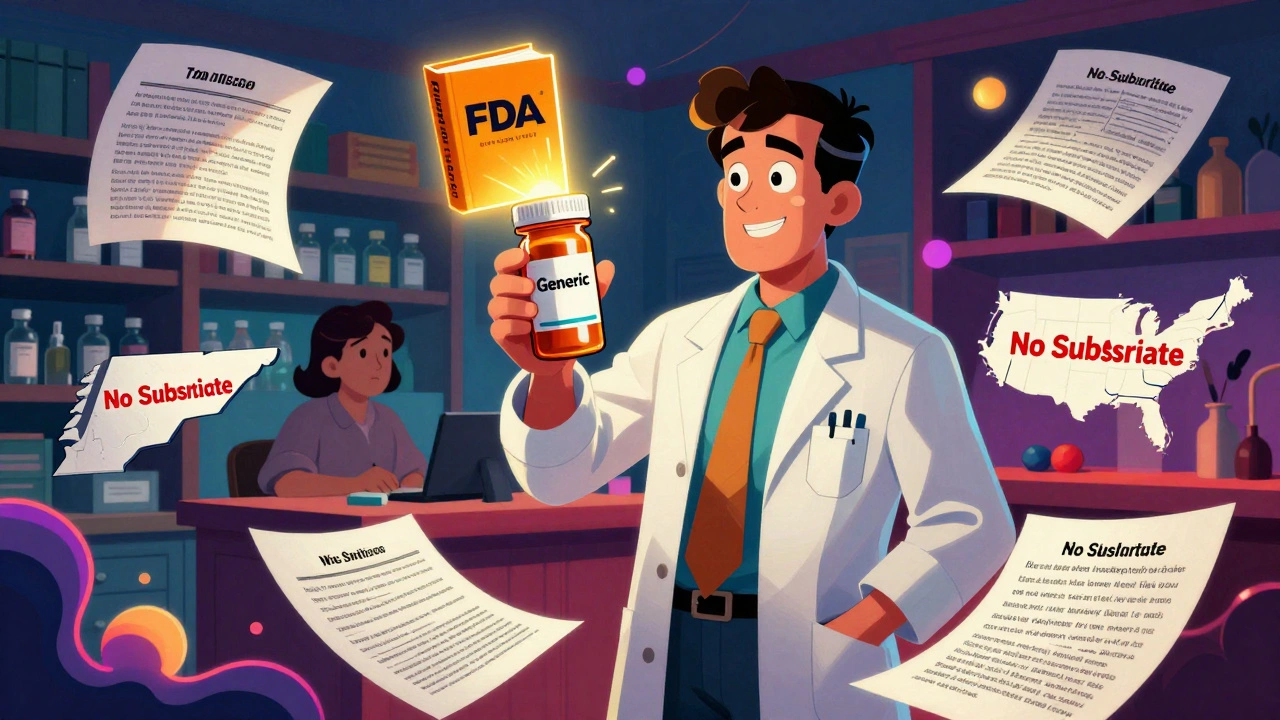
When a pharmacist hands over a prescription bottle labeled with a generic drug name instead of the brand name, they’re not just saving money-they’re navigating a web of state laws, federal standards, and patient rights. In the U.S., generic drugs make up 90.5% of all prescriptions filled, yet pharmacists face wildly different rules depending on which state they work in. One wrong move-like substituting a drug without consent or ignoring a state ban on swapping certain medications-can lead to disciplinary action, lawsuits, or worse, harm to a patient.
What Makes a Generic Drug Legally Substitutable?
Not every generic drug can be swapped in place of a brand-name version. The FDA’s Orange Book is the official source that lists which generics are considered therapeutically equivalent. Only drugs rated as “A” in this book qualify for substitution. That means they must have the same active ingredient, strength, dosage form, route of administration, and bioequivalence as the brand. It’s not enough for the pill to look similar or cost less. The FDA requires rigorous testing to prove the generic performs the same way in the body. If a drug isn’t rated “A,” substitution isn’t legally allowed-even if the pharmacist thinks it’s fine.State Laws Dictate Whether You Can Substitute
There’s no single federal rule forcing pharmacists to swap generics. Instead, each of the 50 states and Washington, D.C., has its own law. These laws fall into two main categories: mandatory and permissive substitution.In mandatory substitution states like New York and California, pharmacists must offer a generic if one is available and not prohibited by the prescriber. Refusing without a valid reason can be considered a violation. In permissive states like Texas and Florida, pharmacists can choose whether to substitute, but aren’t required to. This gives them more professional flexibility but also more responsibility to justify their decision.
Even more complex is how consent works. In explicit consent states-which include 32 states-you must ask the patient for permission before swapping. You can’t assume they’re okay with it. In presumed consent states (18 states), you can substitute unless the patient says no. But even then, you still need to inform them afterward. Misunderstanding this can lead to complaints, investigations, or loss of license.
Drugs That Can’t Be Substituted-Even If They’re A-Rated
Some medications are so sensitive that even FDA-approved generics can’t be swapped without special permission. These are often drugs with a narrow therapeutic index-meaning the difference between an effective dose and a toxic one is tiny. Examples include:- Antiepileptic drugs (like phenytoin or carbamazepine)
- Thyroid medications (like levothyroxine)
- Anticoagulants (like warfarin)
- Cardiac glycosides (like digoxin)
- Some anti-asthma inhalers and time-release formulations
States like Tennessee and Hawaii ban substitution of antiepileptic drugs entirely unless both the prescriber and patient give written consent. Florida prohibits substitution for any drug classified as having a narrow therapeutic index, even if it’s rated “A.” In California, levothyroxine substitutions require explicit patient consent and documentation-even though the FDA considers generics equivalent. Pharmacists who ignore these rules have been reported to state boards for causing seizures, thyroid instability, or dangerous bleeding episodes.
How to Handle “Dispense As Written” and “Medically Necessary” Requests
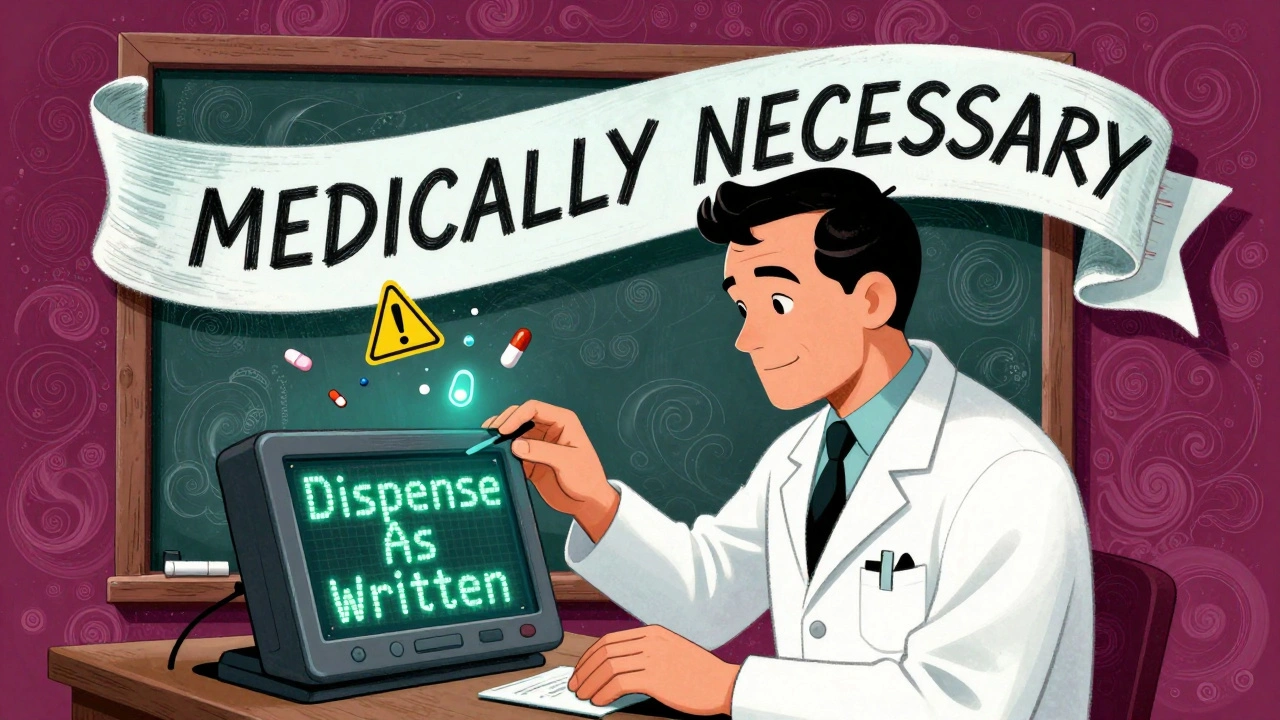
Prescribers can block substitution by writing “Dispense As Written” or “Do Not Substitute” on the prescription. But many states go further. In Florida, the prescriber must write “MEDICALLY NECESSARY” in their own handwriting on paper prescriptions. For electronic prescriptions, they must use a specific code or checkbox in the system. If this isn’t done correctly, the pharmacist is legally allowed to substitute-even if the prescriber thought they blocked it.This is where confusion happens. A doctor might type “Do Not Substitute” into an EHR system, but if the pharmacy’s software doesn’t recognize that field, the system may still allow the swap. Pharmacists need to check not just the paper or screen, but also their own system settings. A 2022 study by the National Association of State Pharmacy Boards found that 68% of disciplinary cases against pharmacists involved documentation errors-not the substitution itself, but failing to record consent, prescriber instructions, or patient counseling.
Documentation Is Your Legal Shield
In pharmacy, paperwork isn’t bureaucracy-it’s protection. Every time you substitute a generic, you must document:- The name of the brand and generic dispensed
- Whether patient consent was obtained (and how)
- Any prescriber restrictions noted on the script
- The date and time of counseling
- Any patient questions or concerns raised
Electronic systems should auto-log this, but many don’t. Pharmacists in permissive states often manually note consent on the prescription label or in the patient’s record. If a patient later claims they weren’t told about the switch, your documentation is the only proof you followed the law. Without it, you’re vulnerable-even if you did everything right.
What Happens If You Get It Wrong?
Violating substitution laws can lead to:- Fines from the state board of pharmacy
- Probation or suspension of your license
- Civil lawsuits from patients harmed by inappropriate substitution
- Criminal charges in extreme cases (e.g., substituting antiepileptics for a seizure patient)
One case from Tennessee in 2023 made headlines when a pharmacist substituted a generic antiepileptic for a patient with a documented history of seizures. The patient had a breakthrough seizure and was hospitalized. The pharmacist didn’t know about the state’s ban. They lost their license. The pharmacy chain paid $1.2 million in a settlement. This wasn’t a rare mistake-it’s a preventable one.
How to Stay Compliant in a Changing Landscape
Laws change constantly. In 2022 alone, 17 states updated their substitution rules. New biosimilar drugs (complex biologic generics) are now entering the market, and 32 states have passed laws governing their substitution-separate from traditional generics.To stay compliant:
- Check your state’s pharmacy board website monthly for updates
- Attend at least 40 hours of continuing education per year focused on pharmacy law
- Use updated pharmacy software that flags restricted drugs and consent requirements
- Train every staff member-technicians can also be held liable if they dispense incorrectly
- Keep a printed copy of your state’s substitution law on the pharmacy counter
Don’t rely on memory. Don’t assume “it’s probably fine.” If you’re unsure, call the state board. It’s better to lose 10 minutes on a phone call than your license.
Patients Want to Know-So Tell Them
Patients don’t always understand why generics are cheaper. Many believe they’re “inferior.” But when pharmacists explain clearly-“This generic has the same active ingredient, same dose, and was tested to work just like the brand”-patient satisfaction jumps. A 2023 survey of over 1,200 patients found 78% were satisfied with substitution when properly explained. The biggest complaint? Not being told beforehand.Simple phrases work: “I’m giving you the generic version of your medication. It’s the same, but costs $38 less. Is that okay?” Then wait for a yes. In explicit consent states, that’s the law. In others, it’s good practice. Either way, it builds trust.
Final Thought: You’re the Last Line of Defense
Pharmacists aren’t just filling prescriptions. You’re the final check before a patient takes a drug. Federal rules say generics are safe. But state laws say you have to follow specific steps to make sure they’re used safely. Your responsibility isn’t just to dispense-it’s to understand, to question, to document, and to protect.When you get it right, you save money and lives. When you get it wrong, the consequences aren’t just legal-they’re personal. In a system built on trust, your knowledge is the most important tool you have.
Can a pharmacist substitute a generic drug without telling the patient?
It depends on the state. In 32 states, pharmacists must get explicit patient consent before substituting a generic. In the other 18, substitution is allowed under presumed consent, but patients must still be notified after the fact. Failing to inform the patient-even in presumed consent states-can lead to complaints, investigations, or disciplinary action by the state board of pharmacy.
Are all generic drugs safe to substitute?
No. Only generics rated “A” in the FDA’s Orange Book are legally eligible for substitution. Even then, some drugs are banned from substitution in certain states-like antiepileptics in Tennessee and Hawaii, or thyroid medications in California-regardless of their FDA rating. Pharmacists must know both federal ratings and state-specific restrictions.
What happens if a pharmacist substitutes a restricted drug?
Substituting a drug that’s legally prohibited-like an antiepileptic for a seizure patient-can result in license suspension, fines, civil lawsuits, or even criminal charges. In 2023, a pharmacist in Tennessee lost their license after substituting a generic antiepileptic, leading to a patient’s hospitalization. Documentation errors and lack of awareness of state laws are the most common causes of these incidents.
How often do state laws on generic substitution change?
State laws change frequently. In 2022, 17 states updated their generic substitution rules. New laws are often introduced to address biosimilars, narrow therapeutic index drugs, or electronic prescribing requirements. Pharmacists should check their state board’s website monthly and complete at least 40 hours of continuing education annually focused on pharmacy law.
Is documentation really that important when dispensing generics?
Yes. In 2022, 68% of disciplinary actions against pharmacists involved documentation errors-not the substitution itself, but failing to record consent, prescriber restrictions, or patient counseling. If a patient claims they weren’t told about the switch, your written record is your only defense. Always log the generic name dispensed, consent obtained, and any patient concerns.

Michael Feldstein
Man, I had no idea state laws varied this much. I thought if it was FDA-approved, it was fair game. Turns out I’ve probably been lucky more than legal. Gotta check my state’s rules tomorrow.
Rebecca Braatz
THIS. So many pharmacists think generics are just cheaper versions when they’re actually legally distinct beasts depending on where you are. I train new techs every month and I hammer this: consent isn’t optional, it’s your shield. If you don’t document it, it didn’t happen. Period.
Also, if you’re substituting levothyroxine in California without written consent? You’re one phone call from losing your license. I’ve seen it happen. Don’t be that person.
Heidi Thomas
Stop pretending this is complicated. If you’re a pharmacist you’re supposed to know the law. No excuses. If you don’t know your state’s substitution rules you shouldn’t be touching a prescription. It’s not rocket science it’s basic professional responsibility. Your patients aren’t guinea pigs.
jagdish kumar
Is the pharmacist the gatekeeper of fate? Or just another cog in the machine that sells pills? We give them power to decide life or death with a checkbox… and then blame them when the system fails. Who made them the priest of the pill?
Dematteo Lasonya
I’ve had patients cry because they thought the generic was inferior. One told me her dad died because they switched his heart med and no one explained it. That stuck with me. Now I always say: ‘This is the same medicine, just cheaper. I’ll tell you exactly how it’s the same.’ It takes 30 seconds. It changes everything.
Also, if you’re not documenting consent, you’re not doing your job. Not morally. Not legally. Not ethically.
Libby Rees
Interesting how the FDA’s Orange Book is treated like gospel, yet state laws override it so often. The inconsistency creates confusion even for trained professionals. A national standard would reduce errors, but politics always gets in the way. Still, the fact that 68% of violations are documentation-related says more about workflow than intent. Systems need to auto-verify, not rely on human memory.
Alex Piddington
Just wanted to say thank you for this breakdown. As a pharmacy student, I’ve been terrified of making a mistake on this exact topic. Your post clarified so much. I’m printing out the state-by-state summary and keeping it in my binder. Also, I’m adding a reminder to my phone: ‘Always confirm consent. Always document. Always ask.’
And yes - calling the state board is never a waste of time. Better safe than suspended.