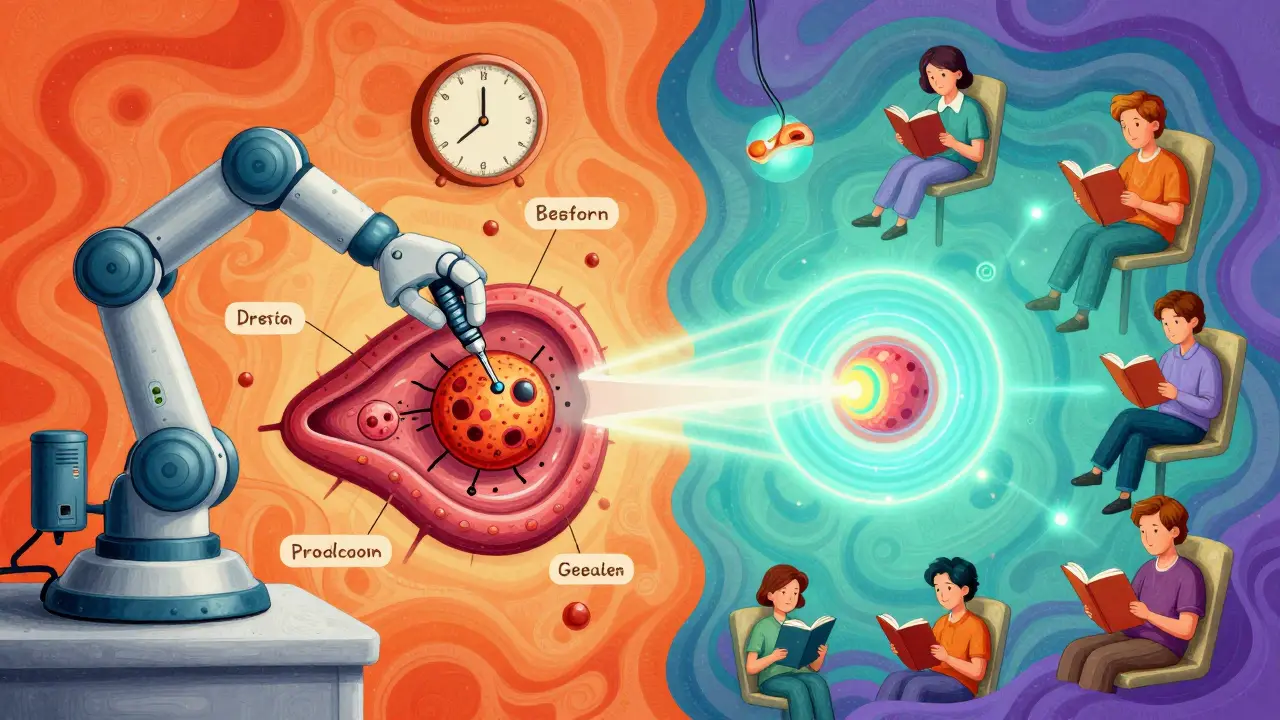
When you’re facing a localized cancer diagnosis, one of the first big decisions is: radiation or surgery? It’s not about which is "better." It’s about which fits you-your body, your life, and your priorities. Both are proven ways to stop cancer from spreading in its early stages. But they work in completely different ways, and the side effects? They’re not the same at all.
What Local Control Really Means
Local control means stopping cancer where it started. It’s not about curing cancer that’s already spread to other organs. It’s about removing or destroying the tumor in its original spot-whether that’s the prostate, the lung, or somewhere else. For many people, this is the most important step in treatment. If you can control the cancer locally, your chances of living a long, healthy life go up dramatically.
Two main tools do this: surgery and radiation. Surgery cuts it out. Radiation zaps it with targeted energy. Neither is a magic bullet. But together, they give you options.
Surgery: Get It Out
Surgery means physically removing the tumor and some surrounding tissue. For prostate cancer, that’s a radical prostatectomy. For lung cancer, it’s often a lobectomy-removing one of the lung’s five lobes. The goal? Remove every last cancer cell. And when the surgeon takes out the tissue, they can send it to the lab. That gives you exact details: How big was the tumor? Did it spread to nearby lymph nodes? This is called pathological staging. It’s one of the biggest advantages of surgery.
Modern surgery isn’t what it used to be. For prostate cancer, most procedures now are robotic-assisted. For lung cancer, video-assisted thoracoscopic surgery (VATS) uses tiny incisions and a camera. These methods cut down recovery time and reduce pain. Still, you’re going under the knife. That means a hospital stay-usually 1 to 3 days for prostate surgery, 3 to 7 days for lung surgery. Recovery takes weeks. You’ll be tired. You’ll need help with daily tasks. But the treatment itself? It’s done in one go.
Radiation: Zap It In Place
Radiation therapy doesn’t cut anything out. It uses high-energy beams-X-rays or protons-to destroy cancer cells. The beams are aimed with millimeter precision. Modern machines can track your breathing, adjust for movement, and focus only on the tumor. That means less damage to healthy tissue.
There are two main types. Traditional radiation for prostate cancer usually means daily treatments, five days a week, for 7 to 9 weeks. Each session takes 15 to 30 minutes. You come in, lie down, the machine does its job, and you leave. No hospital stay. No recovery time. Just life, with a few extra stops on your calendar.
For early-stage lung cancer, there’s a newer option: stereotactic body radiation therapy (SBRT). Instead of 30+ sessions, you get 1 to 5. Each one is powerful. You can do it as an outpatient. Most people go back to work the next day.
But here’s the catch: radiation doesn’t give you the same clear picture as surgery. You won’t know exactly how much cancer was left behind. You’ll rely on scans later to check if it worked.
Prostate Cancer: What the Data Shows
The biggest study on this-called ProtecT-followed over 1,600 men with localized prostate cancer for 10 years. They compared surgery, radiation, and just watching (active surveillance). The results? Survival rates were almost identical. At the 10-year mark:
- Surgery: 96.8% alive
- Radiation: 95.7% alive
- Active monitoring: 95.8% alive
That’s reassuring. But here’s what else happened:
- After 6 months, urinary leakage was 2.5 times more common after surgery.
- Erectile dysfunction was also much higher after surgery.
- Bowel problems? Those were 1.8 times more common after radiation.
But a different study-looking at 91,000 men-found something else. For men with higher-risk prostate cancer, surgery led to better long-term survival. At 15 years, 62% of surgery patients were still alive. For radiation? Only 52%.
Why the difference? The ProtecT trial mostly included low-risk patients. The other study included high-risk cases. That’s key. Your risk level changes everything.
Lung Cancer: Surgery Still Leads
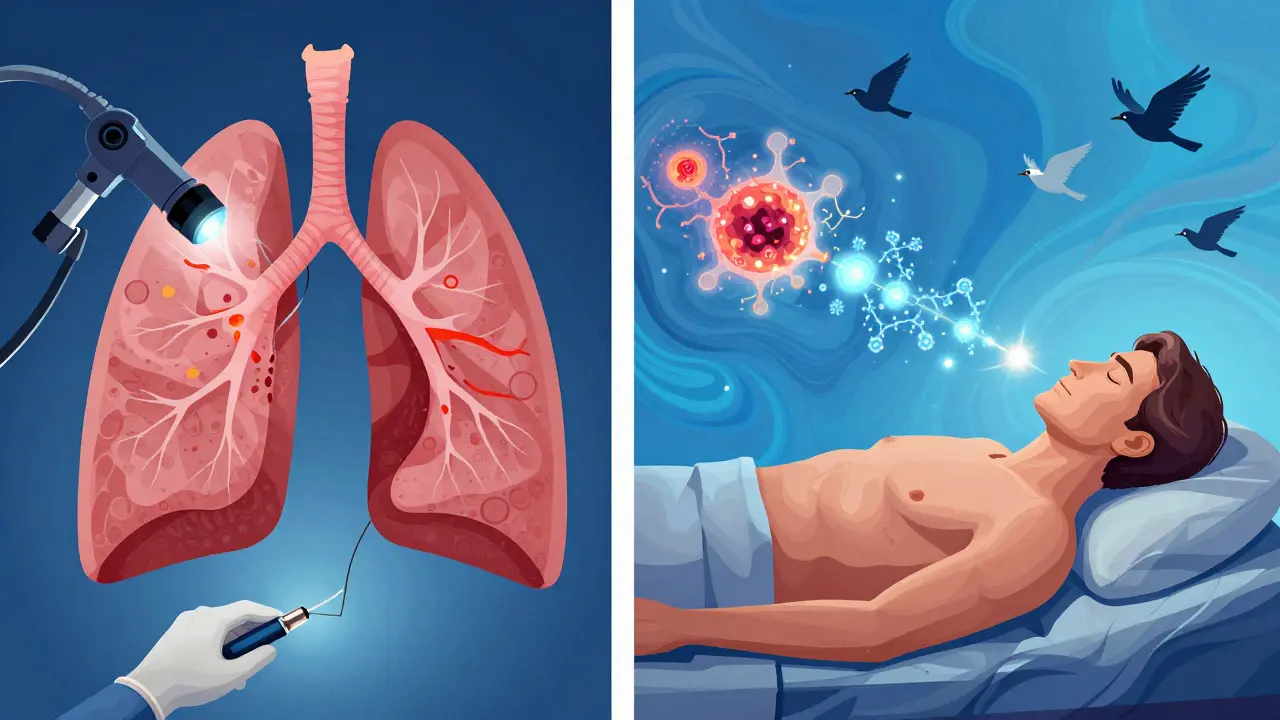
For early-stage non-small cell lung cancer (NSCLC), surgery is still the gold standard-if you’re healthy enough for it. A 2022 analysis of over 30,000 patients found:
- Surgery: 71.4% five-year survival rate
- SBRT (radiation): 55.9% five-year survival rate
That’s a big gap. But SBRT isn’t a second choice because it’s weaker. It’s a choice because surgery isn’t possible for everyone. People with heart disease, severe COPD, or other serious conditions often can’t handle major lung surgery. For them, SBRT is life-saving. Studies show 40-50% five-year survival for stage I lung cancer with SBRT. That’s better than most other treatments for inoperable patients.
Side Effects: What You Actually Live With
Survival rates matter. But so does what your life looks like after treatment.
For prostate cancer:
- Surgery: 14% of low-risk men had urinary leakage 10 years later. For high-risk? 25%. Erectile dysfunction affects 30-60% of men, depending on age and nerve-sparing techniques.
- Radiation: Only 4% had leakage. But 8% had serious bowel problems-diarrhea, urgency, bleeding. That number jumps to 7% if radiation is combined with hormone therapy.
For lung cancer:
- Surgery: Pain, fatigue, reduced lung capacity. Some people need oxygen long-term. Recovery takes 6-8 weeks.
- Radiation: Fatigue, skin irritation, cough, occasional lung scarring. Most side effects fade within months. But radiation to the chest can sometimes affect the heart or esophagus years later.
Neither option is easy. But one might be easier for your life.
Logistics: Time, Travel, and Lifestyle
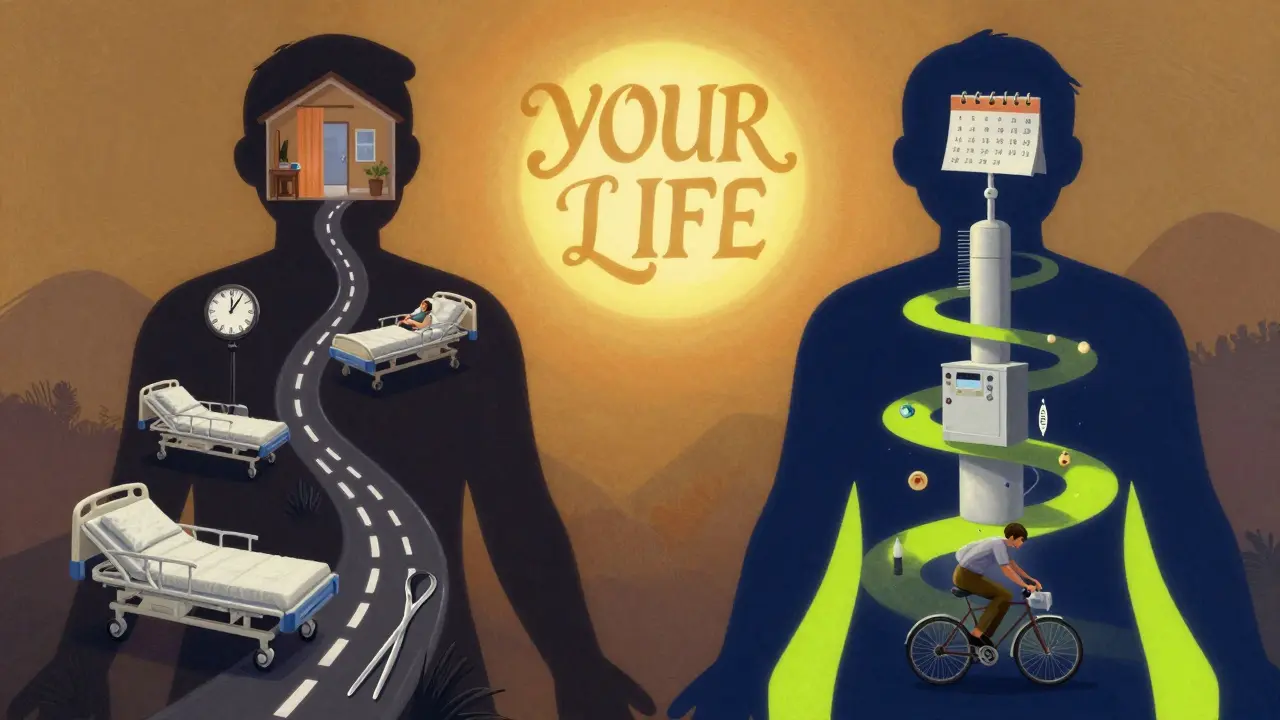
Surgery is intense but short. You go in, recover hard for a few weeks, and then it’s done. Radiation? It’s a marathon. Daily trips for weeks. If you live far from a treatment center, that’s a huge burden. You might need to relocate temporarily. Take time off work. Arrange rides. It adds stress.
SBRT for lung cancer? No travel. No hospital stay. You can keep working. That’s why so many older patients choose it-even if surgery is technically possible.
What Experts Say
Dr. Matthew Cooperberg from UCSF put it plainly: "There’s relatively little high-quality evidence on which to base current treatments." He’s not saying the treatments don’t work. He’s saying we need to stop treating everyone the same.
The American Society of Clinical Oncology says this clearly: All patients with localized prostate cancer should have access to both a urologist and a radiation oncologist before deciding. Why? Because your oncologist might only know radiation. Your surgeon might only know surgery. You need both voices.
Dr. Christopher King, a radiation oncologist at Cedars-Sinai, says: "Radiation isn’t what people imagine." He’s right. Most people think of old-school radiation-burns, nausea, hair loss. Modern radiation? It’s precise. Personalized. Often invisible.
What’s the Right Choice?
There’s no universal answer. But here’s how to think about it:
- If you’re young, healthy, and want to remove the cancer completely-surgery might be the way to go.
- If you’re older, have other health issues, or can’t handle major surgery-radiation (especially SBRT) is a powerful alternative.
- If you’re low-risk prostate cancer and value quality of life over absolute certainty-radiation may cause fewer long-term side effects.
- If you’re high-risk prostate cancer and want the best chance of long-term survival-surgery has shown better outcomes in some studies.
- If you have early lung cancer and are medically operable-surgery still gives the best survival.
- If you can’t have surgery-radiation is your best shot.
And don’t forget: active surveillance is an option for very low-risk prostate cancer. Watch. Wait. Monitor. Only act if things change.
What’s Next?
New techniques are coming. Focal therapy for prostate cancer-treating just the tumor, not the whole gland-is being tested. Proton beam therapy for lung and prostate cancer may reduce side effects even more. The PARTICLE trial, expected to finish in 2025, will compare partial gland ablation to full treatment.
But today, the tools we have work. The data is clear. The choice isn’t about which treatment is better. It’s about which one fits your life.
Is radiation therapy safer than surgery for prostate cancer?
It depends on what you mean by "safer." Radiation avoids the risks of surgery-like bleeding, infection, or anesthesia complications. But it can cause long-term bowel problems, especially if the rectum is near the treatment area. Surgery has higher risks of urinary leakage and erectile dysfunction. Neither is "safer" overall. They just have different risks.
Can I choose radiation instead of surgery for lung cancer?
Yes-but only if you’re not a good candidate for surgery. For early-stage lung cancer, surgery gives the best survival rates. But if you have heart disease, COPD, or other conditions that make surgery too risky, stereotactic body radiation therapy (SBRT) is the standard alternative. It’s not a second choice-it’s a proven, effective treatment.
Does radiation therapy cause cancer to spread?
No. Radiation doesn’t cause cancer to spread. It’s designed to kill cancer cells in a targeted area. In fact, it’s one of the most effective ways to prevent local spread. The fear that radiation "spreads" cancer is a myth. It’s like saying a fire extinguisher causes fires.
How long does recovery take after surgery for prostate cancer?
Most men spend 1 to 3 days in the hospital. Full recovery takes 4 to 8 weeks. Urinary control can take months to return. Some men need pads for a year or more. Erectile function may take 6 months to 2 years to improve, especially if nerves were preserved.
Do I need to go to the hospital every day for radiation therapy?
For traditional radiation, yes-usually five days a week for 7 to 9 weeks. But for SBRT (used in lung and some prostate cancers), you only need 1 to 5 sessions total. No hospital stay. Each session is quick. Many patients treat it like a weekly appointment.
Can I get both radiation and surgery?
Sometimes. For high-risk prostate cancer, doctors often combine surgery with radiation afterward. For lung cancer, surgery may be followed by radiation if cancer cells are found near the edges of the removed tissue. This is called adjuvant therapy. It’s not common, but it’s used when the risk of recurrence is high.
What if I can’t afford daily radiation trips?
This is a real issue. Daily radiation for 7-9 weeks can be logistically impossible for people without reliable transport or paid leave. If this is your situation, talk to your care team. SBRT may be an option. Some centers offer travel assistance. Others have partnerships with local housing for patients. Don’t assume you have to choose radiation if it’s not feasible-there are often solutions.

Emma Nicolls
I went through radiation for prostate cancer last year and honestly? It was way easier than I thought. No hospital stay, no catheter, no "when will I stop leaking" anxiety. Just me, my coffee, and a 20-minute nap in the machine. My wife said I looked like a space traveler. I felt like a champ. 🌟
Stephanie Paluch
I’m 68 and had SBRT for early lung cancer. Didn’t miss a day of work. Got to keep walking my dog. My oncologist said I was the perfect candidate. Surgery? No way. I’ve got COPD and my heart’s seen enough. Radiation saved my life. No regrets. 💪❤️
tynece roberts
so i read this whole thing and honestly the part about bowel issues after radiation kind of scared me. like i knew it was a risk but i didnt realize it could be 8% long term. i had surgery for prostate cancer 3 years ago and yeah the ED was brutal but at least i can still go to the bathroom without panic. also why does no one talk about how radiation makes you feel like a zombie for weeks? like i wasnt tired. i was just... empty. like my soul got zapped too. idk man
Hugh Breen
THIS. IS. WHY WE NEED MORE PATIENT-CENTERED CARE. 🙌 I’ve been in oncology for 12 years and I’ve seen too many people get pushed into surgery because it’s "the standard"-even when they’re 72 with diabetes, heart disease, and three grandkids who need their grandpa to drive them to soccer. Radiation isn’t a backup plan. It’s a hero. And we need to stop making patients feel like they’re settling. You’re not choosing "less"-you’re choosing YOUR life.
Byron Boror
Radiation is just a lazy cop-out. If you can’t handle surgery, maybe you shouldn’t be fighting cancer. Real men go under the knife. We’ve got the best tech in the world-use it. Stop coddling people. If you want to live, you fight. Period.
Rex Regum
Oh please. The whole "radiation is less invasive" narrative is a marketing ploy by Big Radiology™. They don’t want you to know that radiation can cause secondary cancers 15 years later. And those "precision" machines? They still hit your rectum, bladder, heart-whatever’s in the way. Surgery removes the problem. Radiation just hides it. And don’t even get me started on how they downplay the long-term bowel damage. It’s not science-it’s corporate propaganda.
Kelsey Vonk
I keep thinking about how we treat cancer like a math problem. Remove or zap. But it’s not. It’s about identity. For some, the body is a temple. Surgery feels like desecration. For others, radiation feels like being bombarded by invisible enemies. Neither is "better." But the quietest, most personal part of this decision? It’s not about survival rates. It’s about what you’re willing to carry. The fear. The fatigue. The shame. The hope. And nobody talks about that.
Jimmy V
SBRT for lung cancer? Absolute game-changer. I’ve treated 200+ patients. If you’re operable, surgery still wins on survival. But here’s the kicker-80% of patients who *could* have surgery choose SBRT because they don’t want to be laid up for months. And guess what? Their quality of life? Better. You don’t need to be a hero to pick the path that lets you hug your grandkid. That’s not weakness. That’s wisdom.
Richard Harris
I had prostate surgery in 2020. Took 6 months to feel like myself again. Urinary control? Still not 100%. But I’ve got peace of mind. No scans every 3 months. No wondering if it came back. I know it’s gone. That’s worth the struggle. I’d do it again. 🤷♂️
Kandace Bennett
Honestly, if you’re choosing radiation over surgery for prostate cancer, you’re just avoiding the real work. Real men face the knife. Real men endure. Modern medicine has given us the tools-why are we letting people opt for the easy way out? This isn’t a spa day. It’s cancer. You don’t get to pick the path that’s "easiest on your vibe." You pick the path that saves your life. And surgery? It’s still the gold standard. 🇺🇸
Tim Schulz
Wow. So we’ve gone from "cancer is a battle" to "cancer is a scheduling conflict." Next they’ll be selling subscription boxes for SBRT. "Monthly radiation: now with lavender-scented beams!" Look, I get it. No one wants to be cut open. But if you’re going to live in a world of scans, side effects, and "we’ll monitor"-at least have the guts to admit you’re trading certainty for convenience. And stop pretending radiation is "gentle." It’s just quieter. Doesn’t mean it’s kinder.