
SSRI Hyponatremia Risk Estimator
Select the options that apply to you or your loved one to estimate potential risk.
Your Risk Assessment
Enter Details
Please select your profile details and click calculate to see your estimated risk level.
You start taking a new antidepressant to feel better, but instead of lifting the fog of depression, you feel dizzy, confused, or just "off." You might blame it on the mental health struggle itself, or perhaps aging. But there is a specific, physical culprit that often hides behind these symptoms: hyponatremia. This condition, caused by dangerously low sodium levels in your blood, is a known side effect of Selective Serotonin Reuptake Inhibitors (SSRIs). It is not rare, especially if you are over 65, female, or taking other medications like diuretics.
Hyponatremia occurs when your body retains too much water, diluting the sodium in your bloodstream. While mild cases can be subtle, severe drops in sodium can lead to seizures, coma, or even death. The good news? It is preventable with proper monitoring, and there are safer medication alternatives available. Let’s break down why this happens, who is at risk, and how to protect yourself or a loved one.
What Is SSRI-Induced Hyponatremia?
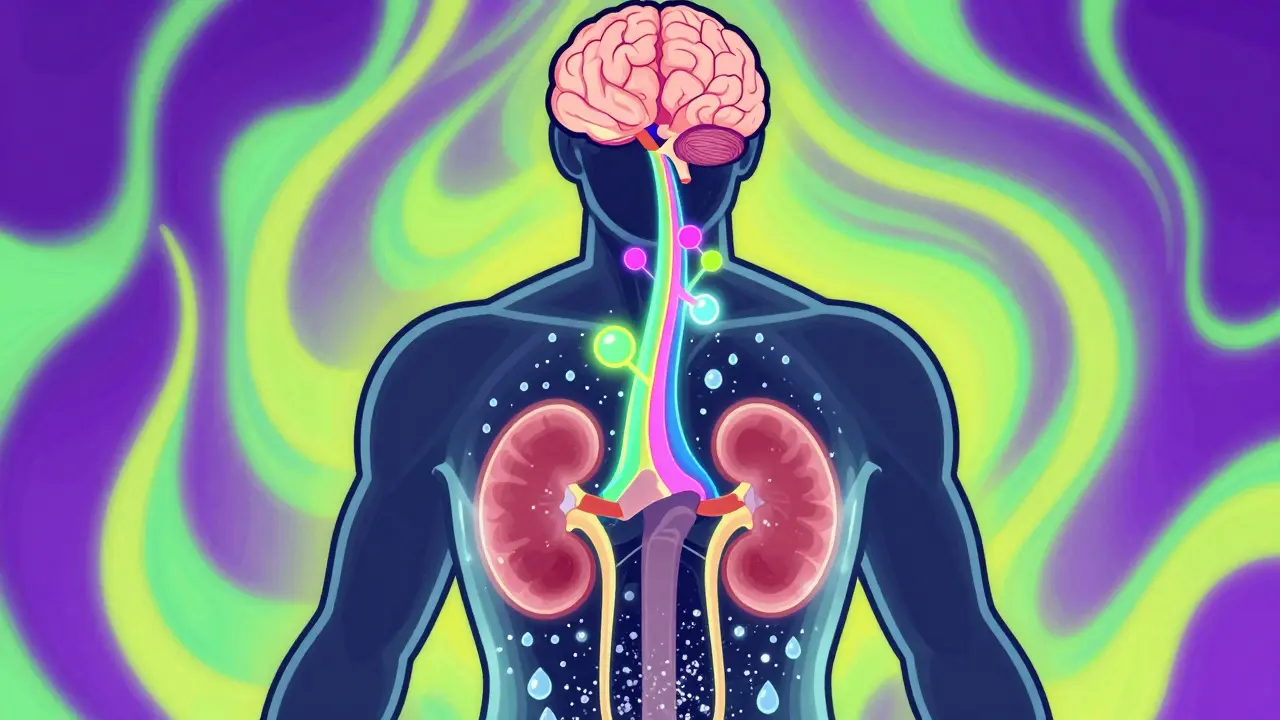
To understand the risk, we first need to look at how SSRIs work. These medications block the reabsorption of serotonin, keeping more of it active in your brain to improve mood. However, serotonin doesn’t just stay in the brain. It also signals the pituitary gland to release antidiuretic hormone (ADH), also known as vasopressin.
Normally, ADH tells your kidneys to hold onto water when you are dehydrated. With SSRIs, this signal can get stuck in the "on" position. This leads to a condition called Syndrome of Inappropriate Antidiuretic Hormone secretion (SIADH). Your kidneys retain water even when you don’t need to, causing your blood volume to expand slightly and your sodium concentration to drop. Serum sodium levels below 135 mmol/L define hyponatremia. When levels drop significantly lower, say between 105-125 mmol/L, the neurological risks become severe.
How common is hyponatremia with SSRIs?
According to a 2024 meta-analysis published in European Psychiatry, hyponatremia affects approximately 1.9% to 4.4% of patients treated with SSRIs generally. However, for elderly patients aged 65 and older, the risk jumps dramatically to 13.9%-18.6%. This makes it one of the most common electrolyte disturbances associated with psychiatric medication use.
Who Is Most at Risk?
Not everyone who takes an SSRI will develop low sodium. Several key factors stack up to increase your vulnerability. If you recognize any of these profiles, you need to be extra vigilant.
- Age: Patients over 65 face a relative risk 3.7 times higher than younger adults. Aging kidneys are less efficient at excreting free water, making them more susceptible to SIADH.
- Gender: Women account for roughly 65.2% of documented cases. The reasons are multifactorial, involving hormonal interactions and potentially lower average body weight.
- Body Weight: Individuals weighing less than 60 kg (approx. 132 lbs) are at higher risk because they have less total body water to buffer the dilution effect.
- Concurrent Medications: Taking thiazide diuretics (often prescribed for high blood pressure) increases the risk by 4.2-fold. Other drugs affecting fluid balance, such as NSAIDs or certain diabetes medications, can also contribute.
- Renal Impairment: Pre-existing kidney issues (eGFR <60 mL/min/1.73m²) reduce the body’s ability to regulate sodium and water effectively.
Symptoms: What to Look For
The tricky part about hyponatremia is that its early symptoms mimic other conditions, leading to delayed diagnosis. The average time from symptom onset to correct diagnosis is 7.2 days. In elderly patients, confusion is often misattributed to dementia or normal aging.
Watch for these signs within the first two to four weeks of starting an SSRI or increasing the dose:
- Mild Symptoms: Nausea, headache, general malaise, fatigue, and muscle cramps. These are easy to dismiss as side effects of the new medication or stress.
- Moderate Symptoms: Confusion, disorientation, difficulty concentrating, and unsteady gait (which can lead to falls).
- Severe Symptoms: Seizures, respiratory arrest, coma, and in extreme cases, death. These usually occur when sodium levels drop below 125 mmol/L.
If you or a loved one experiences sudden confusion or falls shortly after starting an antidepressant, do not assume it is purely psychological. Request a serum sodium test immediately.
Comparing Risks: SSRIs vs. Other Antidepressants
Not all antidepressants carry the same risk. The likelihood of developing hyponatremia depends heavily on the drug’s binding affinity for the serotonin transporter (SERT). SSRIs have a high affinity, which drives the ADH release. Other classes of drugs interact differently with neurotransmitters, resulting in varying safety profiles.
| Antidepressant Class/Drug | Risk Profile (Odds Ratio) | Key Notes |
|---|---|---|
| Citalopram (SSRI) | 2.37 (Highest among SSRIs) | High SERT binding; significant risk in elderly. |
| Sertraline (SSRI) | 2.15 | Commonly prescribed; requires monitoring. |
| Fluoxetine (SSRI) | 1.98 | Long half-life may prolong effects. |
| Venlafaxine (SNRI) | 1.72 | Moderate risk; affects norepinephrine too. |
| Bupropion (Atypical) | 0.85 | Intermediate risk; does not primarily target serotonin. |
| Mirtazapine (Atypical) | 0.47 (Lowest) | Safest alternative for high-risk patients. |
Data from the 2024 meta-analysis shows that SSRIs collectively have a 2.86-fold higher risk compared to non-SSRI antidepressants. Mirtazapine stands out as the safest option, with a risk only 47% that of SSRIs. For every 1,000 patients treated with SSRIs, approximately 18.6 will develop hyponatremia, compared to just 6.5 per 1,000 with mirtazapine.
Prevention and Monitoring Strategies
You cannot change your age or genetics, but you can control how the medication is managed. Prevention relies on proactive testing rather than reactive treatment.
Baseline Testing: Before starting any antidepressant, especially if you are over 65, ask your doctor for a baseline serum sodium test. This establishes your normal range.
Follow-Up Schedule: The American Psychiatric Association recommends repeat testing at 2 weeks after initiation or any dose increase. This is the critical window where SIADH typically manifests. For high-risk patients, monthly monitoring for the first three months is advisable.
Medication Review: Bring a complete list of all medications, including over-the-counter drugs and supplements, to your appointment. Specifically highlight any diuretics (water pills) like hydrochlorothiazide, as the combination with SSRIs is dangerous.
Treatment Options If Hyponatremia Occurs
If tests confirm low sodium, the approach depends on severity. Mild cases (sodium 125-134 mmol/L) are often managed by restricting fluid intake to 800-1000 mL per day and discontinuing or switching the offending SSRI. Sodium levels typically normalize within 72-96 hours after stopping the drug.
Severe cases (sodium <125 mmol/L) require hospitalization. Treatment involves careful infusion of hypertonic saline (3%) to raise sodium levels gradually. Rapid correction is dangerous and can cause osmotic demyelination syndrome, a serious neurological injury. Therefore, medical supervision is mandatory.
Switching medications is often the long-term solution. Dr. Elena Martinez, lead author of the 2024 meta-analysis, notes that mirtazapine should be considered first-line for elderly patients due to its superior safety profile regarding electrolytes. Bupropion is another viable alternative for those who cannot tolerate mirtazapine.
Why Awareness Matters Now More Than Ever
Despite the clear data, awareness remains low. A 2023 survey found that only 28.7% of patients received information about hyponatremia risk before starting SSRIs. Furthermore, 63.4% of primary care physicians were unaware of the typical 2-4 week onset window. This gap in knowledge contributes to the $1.27 billion annual healthcare cost associated with SSRI-induced hyponatremia in the US alone.
As prescribing patterns shift, with a 22.3% decrease in SSRI initiation for patients over 65 between 2018 and 2023, we are seeing a move toward safer practices. However, vigilance is still required. If you are considering antidepressants, discuss your risk factors openly with your provider. Ask for baseline labs. Know the symptoms. Protecting your physical health is just as important as treating your mental health.
Can hyponatremia from SSRIs be permanent?
No, hyponatremia caused by SSRIs is reversible. Once the medication is discontinued or switched, and fluid balance is restored, sodium levels typically return to normal. The average recovery time for sodium normalization is 4.3 days after stopping the SSRI. However, severe cases requiring hospitalization may take longer to fully resolve neurological symptoms.
Which SSRI has the lowest risk of hyponatremia?
Among SSRIs, paroxetine has a slightly lower odds ratio (1.82) compared to citalopram (2.37) or sertraline (2.15). However, all SSRIs carry significant risk compared to non-SSRI options. If you are at high risk, switching to a different class like mirtazapine or bupropion is recommended over choosing a "safer" SSRI.
Should I stop my SSRI if I feel confused?
Do not stop your medication abruptly without consulting your doctor, as this can cause withdrawal symptoms. Instead, contact your healthcare provider immediately to request a blood test for sodium levels. If confusion is accompanied by seizures or loss of consciousness, seek emergency medical attention right away.
Does drinking more water help with hyponatremia?
No, drinking more water can worsen hyponatremia. Since the condition is caused by water retention and dilution of sodium, increasing fluid intake adds to the problem. In mild cases, doctors often recommend fluid restriction (limiting intake to 800-1000 mL/day) to help concentrate sodium levels back to normal.
Are natural remedies effective for preventing SSRI-induced hyponatremia?
There are no proven natural remedies to prevent SIADH induced by SSRIs. The mechanism is pharmacological, driven by serotonin receptors. Prevention relies on medical monitoring, appropriate dosing, avoiding interacting drugs like diuretics, and selecting antidepressants with lower risk profiles based on individual patient history.
