Why State Laws Matter for Your Medication Bill
You might wonder why the same brand-name drug costs differently depending on where you fill it. It isn't just about store discounts. State generic substitution laws determine whether a pharmacist can swap your expensive prescription for a cheaper generic version. These rules are complex. In some places, pharmacists must automatically switch to generics. In others, they need your permission first.
This confusion affects millions of patients and costs the healthcare system billions annually. According to the Congressional Budget Office, generic drugs saved U.S. healthcare $1.68 trillion between 2008 and 2017. That saving depends entirely on how these state laws work on the ground.
Generic substitution laws govern when pharmacists can replace a brand-name prescription with an equivalent lower-cost alternative, creating significant financial impact across the healthcare sector. Also known as Substitution Regulations, these frameworks vary significantly across all 50 states and Washington, D.C.Mandatory vs. Permissive Frameworks
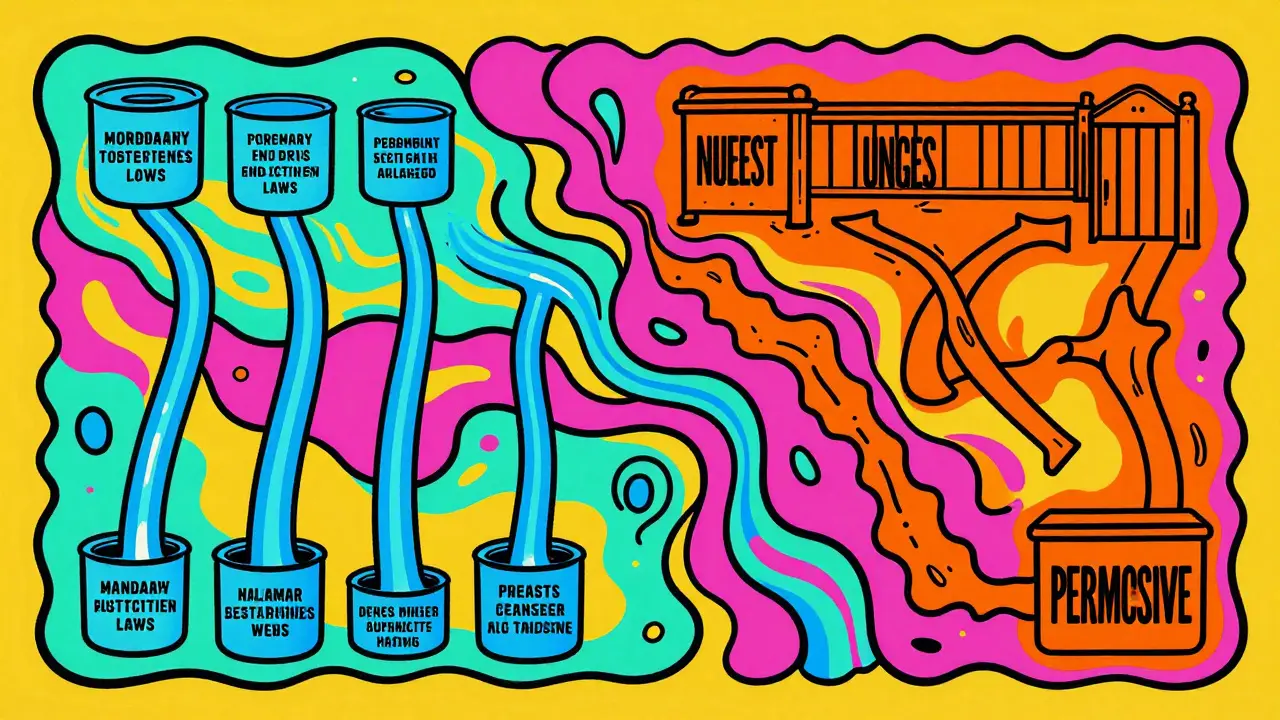
Not all states handle substitutions the same way. You can think of them as falling into two main buckets: mandatory and permissive. Understanding which bucket your state falls into helps you predict what happens when you hand over a prescription.
In mandatory states, the rule is simple: if a generic exists, the pharmacist must substitute it unless the doctor writes "dispense as written." Research published in JAMA Internal Medicine shows 19 states operate under this mandatory model. This pushes utilization rates higher because the default action is saving money.
Permissive states take a different approach. Here, substitution is allowed, but not required. There are 31 states plus D.C. in this camp. Pharmacists have discretion, often leading to slower adoption of generics. While patients get more choice, they also lose out on potential savings if the pharmacist chooses to dispense the brand name for convenience.
| Feature | Mandatory States (19) | Permissive States (31 + DC) |
|---|---|---|
| Default Action | Auto-substitute | Discretionary |
| Patient Consent | Rarely required | Often required |
| Cost Impact | Lower average costs | Higher variance |
The Biosimilar Complexity
Things get much trickier when we move from standard pills to biologics. Small-molecule generics (like ibuprofen copies) have clear rules. Biosimilars, which copy complex protein drugs, face stricter hurdles in most jurisdictions. As of late 2025, roughly 45 states impose stricter requirements for biosimilars compared to traditional generics.
Biosimilars are biological products highly similar to an approved innovator product. Unlike simple chemical copies, they require distinct regulatory approaches due to their molecular complexity, often needing specific physician notification protocols that differ from standard generic substitution.California, for instance, requires pharmacists to notify prescribers electronically within five days of substituting a biologic. In other states, there is no notification requirement at all. This gap creates safety risks. If a doctor doesn't know you switched to a biosimilar, they might not monitor you correctly for immune reactions.
A 2025 report by Avalere Health noted that none of the 56 U.S. jurisdictions treat biosimilars identically to small-molecule generics. This fragmentation makes it hard for pharmacies practicing across state lines. They essentially manage a maze of 50-plus different rule sets for one type of drug class.

Consent and Notification Rules
Who decides if you get the generic you? In many states, the answer isn't straightforward. Seven states plus D.C. require explicit patient consent before any substitution occurs. This protects patient autonomy but slows down access. If you are in one of these states, expect paperwork or a digital signature confirmation during the pickup process.
Notification requirements show even more variation. Some states demand the pharmacist tell you verbally and provide written info. Others rely solely on the drug label. A study found that 31 states mandate independent patient notification beyond the package insert. Without this, patients might show up with a bottle thinking it's the brand, only to find a different manufacturer.
Liability is another hidden factor. In 26 states, pharmacists enjoy explicit legal protection when substituting according to the law. However, 24 states offer no such shield. In those unprotected zones, pharmacists might refuse valid substitutions for high-risk meds like warfarin out of fear of lawsuits, even if clinically safe.
Federal References and State Variations
How do pharmacists know what to swap? They mostly look at the FDA Orange Book. It lists therapeutic equivalence ratings. But 18 states incorporate criteria beyond just the Orange Book. For example, New York permits substitution based on broader therapeutic determinations, while California sticks rigidly to the federal list.
FDA Orange Book is the official publication containing approved drug products and their therapeutic equivalence evaluations, serving as the primary reference for determining when generic substitution is legally permitted. It was established under the Hatch-Waxman Act in 1984.Oklahoma represents a unique outlier. It mandates explicit prescriber authorization for almost any change. This makes Oklahoma effectively non-automatic for most generics. Conversely, Florida uses a positive formulary system identifying specific eligible generics, whereas Pennsylvania uses a negative list banning certain ones. These formulary structures dictate daily workflow.

Economic Impact and Compliance Costs
The economic reality of these laws is stark. States with mandatory substitution see 8.7% higher generic utilization rates. On average, per capita prescription costs are $55 lower in these areas compared to permissive states. However, maintaining compliance is expensive. Pharmacy chains spend about $1.2 million annually per state to update their systems and train staff.
This fragmentation hurts smaller players. Independent pharmacies report 68% more substitution errors than large chains. They lack the expensive software needed to track 50 different regulatory regimes. When technology fails, patients bear the risk. Errors involving incorrect substitution account for nearly a quarter of medication mistakes in states lacking adequate notification protocols.
Trends Toward Harmonization
Is there hope for uniformity? There is momentum. The National Association of Boards of Pharmacy launched a project in January 2024 aiming to consolidate 51 unique frameworks into three regional models by 2027. This would drastically reduce the administrative burden.
Furthermore, Congress is considering federal preemption options. The CBO estimates harmonized laws could generate $14.3 billion in savings over a decade. Yet, political hurdles remain. Pharmacy practice has traditionally been a state responsibility. Until 2026 or 2027, you still need to navigate this patchwork yourself.
Do pharmacists always need my permission to substitute a generic?
No. Only in seven states plus D.C. is explicit patient consent legally required. In most other locations, pharmacists may substitute automatically unless your doctor explicitly forbids it by writing "dispense as written."
What is the difference between small-molecule and biosimilar substitution?
Small-molecule generics are simple chemical copies with lenient rules. Biosimilars are complex biological products. Roughly 45 states have much stricter notification and consent rules for biosimilars to ensure patient safety regarding immune responses.
Can my doctor stop me from getting a cheaper generic?
Yes. Doctors can instruct pharmacists not to substitute by marking the prescription "Dispense as Written" or using state-specific codes. This blocks the pharmacist from legally switching to the generic option.
Does state matter if I have insurance?
Absolutely. Even with private insurance, state laws override plan formularies. Some insurance plans allow the brand while the state law forces the generic, or vice versa, leading to coverage denials if you don't comply.
Will these 50-state laws change soon?
There is ongoing work to harmonize laws into regional models by 2027. However, until then, each state retains its own specific requirements. You must assume local rules apply until federal preemption happens.

Monique Ball
It is absolutely fascinating how complex the regulations are for something as basic as filling a prescription 🧪. We often take for granted the administrative hurdles behind our medication bottles 💉. The distinction between small molecule generics and biosimilars is particularly critical in healthcare safety protocols 🔒. Patients deserve clarity on why their costs fluctuate depending on geography alone 📍. Pharmacists navigate a minefield of fifty different legal jurisdictions daily without enough tools 🗺️. Mandatory substitution frameworks seem like they promote better health outcomes overall 📈. However, permissive states allow more autonomy which can be double edged sword ⚖️. Notification rules vary wildly and this creates safety gaps for vulnerable populations 👶. Biosimilar substitution requires stricter oversight due to immune response risks 🧠. California leads the way with electronic notification protocols for doctors 📱. Independent pharmacies struggle significantly more than large chains due to compliance software costs 💸. Small businesses report higher error rates when managing these fragmented rulesets 📉. Harmonization efforts by NABP offer hope for a simpler future soon 🙎. We need federal preemption to reduce the administrative burden on everyone involved 🏛️. Until then patients must stay vigilant about their own medication choices 🕵️♀️.
Aaron Olney
OMG this is so crazy why we live in such a messy system! The confusion is totally overwhelming and makes me want to scream sometimes. I thought all laws were the same everywhere until i read this stuff. It is insane that pharmacists have to know all these rules. Generic savings mean nothing if you get the wrong pill. My cousin had trouble in oklahoma recently and the doctor fought the pharmacy hard. Just dont trust anything until you check your bottle yourself!
Sabrina Herciu
That is actually quite understandable considering the regulatory environment!!! Oklahoma has very specific prescriber authorization requirements indeed!!!! There are several layers of protection built into the mandatory notification systems!!!!! You really need to verify therapeutic equivalence ratings before assuming interchangeability!!!!! Safety protocols are designed for patient welfare first!!!!!
Philip Wynkoop
pretty wild how each state does things differently ☺️
Jeannette Kwiatkowski Kwiatkowski
Honestly the average person cant grasp these nuances lol. Only people with policy degrees get this kind of stuff right. The economic data is skewed mostly because insurance companies lie about formulary lists. Its just corporate power protecting brand margins from the cheap alternatives. Stop pretending this is about patient choice really.
gina macabuhay
Such arrogance assumes all patients are capable of understanding this complexity immediately. You ignore the vulnerable populations who rely on mandatory substitutions for survival. Profit motives always drive these discussions rather than genuine care for public health standards. Ethical responsibility demands transparency beyond simple cost savings arguments. Dismissing independent pharmacy struggles shows a lack of empathy for local business owners.
Paul Vanderheiden
its really great that harmonization is coming soon! i love seeing progress towards unified regional models by 2027. saving fourteen billion dollars sounds amazing for the whole country. we should all be excited about reducing bureaucracy together. keep up the good work researchers on these trends!
Sophie Hallam
It is encouraging to see movement toward standardization across jurisdictions. While change takes time the current fragmentation causes real financial strain. Finding a balance between patient autonomy and system efficiency remains challenging. Continued dialogue helps clarify these distinctions for everyone involved.
Richard Kubíček
The tension between state sovereignty and national health efficiency defines modern pharmacy practice deeply. Federalism allows localized solutions but creates the patchwork described. Perhaps the solution lies in technology rather than legislation alone eventually. Digital record keeping could bypass many physical substitution barriers effectively. Human error decreases significantly when systems handle logic instead of memory.
Rohan Kumar
yeah right 🙄 big pharma wants you to think this is about patient safety. its just another way to lock in prices while pretending to save money 🤡. nobody actually checks the orange book honestly 🤷♂️. they just push whatever is cheapest for their own bonus 🛂. typical government incompetence as usual 😞.
Poppy Jackson
Dont give up hope for us all! 🌟 Change is hard but we need it for our families. The news about regional models gives us light in dark times. Keep trusting the process even when it feels slow today ❤️.
Austin Oguche
Many international jurisdictions face similar regulatory challenges regarding pharmaceutical substitution protocols. Canada operates under a different framework compared to the United States model entirely. Learning from global best practices could inform domestic policy improvements here. Respect for state autonomy remains a core principle though difficult to navigate efficiently. Collaboration across borders benefits public health outcomes globally.