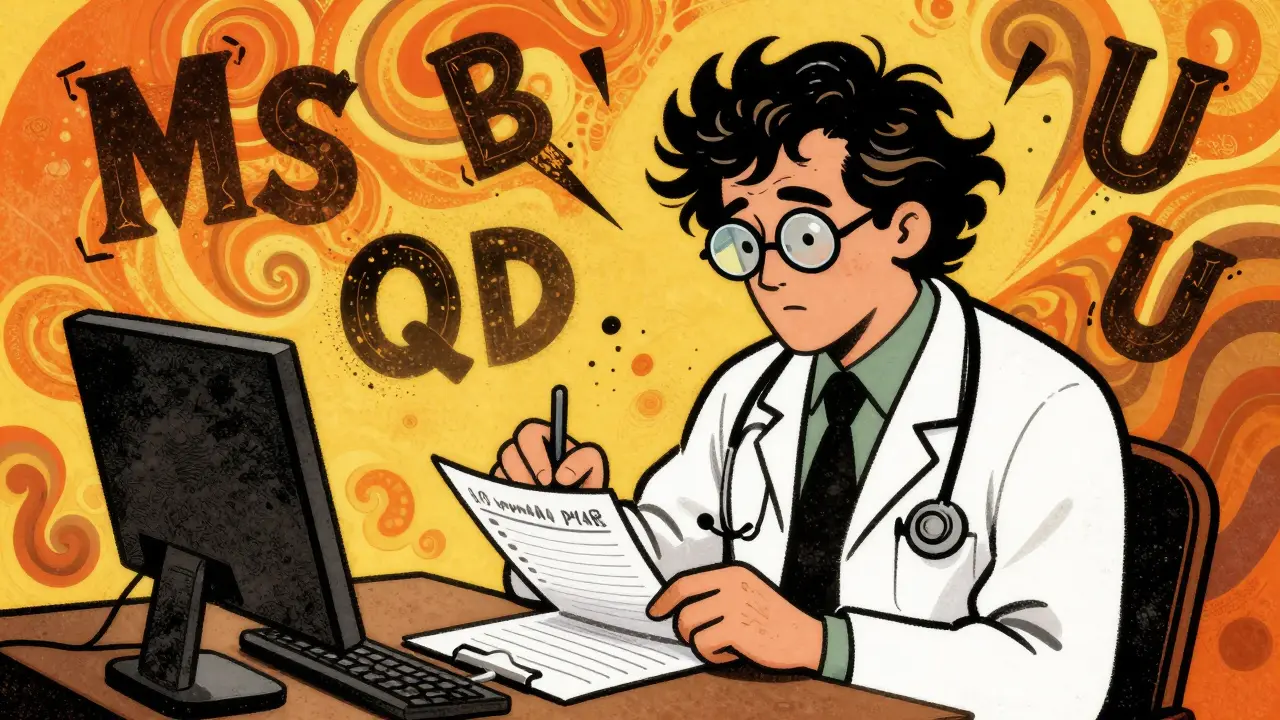
Imagine you are in pain. You need morphine. The doctor writes "MS" on the prescription pad. But when the nurse reads it, she sees "magnesium sulfate." You get the wrong drug. This isn't a movie plot; it is a real risk that happens because of dangerous medical abbreviations. These short cuts in writing can lead to serious dispensing errors, harming patients who trust the system to keep them safe.
We use abbreviations to save time. In medicine, however, saving seconds can cost lives. Organizations like The Joint Commission and the Institute for Safe Medication Practices (ISMP) have created a strict "Do Not Use" list. This list bans specific symbols and letters that are too easy to misread. If you are a patient, knowing these risks helps you double-check your meds. If you are a healthcare worker, ignoring this list puts everyone at risk. Let’s look at why these shortcuts are so dangerous and how we can stop the errors before they happen.
The Most Dangerous Abbreviations You Must Never Use
Not all abbreviations are bad, but some are notoriously risky. The Joint Commission’s "Do Not Use" list focuses on items that cause the most confusion. Here are the biggest offenders that you should avoid completely.
| Abbreviation | Intended Meaning | Why It Is Dangerous |
|---|---|---|
| QD | Once daily | Easily mistaken for qid (four times daily). This can lead to a four-fold overdose. |
| QOD | Every other day | Often confused with QD or qid. Patients may take medication every day instead of skipping days. |
| U | Unit | Looks like the number zero (0), the number four (4), or the letter cc. Writing "10 U" might be read as "10" or "10 cc". |
| cc | Cubic centimeters | Can be misread as the unit abbreviation "u" or the Roman numeral CCL (150). Always use mL instead. |
| MS or MSO4 | Morphine Sulfate | Frequently confused with MgSO4 (Magnesium Sulfate). One is a painkiller; the other treats seizures or pre-eclampsia. |
| SC or SQ | Subcutaneous | Can be mistaken for SL (sublingual) or even "5 every" if handwriting is poor. |
These examples show why clarity matters. A simple letter change turns a dose into an overdose or a painkiller into a different chemical entirely. The ISMP reports that ambiguous abbreviations contribute significantly to preventable adverse drug events. By banning these specific terms, we remove the guesswork from prescribing.
Why Handwriting and Context Create Chaos
You might think, "I write clearly enough." But context changes everything. When a pharmacist scans hundreds of prescriptions a day, fatigue sets in. A quick glance at "TAC" might look like "Tazorac" if the 'C' is looped slightly. TAC stands for triamcinolone, a steroid cream. Tazorac is a retinoid for acne. Using the wrong one can severely irritate a patient's skin.
Drug name abbreviations are particularly high-risk. For example:
- AZT: Intended for zidovudine (an HIV drug), but often mistaken for azathioprine or aztreonam.
- DTO: Stands for diluted tincture of opium, but can be confused with morphine sulfate.
- NMT: Can mean "no more than" or "nebulizer mist treatment." In one case, this led to a near-miss with hypertonic saline administration.
The problem isn't just the letters; it's the lack of standardization. Before electronic health records (EHRs) became common, handwritten notes were the norm. Even now, free-text fields in digital systems allow doctors to type these banned abbreviations. A 2021 study found that while EHRs reduced abbreviation-related errors by over 68%, nearly 13% of errors still involved misinterpretation due to sloppy typing or voice-to-text errors.
The Role of Electronic Health Records in Safety
Technology is our best defense against these errors. Modern EHR systems can block dangerous abbreviations before they reach the pharmacy. This is called a "hard stop." If a doctor tries to type "QD," the system forces them to select "once daily" from a dropdown menu.
However, technology is not perfect. Voice recognition software, which many doctors use to dictate notes, can still mishear commands. If a doctor says "units," the software might transcribe it as "U." As of 2023, major systems like Epic are rolling out AI tools to detect and correct these issues in real-time. By 2026, it is projected that 85% of major EHR systems will automatically correct prohibited abbreviations during voice dictation.
Despite these advances, human behavior remains a hurdle. A survey showed that nearly 44% of physicians over age 50 continued using prohibited abbreviations despite institutional policies. Older clinicians are often set in their ways. Changing culture takes longer than changing software. That is why education and enforcement must go hand in hand.
How Healthcare Facilities Implement Safety Protocols
Implementing the "Do Not Use" list is not just about posting a sign on the wall. It requires a structured approach. Successful programs typically follow a 6-8 week cycle:
- Policy Development (Weeks 1-2): Hospitals update their EHR systems to ban the abbreviations. This costs between $12,500 and $28,000 for mid-sized facilities.
- Education (Weeks 3-4): Mandatory training sessions for all staff. Pharmacists, nurses, and doctors must understand why "cc" is replaced by "mL" and why "U" becomes "unit."
- Phased Enforcement (Weeks 5-8): Systems start with "soft stops" (warnings) and move to "hard stops" (blocks). Immediate feedback mechanisms help staff adapt.
The results speak for themselves. Facilities that implemented full prohibition lists with mandatory education saw an 89.4% reduction in abbreviation-related errors within 18 months. The Mayo Clinic reported a 92.3% drop after combining EHR restrictions with real-time feedback.
But it’s not always smooth sailing. Nurses often report initial confusion, especially when switching from "cc" to "mL." Doctors complain about slower workflow during the first few weeks. However, data shows that processing time returns to normal after six months. The short-term inconvenience is worth the long-term safety gains.
What Patients Can Do to Protect Themselves
You don’t need to be a pharmacist to catch these errors. As a patient, you are the final check in the chain. Here is how you can stay safe:
- Read the Label: If your prescription bottle says "take QD," ask your pharmacist to clarify. It should say "once daily."
- Check Drug Names: Ensure the name matches what your doctor told you. If you expect morphine but see magnesium, speak up immediately.
- Ask Questions: Never hesitate to ask, "Is this written correctly?" Pharmacists appreciate the double-check. In fact, 63.7% of pharmacists have intercepted at least one dangerous abbreviation error in the past year.
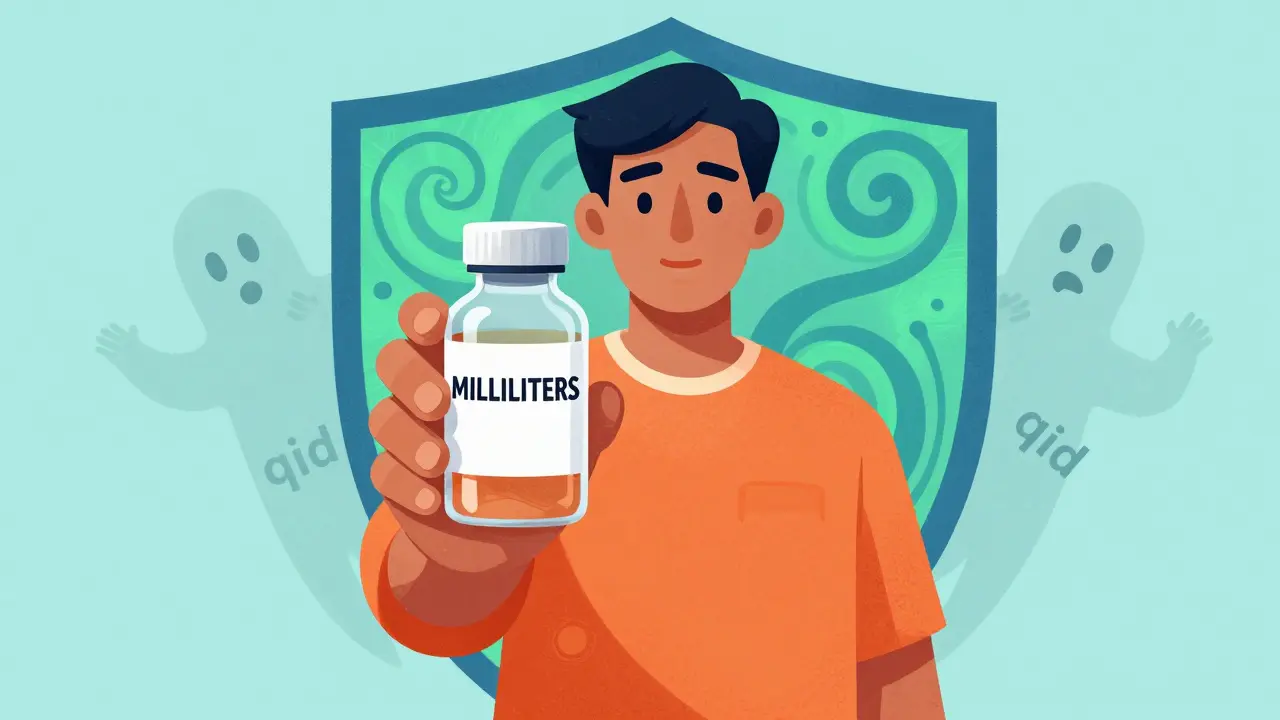
- Use Full Terms: When discussing your meds with providers, use full words. Say "milliliters" instead of "ccs" and "units" instead of "Us."
Remember, silence can be dangerous. If something looks odd, it probably is. Your advocacy can prevent a hospital admission or worse.
Global Standards and Future Directions
This isn't just a US issue. The push for clear communication is global. Canada has its own ISMP guidelines. The UK’s NHS issued a Safer Practice Notice in 2021. Australia’s Commission on Safety and Quality in Health Care updated its guidelines in 2022. All these bodies agree: ambiguity kills.
The economic impact is huge. Preventing these errors saves approximately $1.27 billion annually in the US alone. Regulatory bodies like CMS (Centers for Medicare & Medicaid Services) now tie reimbursement rates to safety metrics. Hospitals with high rates of abbreviation-related errors face financial penalties.
Looking ahead, AI will play a bigger role. New algorithms are being trained to spot risky patterns in prescriptions instantly. But until then, the human element remains critical. We must continue to enforce the "Do Not Use" list strictly. There is no room for "good enough" when patient lives are on the line.
What is the Joint Commission "Do Not Use" list?
It is a standardized list of prohibited abbreviations, acronyms, and symbols established by The Joint Commission and ISMP to prevent medication errors. Healthcare organizations must implement this list to maintain accreditation. It includes items like QD, U, cc, and MS.
Why is "QD" considered dangerous?
QD stands for "quaque die" (once daily). It is frequently misread as "qid" (quater in die, or four times daily). This confusion can lead to a patient taking four times the intended dose, resulting in severe overdose.
Should I use "cc" or "mL" for volume?
You should always use "mL" (milliliters). "cc" (cubic centimeters) can be misread as "u" (units) or the Roman numeral CCL (150). Using mL eliminates this ambiguity.
What is the difference between MS and MgSO4?
MS usually stands for Morphine Sulfate, a potent opioid painkiller. MgSO4 stands for Magnesium Sulfate, used for conditions like seizures or pre-eclampsia. Confusing these two can lead to fatal outcomes if the wrong drug is administered.
How do electronic health records help prevent these errors?
EHRs can enforce "hard stops" that prevent doctors from typing banned abbreviations. They force the use of full terms like "once daily" or "unit." Studies show EHRs reduce abbreviation-related errors by over 68% compared to handwritten orders.
Are there any abbreviations that are safe to use?
Many abbreviations are safe if they are unambiguous and widely accepted, such as "IV" for intravenous or "PO" for by mouth. However, it is always best practice to write out full terms whenever possible to ensure clarity.
What should I do if I see a dangerous abbreviation on my prescription?
Contact your pharmacist or prescriber immediately. Ask them to clarify the instruction. Do not assume you know what it means. Pharmacists are trained to catch these errors and will gladly correct them for your safety.
