
Most people think their therapy copay is the full price. You see $30 on your insurance card, book a session, and assume that’s it. But what if that $30 is just the tip of the iceberg? What if you’re actually paying hundreds-or even thousands-more before your insurance even kicks in? The truth is, your copay tells you almost nothing about the real cost of therapy. To know what you’ll actually spend, you need to look at the whole picture: deductibles, coinsurance, out-of-pocket maximums, session frequency, and whether your therapist is in-network or not.
Understanding Your Insurance Plan Type
Not all insurance plans work the same way. There are three main structures that determine how much you pay for therapy: copay plans, deductible plans, and coinsurance plans. Knowing which one you have changes everything.Copay plans are the simplest. You pay a fixed amount per session-say $30 or $50-and your insurance covers the rest. Sounds easy, right? But only if you’ve already met your deductible. Many copay plans require you to pay full price until you hit your deductible. So if your deductible is $1,500 and each session costs $125, you’ll pay $125 for the first 12 sessions before your $30 copay even applies. That’s $1,500 before you see any insurance help.
Deductible plans mean you pay 100% of the cost until you reach your annual deductible. This is where people get shocked. A $1,500 deductible sounds manageable-until you realize you’re paying $125 per session and need 12 sessions just to get to the point where your copay kicks in. If you’re in therapy for 20 sessions, you’re paying full price for half your treatment.
Coinsurance plans are the trickiest. After you meet your deductible, you pay a percentage of the cost-usually 20% to 40%. Let’s say your therapist charges $125 per session, your deductible is $1,500, and your coinsurance is 20%. After paying $1,500 for 12 sessions, you pay 20% of $125, which is $25 per session. But here’s the catch: the $125 is the allowed amount your insurance agrees to pay. If your therapist charges $175, you might owe the difference. And if you go out-of-network? You could be paying 40-50% of the full fee, even after your deductible.
In-Network vs. Out-of-Network: The Hidden Cost Difference
Choosing an in-network therapist isn’t just about convenience-it’s about money. In-network providers have agreed to accept your insurance’s negotiated rate. That means your $125 session might be capped at $125 by your insurer. Out-of-network therapists don’t have that agreement. They can charge whatever they want, and your insurance might only cover a portion based on what they consider “usual and customary.”For example, if your out-of-network benefit is 60% coverage after your deductible, and your therapist charges $200 per session, your insurance might only recognize $140 as the allowed amount. You’d pay $80 (40%) of $140, plus the $60 difference. That’s $140 out of pocket per session-almost triple what you’d pay in-network.
Thriveworks’ 2024 data shows therapy costs vary wildly by location: $176 per session in New York, $227 in North Dakota. So even if your coinsurance rate is the same, your actual cost depends on where you live. A 20% coinsurance in New York is $35.20. In North Dakota, it’s $45.40. That’s over $100 extra per month if you’re seeing someone weekly.
How Many Sessions Do You Really Need?
Most people assume therapy lasts a few months. But research from Grow Therapy shows that 50% of patients need 15 to 20 sessions to see real improvement. For complex conditions like PTSD or chronic anxiety, it can be 30+ sessions. That’s not a one-off expense-it’s a year-long financial commitment.If you’re paying $40 per session after your deductible, and you need 20 sessions, that’s $800. But if you haven’t met your deductible yet? You’re paying $125 x 12 = $1,500 before you even get to the $40 copay. Total? $1,820 for 20 sessions. That’s not $800. That’s $1,820.
And if you’re on coinsurance? Let’s say your total therapy cost over the year hits $30,000. You pay your $3,000 deductible, then 20% of the remaining $27,000-that’s $5,400. Your total out-of-pocket? $8,400. That’s not a monthly bill. That’s a yearly financial shock.
Out-of-Pocket Maximum: The Safety Net You Might Not Know About
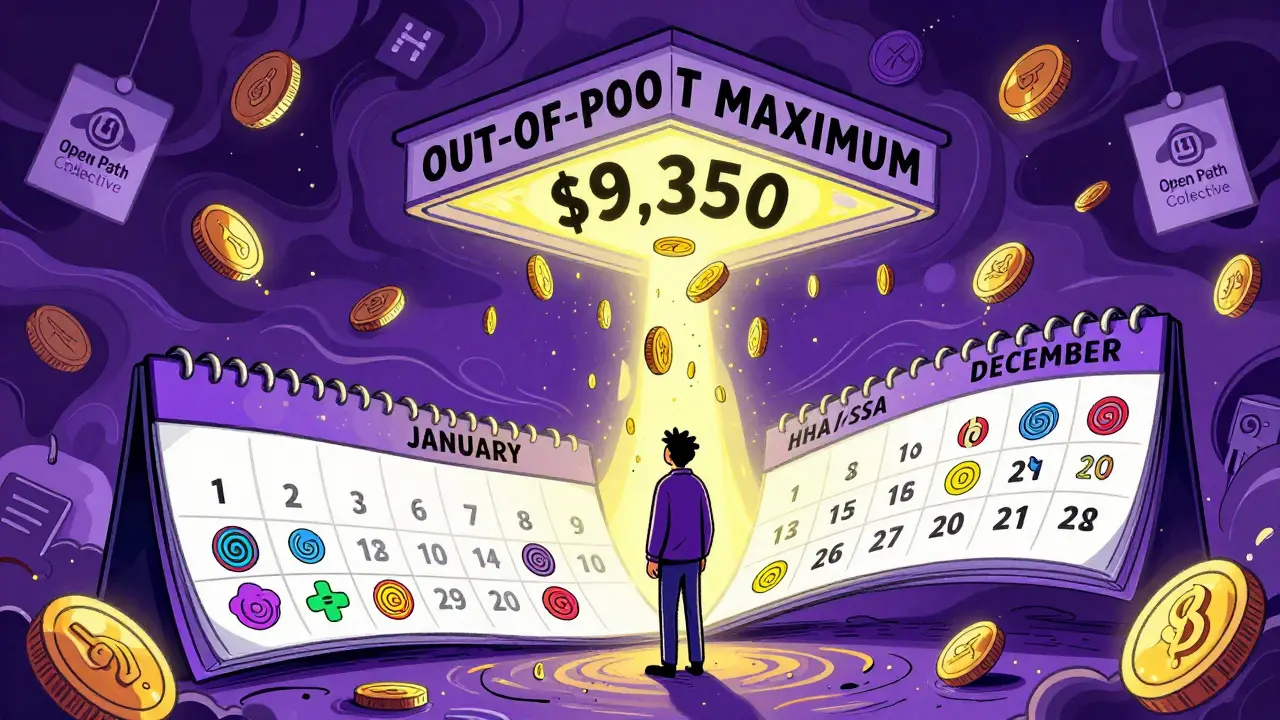
Every insurance plan has an out-of-pocket maximum. In 2024, the cap for individual plans is $9,350. For families, it’s $18,700. Once you hit that number, your insurance pays 100% of covered services for the rest of the year.This is your ceiling. No matter how many sessions you need, you won’t pay more than that. But here’s the catch: not all services count toward the same deductible. Some plans have separate deductibles for medical and mental health care. That means you could hit your medical deductible but still be paying full price for therapy.
And don’t forget: your monthly premium doesn’t count toward your out-of-pocket maximum. You’re paying that whether you use therapy or not. So if your premium is $400 a month, that’s $4,800 a year just to have the plan. Add $9,350 in out-of-pocket costs? You’re spending $14,150 just to access therapy.

Medicare, Medicaid, and Other Public Plans
If you’re on Medicare, your costs are different. Medicare covers 80% of therapy sessions, so you pay 20%. With the average session at $143, that’s about $28.65 per visit. But if you don’t have a Medigap Plan G, you’re still responsible for the Part B deductible ($240 in 2024) and the 20% coinsurance. That means you could pay $240 upfront, then $28.65 per session until you hit your out-of-pocket maximum.Medicaid plans vary by state, but most have little to no copay for therapy. In many cases, you’ll pay nothing. But eligibility is tight. If you’re not on Medicaid, don’t assume you’re covered.
What If You Don’t Have Insurance?
About 42% of private practice therapists offer sliding scale fees based on income. That means you might pay $40-$70 per session instead of $125-$200. Platforms like Open Path Collective connect uninsured people with therapists who charge $40-$70 per session. University training clinics-staffed by supervised grad students-often charge 50-70% less than market rates.These aren’t “cheap alternatives.” They’re legitimate, effective options. But they require research. You can’t just call your insurance company-you have to search for them. And availability is limited. You might need to wait weeks for an opening.
How to Calculate Your Real Therapy Cost: A Step-by-Step Guide
Here’s how to build your own therapy budget:- Find your plan type. Call your insurer or log into your portal. Ask: “Is my mental health coverage subject to a deductible? Is it coinsurance or copay?”
- Confirm your deductible. How much have you paid so far this year? How much is left?
- Know your allowed amount. Ask your therapist what they charge and what your insurance allows. If they’re out-of-network, ask what your plan pays.
- Estimate your sessions. Are you planning 12 sessions? 20? 30? Be realistic.
- Break it into phases.
- Phase 1 (pre-deductible): Pay full price until deductible is met.
- Phase 2 (post-deductible): Pay copay or coinsurance.
- Phase 3 (post-maximum): Pay nothing.
- Add extras. Transportation, time off work, childcare-these aren’t billed, but they cost money.
Example: You have a $1,500 deductible, $40 copay after deductible, and need 20 sessions at $125 each.
- First 12 sessions: $125 x 12 = $1,500 (deductible met)
- Next 8 sessions: $40 x 8 = $320
- Total: $1,820
Without insurance? $2,500. With insurance? $1,820. That’s a $680 saving. But only if you knew to look beyond the copay.
Tools That Actually Help
You don’t have to do this alone. Use these tools:- Alma’s Cost Estimator-enter your insurance and therapist to see your exact out-of-pocket cost.
- Rula’s cost estimator-shows average session costs based on your plan.
- Your insurer’s portal-check your deductible status and allowed amounts.
- GoodRx-compare therapy prices and find discounts.
These aren’t just nice-to-haves. They’re essential. Nearly 40% of patients are blindsided by their first therapy bill because they didn’t check.
When to Time Your Therapy
Insurance plans reset on January 1. If you’re planning long-term therapy, start in January. That gives you a full year to hit your deductible and max out your out-of-pocket limit. If you start in June, you’ll pay full price for the rest of the year, then start over in January. That doubles your cost.Also, if you’re getting other medical care-physical therapy, prescriptions, lab tests-schedule those early. All covered services count toward your deductible. One MRI could knock out half your therapy deductible before you even book your first session.
Final Thought: Therapy Is an Investment-But Only If You Plan for It
Therapy works. But it’s not cheap. And if you don’t understand how your insurance really works, you’ll either skip it-or get hit with a bill you can’t afford. The copay is just a number on a card. The real cost is the sum of your deductible, your coinsurance, your session frequency, and your location. Don’t guess. Calculate. Use the tools. Ask questions. Know what you’re signing up for. Because mental health isn’t optional. But financial stress shouldn’t be part of the price.Is my therapy copay the only thing I pay?
No. Your copay is only what you pay after you’ve met your deductible. Before that, you pay the full session cost. Even after meeting your deductible, you might pay coinsurance (a percentage) instead of a fixed copay. And if you go out-of-network, you could pay even more.
What’s the difference between a deductible and an out-of-pocket maximum?
Your deductible is the amount you pay before your insurance starts sharing costs. Your out-of-pocket maximum is the most you’ll pay in a year for covered services-including deductibles, copays, and coinsurance. Once you hit that cap, your insurance pays 100% for the rest of the year. Deductibles reset annually; out-of-pocket maximums do too.
Do all medical expenses count toward my mental health deductible?
Not always. Some insurance plans have separate deductibles for medical and mental health services. Others combine them. You need to check your plan details. If your plan has a separate mental health deductible, only therapy and psychiatric visits count toward it. Other medical bills won’t help you reach it faster.
Can I use my HSA or FSA to pay for therapy?
Yes. Therapy is a qualified medical expense under both Health Savings Accounts (HSAs) and Flexible Spending Accounts (FSAs). You can use pre-tax dollars from these accounts to pay for copays, coinsurance, or full session fees-even if you haven’t met your deductible yet.
What if I can’t afford therapy even with insurance?
Many therapists offer sliding scale fees based on income. Platforms like Open Path Collective provide sessions for $40-$70 to uninsured or underinsured people. University training clinics also offer low-cost therapy through supervised students. Check with local community health centers-they often have mental health programs with reduced rates.
Does Medicare cover therapy?
Yes. Medicare Part B covers 80% of the cost for outpatient therapy after you meet your annual deductible ($240 in 2024). You pay the remaining 20%. If you have a Medigap Plan G, it covers that 20% coinsurance, so you pay nothing out of pocket beyond your Part B premium.
How many therapy sessions are typical before I see results?
Most people start seeing improvement after 8-12 sessions. For lasting change, 15-20 sessions are common. For complex conditions like trauma or chronic depression, 30+ sessions may be needed. Don’t assume therapy is short-term-plan your budget for the long haul.

Nina Stacey
Okay but like... I just found out my deductible was $2k and I’ve been paying $150 a session for 6 months thinking I was covered? I’m crying in the parking lot after my last session. This post saved me from financial ruin. Thanks for actually explaining it like a human.
mary lizardo
It is lamentable that the general populace remains so woefully uninformed regarding the structural mechanics of health insurance. The notion that a copay constitutes the totality of one’s financial obligation is not merely erroneous-it is indicative of a systemic failure in public financial literacy.
jessica .
They don’t want you to know this. Insurance companies and therapists are in cahoots. Why do you think they hide the real cost? It’s all part of the medical-industrial complex. They want you broke so you’ll take the cheap meds and stop talking about your trauma.
Sajith Shams
You Americans think insurance is magic. In India, we pay cash and get real rates. No deductibles, no coinsurance, no bullshit. Just tell the therapist your income and they adjust. Simple. Your system is broken because you outsource everything to corporations.
Erica Vest
Important note: HSA/FSA funds can be used for therapy even before meeting your deductible. Also, some plans count out-of-network payments toward your out-of-pocket maximum even if they don’t count toward your deductible. Always ask for a breakdown of what counts toward what. Many people miss this.
Chris Davidson
Stop wasting money on therapy. Just meditate. Or journal. Or go for a walk. You think you need a professional to tell you to breathe? The system is rigged to make you dependent. I’ve been trauma-free for 8 years without a single session.
Glen Arreglo
As someone who moved from the Midwest to Canada, I can tell you the difference in access is night and day. Here, I pay $10 per session with my provincial plan. No deductibles. No coinsurance. No guesswork. Maybe we should stop pretending the US system is normal.
Matt Davies
This post is the emotional equivalent of finding a $20 bill in last winter’s coat. I’ve been tiptoeing around therapy costs like they’re landmines. Now I’ve got a map. I’m actually gonna book that next session instead of ghosting my therapist like a bad Tinder date. Thank you.
mark shortus
I just got a bill for $3,200 and I thought I was covered. My therapist said ‘Oh yeah, you’re out-of-network.’ I screamed into my pillow for 45 minutes. My cat left the room. My dog cried. My therapist sent me a ‘we’re here for you’ email. I deleted it. I’m not okay. I’m not okay.
Takeysha Turnquest
Therapy isn’t just a cost-it’s a ritual of self-reclamation. The money you pay isn’t for time, it’s for the sacred space where your soul stops screaming long enough to whisper. The system tries to commodify healing. But you? You’re not a transaction. You’re a miracle trying to survive capitalism.
Jedidiah Massey
Bro, if you’re paying over $100/session and not using an HSA/FSA, you’re doing it wrong. Also, Alma’s estimator is 97% accurate if you input your plan ID correctly. I’ve saved $1,800 just by using their tool. 🤑🧠
Kitt Eliz
YESSSSS!!! I’ve been screaming this from the rooftops! 🙌 Use Open Path Collective. I got 16 sessions for $50 each. My therapist is a grad student from UBC. She’s brilliant. I cried in session #3 and she didn’t flinch. 💪❤️ Also-start therapy in JANUARY. I did it in March and paid double. Don’t be me. 🚨