Imagine a simple mistake: a nurse reads a label quickly and gives a patient 10mg of a drug instead of 1mg, or a grandparent forgets they already took their blood pressure pill and takes a second dose. These aren't just "oops" moments; they are medication errors that can lead to permanent injury or even death. According to the World Health Organization, these preventable events cost the global economy about $42 billion every year. Whether you are a patient, a caregiver, or a healthcare worker, the goal is the same: getting the right drug to the right person in the right dose at the right time.
The Real Cost of Medication Mistakes
We often think of medical errors as rare occurrences, but the data tells a different story. In the United States alone, it's estimated that at least 1.5 million people are harmed annually by medication mistakes. Historically, the 1999 "To Err is Human" report was the wake-up call that revealed thousands of deaths were happening annually due to avoidable drug errors. Today, the risk is still high, particularly for people taking five or more medications-a situation known as polypharmacy-which increases the chance of an error by about 30%.
For those over 75, the risk jumps even higher. Many of these errors happen during "transitions of care," like when a patient is discharged from a hospital to their home. If the home doctor doesn't know exactly what the hospital gave the patient, or if the patient is confused about new dosages, the risk of a dangerous interaction skyrockets.
How Hospitals are Fighting Errors with Tech
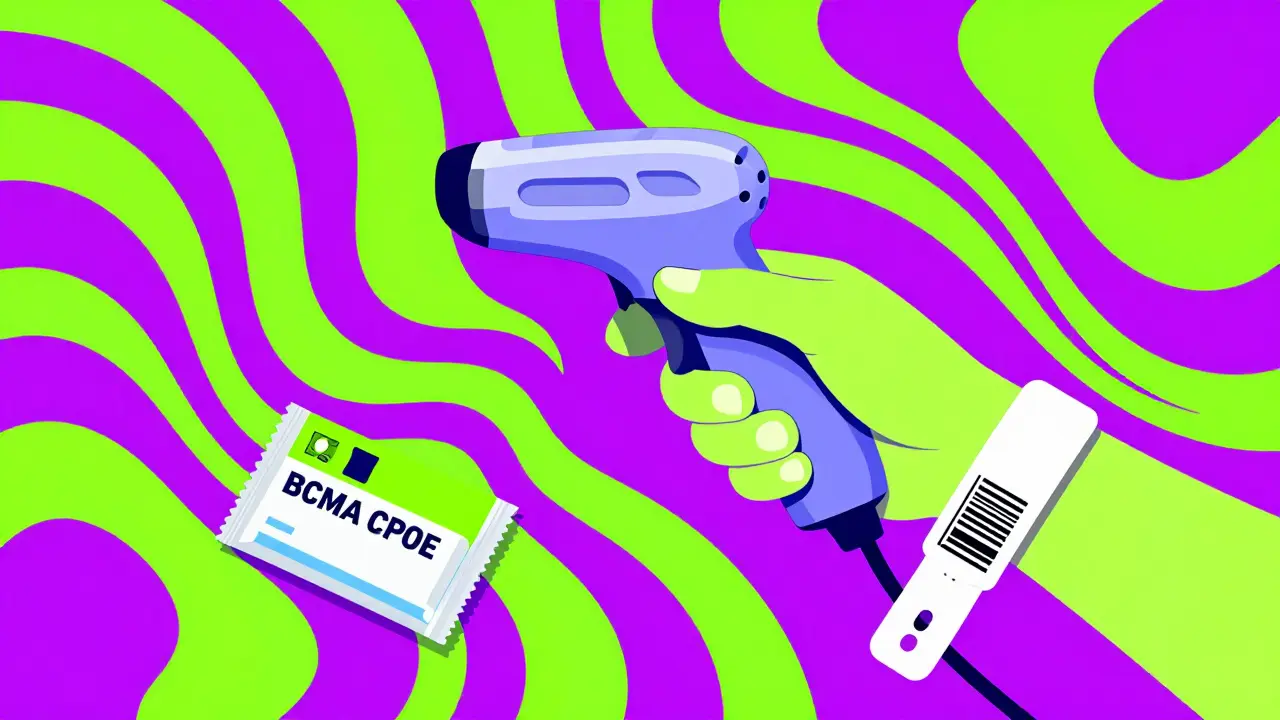
Hospitals have moved away from relying solely on human memory. They now use a combination of software and hardware to create a safety net. One of the most effective tools is Barcode Medication Administration (or BCMA) is a system where clinicians scan a barcode on the patient's wristband and the medication packaging before administration. This ensures the "Five Rights" are met: right patient, right drug, right dose, right route, and right time.
The impact of BCMA is massive. Recent data shows it can cut dispensing error rates by nearly 44%. Specifically, it's a powerhouse for preventing "wrong drug" errors, reducing them by nearly 57%, and almost eliminating monitoring errors entirely. However, tech isn't perfect. Some nurses report "alert fatigue," where the constant beeping of the system becomes background noise, leading some to find workarounds that can actually introduce new risks.
Another critical layer is Computerized Physician Order Entry (or CPOE) is a digital system that replaces handwritten prescriptions with electronic orders, often including automated checks for drug interactions. When CPOE is paired with clinical decision support, it can reduce errors by at least 50% in hospital settings by flagging dosages that are too high or medications that clash with a patient's allergies.
| Technology | Primary Function | Error Reduction Rate | Main Drawback |
|---|---|---|---|
| BCMA | Bedside verification via scanning | ~44% overall reduction | Workflow delays & alert fatigue |
| CPOE | Digital prescribing & order entry | Up to 50% reduction | Implementation complexity |
| Medication Reconciliation | Comparing lists during transitions | High for transitions | Poor accuracy at discharge |
Preventing Errors at Home: A Practical Guide
While hospitals have barcodes and software, your home safety depends on organization and communication. Many people rely on pill organizers or blister packs, but these only reduce errors by about 15-20%. In fact, 63% of seniors using organizers still report confusion between containers. To actually move the needle on safety, you need a more active approach.
First, simplify the schedule. The NIH suggests that having three or fewer daily doses is the "sweet spot" for avoiding mistakes. If you're managing a complex list of meds, the most effective strategy is a weekly medication review with a pharmacist. This single habit can reduce home errors by 37% in elderly patients. Don't just trust the bottle; have a professional look at the whole picture every seven days.
Second, be wary of where you buy your medicine. With the rise of online shopping, Falsified Medicines are substandard or counterfeit drugs that are deliberately and fraudulently mislabeled or produced. Experts warn that about 95% of online pharmacies selling prescription drugs without a valid prescription are operating illegally. Watch out for sites that use "Canada" in the URL or maple leaf symbols to look official; they often aren't.
The Danger Zone: High-Alert Medications
Not all medications carry the same risk. Some are labeled as "high-alert" because a small mistake in dosage can lead to catastrophic outcomes. These include Insulin, Anticoagulants (blood thinners), and Opioids. According to the FDA, these specific categories account for 62% of severe medication errors.
When dealing with these drugs, the "double-check" method is non-negotiable. In a hospital, this means two nurses verifying the dose. At home, this means using a dedicated log or a second person to confirm the dose before it's administered. Because these drugs have a narrow therapeutic window-meaning the difference between a helpful dose and a toxic one is small-there is no room for guesswork.
Common Pitfalls and How to Avoid Them
Whether you're a professional or a patient, some traps are incredibly common. One is the "workaround." In hospitals, this happens when a barcode is damaged and a nurse manually enters the data to save time. In the home, it happens when a patient splits a pill that isn't meant to be split. Both actions bypass the safety systems designed to protect the patient.
Another pitfall is the assumption that a discharge summary is always correct. Medication Reconciliation is the process of creating the most accurate list possible of all medications a patient is taking. However, worldwide data shows this process is often poorly executed at the point of discharge. Never leave a hospital without a printed, updated list of every drug you are taking, including over-the-counter supplements and vitamins, as these can interact with prescription meds.
What's Next for Medication Safety?
We are moving toward a world where AI does the heavy lifting. Predictive analytics are already being piloted to spot high-risk prescribing patterns before the drug even leaves the pharmacy. Some systems have already reduced high-risk errors by over 50% in trials. We're also seeing the introduction of blockchain technology to track the drug supply chain, making it almost impossible for falsified drugs to enter the legitimate market.
But as the ECRI points out, technology is only a tool. It cannot fix a broken culture. If the staff isn't trained for 16-20 hours on how to use these systems, or if the workflow is so clunky that people find ways to skip the safety steps, the technology is useless. True safety comes from combining smart tools with a disciplined, human-centric approach to care.
What is the most common cause of medication errors at home?
For patients aged 75 and older, the most common errors involve incorrect timing (41%) and wrong dosages (33%), often exacerbated by taking five or more medications daily.
How can I tell if an online pharmacy is fake?
Be suspicious of sites that do not require a prescription, those that use generic "Canada" labels or maple leaf logos to appear authentic, and those that offer prices significantly lower than market value.
Does using a pill organizer actually prevent mistakes?
While they help, they only reduce errors by about 15-20%. Many users, especially seniors, still experience confusion between different containers. A weekly pharmacist review is significantly more effective.
What are 'high-alert' medications?
These are drugs that carry a higher risk of causing significant patient harm when used in error, such as insulin, anticoagulants, and opioids. They account for the majority of severe medication errors.
How does barcode scanning help in hospitals?
Barcode Medication Administration (BCMA) ensures that the right drug is given to the right patient by scanning both the patient's ID band and the medication, reducing dispensing errors by roughly 44%.

Sarina Montano
The whole 'alert fatigue' thing is such a nightmare for clinicians. It's basically the boy who cried wolf but with beeping machines, and honestly, it creates a dangerous cognitive tunnel where the most critical warnings just blend into the background noise. I've seen people develop these subconscious 'blind spots' to the very tech meant to save them. Using creative visual cues or haptic feedback might be a better way to break that cycle than just adding more loud alarms that everyone ignores.
Ben hogan
Typical technocratic optimism. You assume a barcode solves the human failing, but the failure is ontological. The 'workaround' isn't a bug; it's the feature of a lazy system designed by people who have never actually stepped foot in a chaotic ward.
Kelly DeVries
omg the part about the canada pharmacies is so real lol i actually saw a site like that and it looked so sketchy
Simon Stockdale
its just crazy how these big pharma companies and hospitals try to push this high tech stuff on us when common sense used to be enough but now everything is about the money and the systems and if u just look at how we do things in the real amerian heartland we know that taking care of our own is better than some beeping machine from a company that probably doesn't even care if we live or die as long as the insurance pays out the big bucks for the barcodes
Rakesh Tiwari
Oh, wonderful. Another guide telling us to trust the 'professional' pharmacist every seven days. Because clearly, the pharmaceutical industry is known for its impeccable ethics and zero interest in profit-driven prescribing habits. Truly inspiring.
Victor Parker
Blockchain for drugs?? 🙄 That's exactly how they track us. First it's a 'safe supply chain' then it's a digital ID linked to every pill you swallow. They just want total control over who gets what and when. Wake up people!! 💊👁️
Suchita Jain
It is most distressing to observe the lack of discipline in home care. One must maintain a rigorous schedule and a sacred devotion to the accuracy of one's medical records to avoid such calamities.
danny Gaming
bcma sounds like a joke if the nurse is just manualy enterin stuff anyway lol totaly waste of money and time
Ryan Hogg
This honestly triggers me so much. I remember my dad forgetting his meds and it was just the most heartbreaking thing to watch. You feel this weight on your chest knowing a simple mistake can just erase someone from your life. It's just unfair that we have to live with this kind of anxiety every single day.
kalpana Nepal
Technology is just a shadow of the truth. Only the strong mind can prevent error. We must be proud of our own strength over machines.
Danny Wilks
I find the transition of care to be the most fascinating aspect of this entire discussion, as it highlights the profound systemic fragmentation that exists within modern healthcare, where the hand-off between a specialized acute care facility and a primary care physician often results in a critical loss of data that could otherwise be mitigated by a simple, unified digital record.
Trey Kauffman
Imagine thinking a 'double-check' method is a revolutionary discovery. It's basically the medical version of 'measure twice, cut once,' yet we treat it like some high-level strategic insight. Absolutely precious.
Lynn Bowen
The advice about the pharmacist reviews is really a great way to bridge the gap for people who might feel overwhelmed by the medical system.