Ever wonder why a bottle of generic ibuprofen costs $2 while the brand-name version sits at $15? It’s not magic. It’s not greed. It’s basic manufacturing math - and the system was designed this way on purpose.
How Generic Drugs Skip the Billion-Dollar R&D Bill
Branded drugs don’t just appear out of nowhere. They’re the result of 10 to 15 years of research, hundreds of clinical trials, and an average cost of $2.6 billion to bring one new drug to market. That’s according to the Tufts Center for the Study of Drug Development. The money goes into testing safety, figuring out dosing, proving it works better than existing options, and fighting regulatory hurdles. Generic manufacturers don’t do any of that. Instead, they wait until the original patent expires. Then, they prove their version is bioequivalent - meaning it delivers the same active ingredient at the same rate and amount into the bloodstream. That’s it. No need for new animal studies. No need for multi-year human trials. The FDA’s Abbreviated New Drug Application (ANDA) process cuts approval time from 12 years to about 36 months and slashes costs from $2.6 billion down to just $2-5 million. That’s a 99% drop in development cost. And that’s where the price difference starts.Manufacturing Costs: What’s Actually in the Price?
Let’s break down what you’re paying for when you buy a generic pill. The biggest single cost? Active Pharmaceutical Ingredients (API). This is the actual medicine - the chemical that does the work. For common drugs like lisinopril or metformin, API can make up 40-60% of the total production cost. And here’s the twist: API prices swing wildly. A shortage of raw materials in India or China can push costs up 20-30% in a year. But because generic makers buy in massive volumes and often lock in long-term contracts, they keep those spikes under control. Next come the excipients - the fillers, binders, and coatings that turn powder into a pill. These are cheap, standardized, and rarely change. Then there’s packaging: blister packs, bottles, labels. Minimal cost. Quality control? Essential, but not expensive. Generic manufacturers follow the same FDA rules as branded ones. The difference? They don’t have to build new labs or revalidate every process from scratch. According to Boston Consulting Group’s analysis of 15 major generic producers, only 30% of the Cost of Goods Sold (COGS) goes to actual manufacturing. Another 4% covers supply chain logistics. And just 3-5% covers regulatory and compliance overhead. Compare that to branded drugs, where R&D and marketing eat up 70% or more of the budget.Scale Is Everything - The 18% Rule
Here’s the secret sauce: scale. Generic manufacturers don’t make one version of a drug. They make thousands. And they make them in huge batches. The more you produce, the cheaper each unit gets. It’s not linear - it’s exponential. BCG found that for every doubling of total production volume, the per-unit cost drops by 18%. If you double the number of pills made for a single product (SKU), the cost plummets by 45%. That’s why a generic drug with 20 manufacturers selling it can cost 95% less than the original brand. That’s why you see so many generic versions of statins, blood pressure meds, and antidepressants. These are old, well-understood drugs with simple chemical structures. Easy to replicate. Easy to mass-produce. But try making a generic inhaler or injectable? That’s a whole different game. Those require precision engineering, sterile environments, and complex formulations. The barriers to entry are high. Fewer companies can make them. And that’s why those generics don’t always drop in price as much.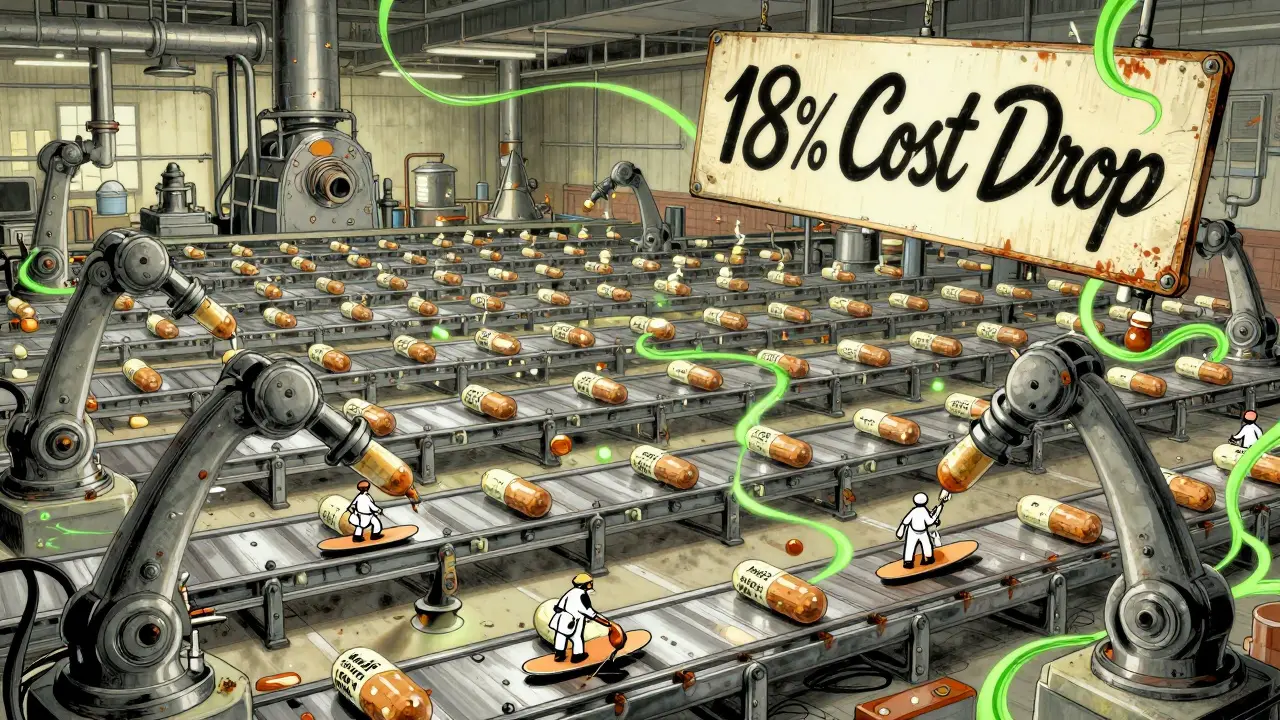
Why Generics Capture 90% of Prescriptions - But Only 23% of Spending
Here’s the mind-blowing stat: In the U.S., 90% of all prescriptions are filled with generic drugs. That’s over 8.9 billion prescriptions in 2023. But they only account for 23% of total drug spending - about $443 billion out of $2.8 trillion. That means people are taking way more generic pills, but the money spent on branded drugs is still massive. Why? Because branded drugs are often expensive, patented, and heavily marketed. Doctors still prescribe them. Patients ask for them. Insurance plans sometimes favor them. But here’s the kicker: Even when the same company makes both the brand and the generic version, the profit margin on the generic is razor-thin. One study found that branded-generic versions from the same manufacturer had retail margins between 201% and 1,016% higher than the branded version. That’s not a typo. The company makes more money selling the generic than the brand - because the generic costs so little to make.The Trade-Off: Low Prices, High Pressure
This system works - but it’s brutal. Generic manufacturers operate on margins so thin that a 1% improvement in production efficiency can mean the difference between survival and bankruptcy. Dr. James Robinson from UC Berkeley calls it a “hyper-competitive environment.” That pressure has consequences. When costs are squeezed too hard, supply chains crack. In 2022, there were 350 active drug shortages in the U.S. - many of them involving generics. Why? Because no one wants to make a low-margin drug if the factory could be shut down by a single raw material delay or a regulatory inspection. The FDA’s Dr. Janet Woodcock put it bluntly: “The 18% learning curve improvement per production doubling creates relentless pressure for generic manufacturers to achieve scale or exit the market.” That’s why the industry is consolidating. The top 10 generic companies now control over half the global market. Smaller players are being bought out. That’s good for efficiency - but bad for competition.
What’s Changing in 2026?
The rules are shifting. The FDA’s GDUFA III program, launched in 2023, raised industry fees by 13% to speed up approvals - aiming to cut review times from 40 months to 24. That’s good news for new generic entrants. The Inflation Reduction Act of 2022 lets Medicare negotiate drug prices. That’s already pushing down prices for some high-cost branded drugs - and by extension, it’s putting downward pressure on generics too. Analysts expect another 10-15% price drop in the next few years. Automation is coming fast. Continuous manufacturing - where pills are made in a single, uninterrupted flow - could cut generic production costs by 20-25% by 2027. That’s huge. But there’s a risk. If manufacturers move API production away from China to the U.S. or India to avoid geopolitical risk, costs could jump 5-8% in the short term. That’s already happening.So Why Does This Matter?
Because generic drugs aren’t just cheap alternatives. They’re the backbone of affordable healthcare. In 2023, the U.S. healthcare system saved $1.7 trillion over five years because of generics. That’s billions of dollars in out-of-pocket savings for patients. It’s fewer people skipping doses because they can’t afford meds. It’s more people managing chronic conditions like diabetes, hypertension, and depression. The system isn’t perfect. Supply chains are fragile. Competition is shrinking. But the core principle holds: When you remove the cost of invention and rely on scale, efficiency, and competition, you get drugs that work - and cost a fraction of what they used to. It’s not about cutting corners. It’s about not paying twice for the same thing. If you’re taking a generic drug today, you’re not getting the cheap version. You’re getting the smart version.Are generic drugs as effective as brand-name drugs?
Yes. The FDA requires generic drugs to have the same active ingredient, strength, dosage form, and route of administration as the brand-name version. They must also be bioequivalent - meaning they deliver the same amount of medicine into your bloodstream at the same rate. Thousands of studies confirm they work just as well. The only differences are in inactive ingredients like color or shape - which have zero effect on how the drug works.
Why do some generic drugs cost more than others?
It depends on competition. If 10 companies make the same generic, prices drop dramatically - sometimes to pennies per pill. If only one or two companies make it, prices stay higher. Complex drugs like inhalers or injectables cost more to produce, so they’re more expensive. Also, if a drug’s active ingredient is hard to source or has supply issues, prices can spike temporarily.
Can I trust generic drugs made overseas?
Yes. The FDA inspects all manufacturing facilities - whether they’re in the U.S., India, China, or elsewhere - using the same standards. Over 50% of generic drugs sold in the U.S. are made overseas, and the FDA’s inspection rate for foreign plants has doubled since 2015. A 2023 FDA report found no significant difference in quality between U.S.-made and imported generics.
Why don’t doctors always prescribe generics?
Sometimes it’s habit. Sometimes the brand was the only option when the patient started treatment. Some doctors still believe (incorrectly) that generics are inferior. Insurance plans often push generics, but if a doctor writes a prescription with "Do Not Substitute," the pharmacist must fill the brand name. Always ask: "Is there a generic version?" - you might save hundreds a year.
Will generic drug prices keep falling?
In the long term, yes - but not always smoothly. Automation, better supply chains, and more competition will push prices down. But if geopolitical issues, raw material shortages, or consolidation reduce the number of manufacturers, prices could spike temporarily. The trend is downward, but it’s not linear. What’s certain is that generics will remain the most cost-effective option for patients and payers.

Jarrod Flesch
Just had my mom switch her blood pressure med to generic last month. She’s been saving $80 a month without any side effects. Honestly, I wish more people knew how reliable these are.
Stephen Rock
Branded drugs are just expensive marketing wrapped in placebo packaging. The active ingredient doesn’t care if it’s called Advil or ibuprofen. People pay for the logo not the medicine.
Uju Megafu
Oh please. You think this is about savings? It’s about corporate greed disguised as efficiency. Generic manufacturers are squeezing workers in India and China to the bone just to hit their 18% cost drop targets. This isn’t progress-it’s exploitation dressed in white coats. And don’t even get me started on how the FDA turns a blind eye to factory conditions. Someone’s getting rich while others are literally dying because they can’t afford the $0.03 pill that costs $0.10 to make. Wake up.
Gerard Jordan
My dad’s on generic metformin and he says it’s the same as the brand. He even laughs now when people say "it’s not the real thing." 🤷♂️💊
Roisin Kelly
Wait so you’re telling me the FDA inspects factories in China the same way they do in the US? That’s a joke right? I bet they just rubber stamp everything. I read a guy on Twitter who got sick from a generic and now he’s in a coma. They don’t tell you that stuff.
Amber Lane
Generics saved my life. No drama. Just science.
Barbara Mahone
The 18% learning curve per production doubling is a fascinating economic principle. It’s not just about scale-it’s about systemic efficiency. The pharmaceutical industry’s shift toward consolidation reflects broader global trends in manufacturing, where marginal gains drive market dominance. What’s often overlooked is how this model incentivizes innovation in process engineering rather than chemical discovery.
michelle Brownsea
Let me be perfectly clear: The fact that 90% of prescriptions are generic doesn’t mean we’ve "solved" healthcare-it means we’ve normalized underfunding. We’ve created a system where the most vulnerable patients are forced to accept the cheapest option, and then we pat ourselves on the back for being "smart." This isn’t progress. It’s moral surrender. And the FDA? They’re not regulators-they’re enablers of a broken system. Where’s the accountability? Where’s the compassion? Where’s the outrage?
Andrew Rinaldi
It’s interesting how we treat generics like they’re lesser, when they’re actually the result of a smarter, more efficient system. We celebrate innovation in tech, but when it comes to medicine, we equate cost with quality. Maybe the real question isn’t why generics are cheap-but why we still think expensive means better.
Ashok Sakra
My cousin in India works in a generic factory. He says they make 10 million pills a day. He says they get paid $2 a day. He says if one pill is wrong, they all get fired. I don’t know what to think anymore.
Kelly McRainey Moore
I used to be skeptical too, but after switching my anxiety med to generic, I didn’t notice a difference. My pharmacist even said, "The only thing different is the price." And honestly? That’s all I care about. 😊