Pregnancy Medication Risk Calculator
Based on the article's guidance:
- • Most exposures don't cause birth defects
- • First trimester (weeks 1-12) is most critical
- • "Window of all or nothing" applies to early exposures
- • Risk depends on medication type, dose, and timing
When you’re pregnant, even something as simple as taking a pain reliever can spark serious questions. Teratogenic medications - drugs that can interfere with fetal development - are a real concern, but the fear around them is often out of proportion to the actual risk. The truth is, most medications don’t cause birth defects. But some do. And knowing which ones, when they’re dangerous, and what to do if you’ve taken one before realizing you’re pregnant can make all the difference.
What Exactly Is a Teratogen?
A teratogen is any substance - drug, chemical, or infection - that can disrupt the development of an embryo or fetus. The most infamous example is thalidomide, a sedative prescribed in the 1950s and early 1960s to treat morning sickness. Between 10,000 and 20,000 babies worldwide were born with severe limb deformities because of it. That tragedy changed how we study drugs in pregnancy forever. Today, we know that teratogenic effects depend on three things: the specific drug, the dose, and, most importantly, the stage of pregnancy when exposure happens.When Is the Fetus Most at Risk?
The first trimester - weeks 1 to 12 - is the most critical window. That’s when major organs are forming. Between days 15 and 60 after conception, the embryo is especially vulnerable. A medication taken during this time can cause major structural defects like heart malformations, cleft lip, or missing limbs. After week 12, the risk of major structural defects drops sharply. But that doesn’t mean later exposure is harmless. In the second trimester, drugs may affect brain development or organ function. In the third trimester, they can lead to withdrawal symptoms, low birth weight, or altered neurological development.Medications With Known Teratogenic Risks
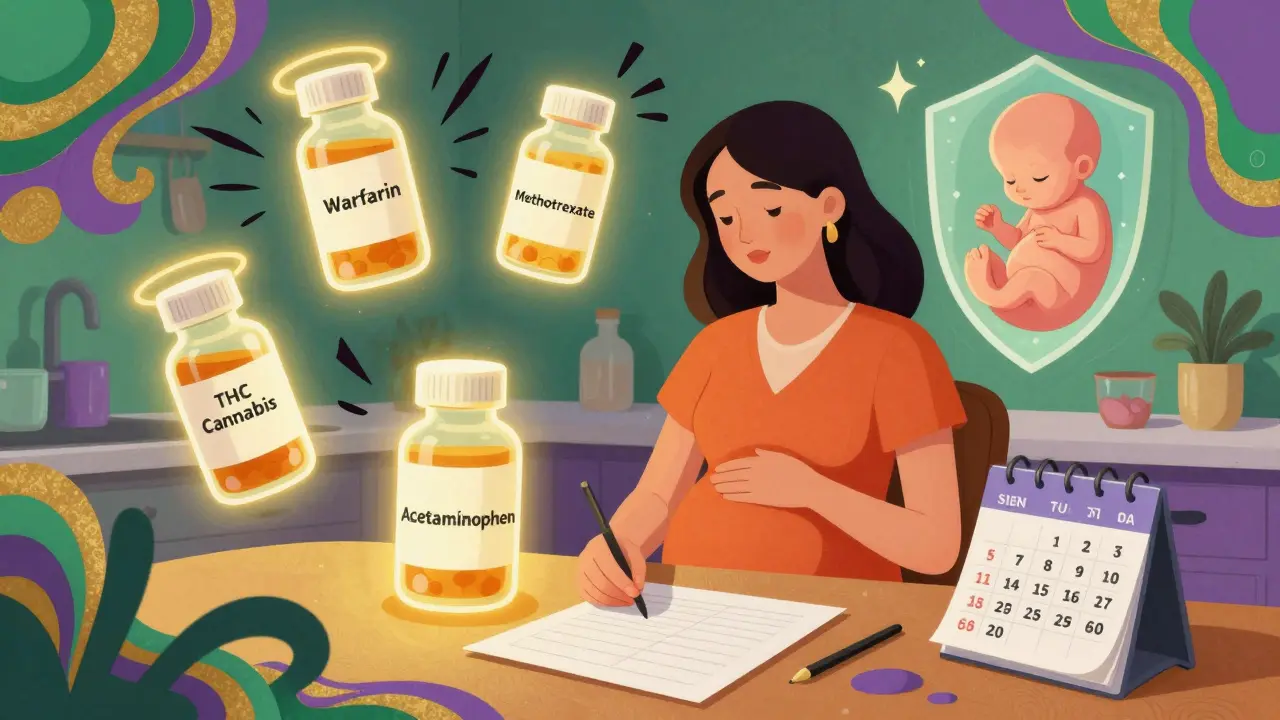
Not all drugs are equal when it comes to pregnancy. Some have clear, well-documented dangers:- Warfarin: This blood thinner can cause fetal warfarin syndrome, which includes underdeveloped nose, bone abnormalities, vision problems, and intellectual disability. Risk is highest in the first trimester.
- Carbamazepine: Used for epilepsy and bipolar disorder, it increases the risk of neural tube defects like spina bifida by about 1%. It can also lead to vitamin K deficiency in newborns, causing bleeding.
- Methotrexate: A chemotherapy and autoimmune disease drug, it blocks folate - a nutrient critical for neural tube development. Exposure in the first trimester can raise neural tube defect risk by 10-20%.
- Factor Xa inhibitors (rivaroxaban, apixaban, edoxaban): These newer blood thinners cross the placenta, and there’s no way to reverse their effects if bleeding occurs. They’re not recommended in pregnancy.
- THC-containing cannabis: Studies show a 15-20% higher chance of low birth weight and 10-15% higher risk of preterm birth. THC passes into breastmilk and may affect infant brain development.
These aren’t hypothetical risks. They’re based on decades of clinical data, case reports, and registries tracking thousands of pregnancies.
The Acetaminophen Debate
One of the biggest sources of confusion is acetaminophen (paracetamol). It’s the go-to pain reliever for pregnant women. But recent studies have linked long-term use to slightly higher risks of ADHD and autism. The CDC says these associations exist - but stresses no direct cause has been proven. Meanwhile, the American College of Obstetricians and Gynecologists (ACOG) issued a clear statement in September 2025: “The conditions you treat with acetaminophen - fever and pain - are far more dangerous than any theoretical risk from the drug.” Untreated fever, for example, carries a 20-30% increased risk of neural tube defects. ACOG’s message is simple: if you need acetaminophen, take it. Don’t skip it out of fear.
How Medications Affect the Fetus
It’s not just about the drug itself. Five pathways can lead to harm:- No effect: About 60-70% of medications have no measurable impact on fetal development.
- Direct damage: The drug directly interferes with cell growth or organ formation - like methotrexate blocking folate.
- Indirect impact: The drug lowers maternal blood pressure, reducing oxygen and nutrients to the placenta.
- Placental disruption: Some drugs change how the placenta works, limiting nutrient transfer.
- Uterine stimulation: Certain medications can trigger contractions, leading to preterm labor.
This is why context matters. A drug that’s risky at 8 weeks might be safe at 20 weeks. A high dose might be dangerous, while a low one isn’t. And sometimes, the illness itself - not the medicine - is the real threat.
What About Antidepressants and Seizure Medications?
This is where things get complicated. For many women, stopping medication during pregnancy is riskier than continuing it. Women with uncontrolled epilepsy face a higher chance of miscarriage, stillbirth, or birth defects than those taking seizure meds. Untreated depression increases the risk of preterm birth, low birth weight, and developmental delays. ACOG and the FDA agree: if you’re on medication for epilepsy, hypertension, or depression, don’t stop without talking to your doctor. The goal isn’t to avoid all drugs - it’s to use the safest one at the lowest effective dose.What Should You Do If You Took Medicine Before Knowing You Were Pregnant?
About 40-50% of pregnancies are unplanned. Many women take medications - even ones with known risks - before realizing they’re pregnant. The panic is understandable. But here’s the reality: most exposures don’t lead to birth defects. If you took a medication in the first few weeks of pregnancy, the embryo is either unaffected or it’s so early that any damage would result in a miscarriage - which often goes unnoticed. The key is not to assume the worst. Contact your healthcare provider. They can check the specific drug, timing, and dose. Services like MotherToBaby handle over 10,000 calls a year from women in this exact situation. They don’t scare you - they give you facts.
How to Navigate Medication Use During Pregnancy
The best approach is proactive. If you’re planning pregnancy, review all your medications with your doctor - including over-the-counter pills, supplements, and herbal products. Don’t rely on internet searches. The FDA’s Pregnancy and Lactation Labeling Rule (PLLR), introduced in 2015, replaced the old A-B-C-D-X categories with detailed narratives on prescription labels. But many providers still use the old system. Ask for the full label. Use trusted resources like LactMed and MotherToBaby. Talk to your pharmacist - they’re trained to assess medication risks in pregnancy. And if you’re on psychiatric meds, mental health professionals and OBs should work together. Your well-being matters as much as your baby’s.Why So Much Uncertainty?
Here’s the uncomfortable truth: we don’t know enough. About 70-80% of medications lack solid safety data in pregnancy. Why? Because ethical rules prevent randomized trials on pregnant women. Nearly all our data comes from observational studies, case reports, or animal testing. That’s why guidelines change. That’s why you hear conflicting advice. But progress is happening. The FDA’s Sentinel Initiative is tracking 10 million patient records to build better data. Pharmacogenomics - using your DNA to predict how you’ll respond to a drug - could soon personalize risk assessments. Experts predict a 30-40% improvement in accuracy within five years.What’s the Bottom Line?
Don’t panic. Don’t assume every pill is dangerous. Don’t stop necessary meds without medical advice. The goal isn’t to be completely drug-free - it’s to be informed. Most medications are safe. Some are risky, but only under specific conditions. And sometimes, not taking a drug is the biggest risk of all. If you’re pregnant or planning to be, have the conversation early. Keep your provider updated. Use trusted sources. And remember: your health matters. A healthy mom is the best foundation for a healthy baby.Can I take acetaminophen while pregnant?
Yes. Acetaminophen (paracetamol) is considered the safest pain reliever for use during pregnancy. While some studies have looked at possible links between long-term use and ADHD or autism, no direct cause has been proven. Major medical groups like ACOG emphasize that untreated pain and fever pose greater risks to both mother and baby. If you need it for headaches, fever, or muscle pain, it’s generally safe to use at the lowest effective dose for the shortest time.
What if I took a medication before I knew I was pregnant?
Don’t panic. Many women take medications before realizing they’re pregnant - especially since nearly half of all pregnancies are unplanned. The first few weeks of pregnancy are often a "window of all or nothing" - either the embryo isn’t affected at all, or exposure leads to a very early miscarriage you might not even notice. Contact your healthcare provider. They can check the specific drug, when you took it, and how much. Services like MotherToBaby offer free, expert consultations to help you understand your actual risk.
Are over-the-counter medications safe during pregnancy?
Not necessarily. Many OTC drugs - like ibuprofen, aspirin, or cold medicines containing pseudoephedrine - carry risks depending on the trimester. Even herbal supplements and vitamins can be harmful. Always check with your provider before taking anything new. What’s safe for you at 12 weeks might not be safe at 30 weeks. There’s no universal list of "pregnancy-safe" OTC drugs - it depends on your health, history, and stage of pregnancy.
Why did the FDA change its pregnancy risk categories?
The old A-B-C-D-X system was too simplistic. A "C" category could mean "harmful in animals, no human data" - or "moderate risk with clear benefit." In 2015, the FDA replaced it with the Pregnancy and Lactation Labeling Rule (PLLR), which requires detailed narrative sections on prescription labels: risks, clinical considerations, and data sources. This gives doctors and patients more useful information than a single letter.
Is it safe to continue taking antidepressants during pregnancy?
For many women, yes. Untreated depression or anxiety increases the risk of preterm birth, low birth weight, and developmental delays. Stopping medication abruptly can trigger a relapse, which is dangerous for both mother and baby. ACOG and the FDA recommend individualized care: work with your doctor to choose the safest medication at the lowest effective dose. SSRIs like sertraline are often preferred, but the decision should be based on your history, symptoms, and response to treatment.

Randy Harkins
Just wanted to say how relieved I am to see this laid out so clearly. I took ibuprofen for a headache before I knew I was pregnant, and I spent three days spiraling. Reading this? Total game-changer. The "window of all or nothing" concept alone gave me peace. Thank you for sharing the science, not the fear.
Tori Thenazi
Okay, but have you heard about the 2023 leaked FDA memo?? The one that says they’ve been suppressing data on SSRIs and autism for 12 years?? I’m not saying the article’s wrong… I’m just saying… why is the CDC still pushing acetaminophen?? And why does every single study have "correlation not causation" as a disclaimer?? Hmmmm…
Monica Warnick
Interesting. I’m 28 weeks and have been on sertraline since before conception. My OB said "it’s fine," but my doula said "you’re basically dosing your baby." I’ve been silently panicking. This article didn’t answer my real question: if I stop now, will my brain implode? Or will my baby implode? I’m stuck.
Chelsea Deflyss
so i read this and i think like… why do we even have guidelines? like if 70% of meds have no data then why are we trusting anything? i took melatonin for sleep and now i’m scared my kid will have 3 eyes. also is it true that prenatal vitamins cause autism? i saw a tiktok.
Susan Kwan
Wow. A medical article that doesn’t sound like a pharmaceutical ad. Refreshing. I’m a nurse. I’ve seen moms panic over Tylenol while ignoring the fact they’re vaping. The real teratogen? Fear. And misinformation. This? This is what medicine should look like.
Ryan Vargas
Let’s zoom out. We’re operating on a model of risk that was built on trauma - thalidomide, DES, isotretinoin - and now we’ve built an entire medical culture around avoiding any possible harm, even if it means ignoring the documented harm of untreated illness. This isn’t precaution. It’s pathology. We’ve turned pregnancy into a sterile lab, not a human experience. The real teratogen isn’t acetaminophen - it’s the anxiety we’ve weaponized as "care."
Tasha Lake
From a pharmacogenomics standpoint, the variability in placental transporters (like ABCB1 and SLCO1B1) explains why two women taking identical doses can have wildly different fetal exposures. We’re still using population averages when individualized risk modeling is within reach. The FDA’s Sentinel Initiative? It’s a start - but we need real-time pharmacovigilance integrated with EHRs and maternal DNA data. We’re 20 years behind where we should be.
Simon Critchley
As a Brit who’s seen the NHS handle this, I’ve got to say - the US is way too reactive. Here, we have the BNF Pregnancy and Lactation section. It’s updated monthly. No letter categories. Just plain English: "Use with caution in 1st trimester. Avoid if possible. Monitor fetal growth." Simple. Clear. No panic. We need more of this. Also - yes, THC in breastmilk? 15% higher risk? That’s not a headline - that’s a public health crisis waiting to happen.
John McDonald
Y’all are overthinking this. If you need the med - take it. If you’re scared - talk to your doc. If you’re scrolling Reddit at 2am - put the phone down and breathe. Your body knows how to do this. Medicine isn’t about zero risk. It’s about better risk. You’re not a lab rat. You’re a person. And you’ve got this.
Jacob den Hollander
Just had my first baby - 32 weeks, no meds except prenatal vitamins and Zofran for nausea. I didn’t know half this stuff. My OB didn’t explain the placental pathways. My pharmacist didn’t mention the folate-blocking risks. I wish I’d read this before week 6. To anyone reading this who’s pregnant or planning - don’t wait. Ask for the full label. Talk to your pharmacist. Write down your meds. You’re not being paranoid - you’re being proactive. And you’re not alone.
glenn mendoza
It is with the utmost respect for the scientific method and the ethical imperatives of maternal-fetal medicine that I commend this comprehensive exposition. The delineation of teratogenic mechanisms, coupled with the contextual framing of risk-benefit ratios, represents a paradigmatic shift from fear-based decision-making to evidence-informed autonomy. One must not conflate statistical association with causal attribution, nor should one discount the profound physiological imperative to maintain maternal homeostasis. This document constitutes a masterclass in clinical communication.
Kathryn Lenn
Oh good, another article that says "don’t panic" while listing 12 drugs that will melt your baby’s brain. I’m supposed to trust the FDA after they approved Vioxx? And now acetaminophen? Sure. And the fact that they banned DDT for environmental reasons but still say it’s fine to take it daily? Hmm. I’ll pass. I’m not a guinea pig.
John Watts
Hey - if you’re reading this and you’re scared, I see you. I’ve been there. I took 200mg of ibuprofen at 5 weeks. I cried. I googled. I almost quit my job because I was so scared. Then I called MotherToBaby. They walked me through it. No judgment. Just facts. You’re not broken. You’re not a bad mom. You’re human. And you’re doing better than you think.
Angie Datuin
My OB said "avoid all meds." So I didn’t take anything for migraines. I had two ER visits. My baby was born at 34 weeks. I wish I’d known that the migraine itself was the real danger. This article saved my future pregnancy.