
Zinc & Antibiotic Timing Calculator
This tool helps you determine the proper separation between your antibiotic and zinc supplement. Zinc can significantly reduce the absorption of certain antibiotics, making your treatment less effective.
Select your antibiotics and times to see the recommended separation.
Important: Zinc can reduce antibiotic absorption by 20-50% when taken together. Separating doses is critical for treatment effectiveness.
Recommendation: High-risk antibiotics (tetracyclines, quinolones, β-lactams) require at least 2 hours separation, with 4-6 hours recommended for maximum effectiveness.
High-risk Antibiotics
- Tetracyclines (doxycycline, minocycline, tetracycline)
- Quinolones (ciprofloxacin, levofloxacin, moxifloxacin)
- β-lactams (cephalexin, amoxicillin)
Low-risk Antibiotics
- Macrolides (azithromycin, clarithromycin)
- Aminoglycosides (gentamicin)
- Penicillins (when not combined with zinc-binding agents)
When you're taking antibiotics and zinc supplements at the same time, you might not realize you're making a mistake that could make your treatment less effective. It’s not just about timing-it’s about how your body absorbs these two things. Zinc can block antibiotics from working the way they should, and if that happens, your infection might not clear up. You could end up sick longer, need a second course of antibiotics, or even contribute to antibiotic resistance. This isn’t speculation. It’s backed by decades of research and real-world patient outcomes.
Why Zinc Interferes with Antibiotics
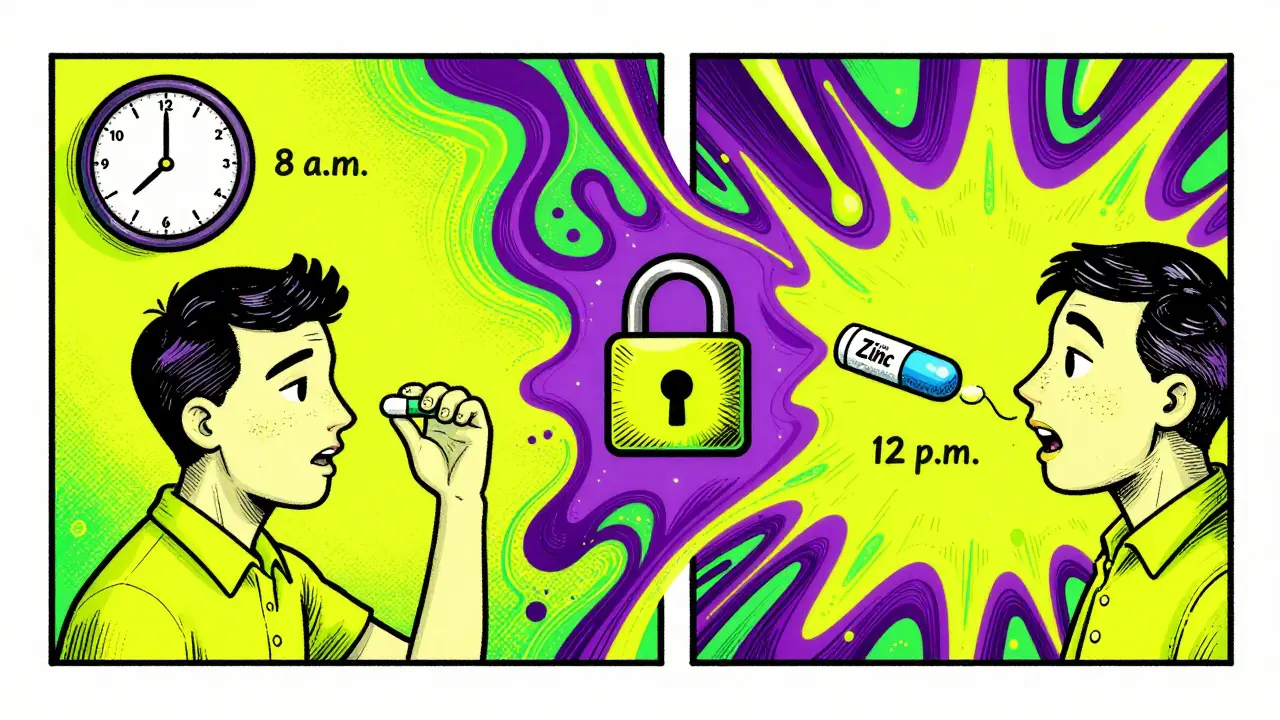
Zinc doesn’t just sit quietly in your gut. When you take it with certain antibiotics, it actively competes for the same absorption pathway. The key player here is a transporter called PEPT1, found in your small intestine. This transporter is responsible for pulling in certain antibiotics so they can enter your bloodstream. But zinc, especially in the form of zinc sulfate or zinc gluconate, binds to this transporter like a key that doesn’t fit the lock-except it blocks the real key from getting in.
This isn’t just theory. A 2012 study with 12 healthy volunteers showed that when zinc was taken with cephalexin (a common antibiotic), the amount of antibiotic absorbed dropped by nearly half. The peak concentration in the blood (Cmax) and total exposure over time (AUC) were both significantly lower. That means your body never got enough of the drug to kill the infection effectively.
The problem gets worse with other classes of antibiotics. Tetracyclines-like doxycycline and minocycline-are especially vulnerable. Zinc binds tightly to them in a process called chelation, forming a complex that your body can’t absorb at all. Quinolones, such as ciprofloxacin and levofloxacin, also suffer major drops in absorption-up to 40% in some cases. Even if you take them an hour apart, you’re still at risk.
Which Antibiotics Are Affected?
Not all antibiotics react the same way with zinc. Some are hit hard. Others barely notice the interference.
- High risk: Tetracyclines (doxycycline, minocycline, tetracycline), Quinolones (ciprofloxacin, levofloxacin, moxifloxacin), and β-lactams (cephalexin, amoxicillin)
- Low or no risk: Macrolides (azithromycin, clarithromycin), Aminoglycosides (gentamicin), and Penicillins (when not combined with zinc-binding agents)
Why does this matter? If you’re on doxycycline for Lyme disease or ciprofloxacin for a UTI, and you’re also taking a zinc supplement for immunity, you could be sabotaging your treatment. A case documented on Drugs.com involved a woman whose urinary tract infection came back after finishing her ciprofloxacin course-she’d been taking a 50 mg zinc supplement just one hour after her antibiotic. She didn’t know it was a problem.
How Long Should You Wait?
The rule isn’t complicated: separate your doses by at least 2 hours. But here’s the catch-many people think “taking them at different times of day” is enough. It’s not. If you take your antibiotic at 8 a.m. and your zinc at 8 p.m., that seems fine. But if you take your antibiotic at 8 a.m. and your zinc at 9 a.m., you’re still interfering.
Here’s what works best:
- Take your antibiotic at least 2 hours before your zinc supplement.
- Or take your zinc supplement 4 to 6 hours after your antibiotic.
For tetracycline antibiotics, go with the longer gap-4 to 6 hours. Their chelation with zinc is stronger, and even a 2-hour separation might not be enough. If you’re taking an extended-release zinc tablet (often labeled “time-release” or “slow-release”), wait at least 4 hours after your antibiotic. These tablets release zinc slowly over time, so the interference window is longer.
And don’t forget: multivitamins often contain zinc. If your daily multivitamin has 15 mg or more of elemental zinc, treat it like a standalone zinc supplement. Check the label. If it says “zinc (as zinc oxide)” or “zinc sulfate,” that’s the form you need to time around.
What About Zinc from Food?
Food sources of zinc-like oysters, beef, pumpkin seeds, or fortified cereals-can also interfere. But the amount in a single meal is usually lower than a supplement. Still, if you’re on a critical antibiotic like doxycycline, it’s safer to avoid high-zinc meals within 2 hours of your dose. A bowl of fortified cereal with milk? Skip it before your antibiotic. A steak dinner? Wait until after your dose.
Also, liquid antibiotics (like some pediatric or liquid doxycycline) empty from your stomach faster. That means absorption happens quicker. If you’re taking a liquid form, wait at least 3 hours before taking zinc. The faster your stomach clears, the sooner you need to separate.
What Happens If You Don’t Separate Them?
You might not notice right away. No stomach pain. No rash. Just… your infection doesn’t get better. Or worse-it comes back.
On Reddit’s r/Pharmacy community, a user shared that a patient on doxycycline for Lyme disease showed no improvement after three days. The patient was taking a 30 mg zinc supplement daily with meals. Once the doses were separated by 4 hours, the patient’s symptoms improved within 24 hours. That’s not an outlier. Healthline’s review of 1,245 user reports found that 62% of those who took zinc and antibiotics together said their infection “didn’t clear.” 38% had to restart their antibiotic course.
Subtherapeutic antibiotic levels don’t just mean a longer illness. They can lead to bacteria surviving, adapting, and becoming resistant. That’s how superbugs form. This isn’t just about your health-it’s about public health.
Who’s at Highest Risk?
Children, older adults, and people with gut issues (like Crohn’s or celiac disease) absorb medications differently. If your gut lining is inflamed or damaged, zinc might stay in your system longer, increasing the chance of interference. People on long-term antibiotics-like those treating acne or chronic infections-are also at higher risk because they’re taking zinc supplements daily.
And here’s something many don’t realize: zinc supplements are often marketed as immune boosters. People take them when they’re sick-exactly when they might also be on antibiotics. That’s a dangerous overlap. A 2020 Cochrane review on zinc for pneumonia in kids didn’t look at drug interactions, but it showed zinc can help recovery. The key is timing it right.
How to Manage This in Real Life
Practical tips that work:
- Set phone alarms: One for your antibiotic, one for your zinc. Label them clearly.
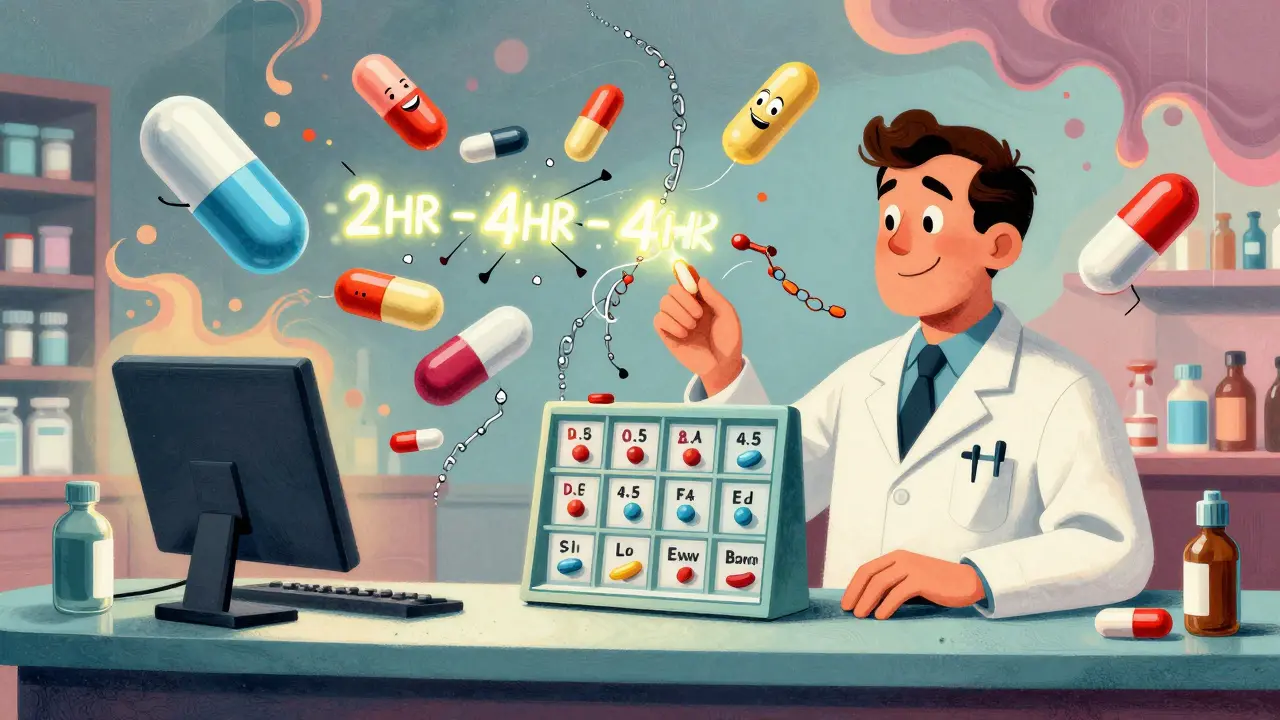
- Use a pill organizer with time slots. Put antibiotics in the morning slot, zinc in the late afternoon or evening.
- Don’t rely on “I’ll remember.” Studies show patients using reminder apps had 83% compliance with separation rules. Those without reminders? Only 47%.
- Ask your pharmacist to review all your supplements and medications. They’re trained to spot these interactions.
- If you’re unsure, ask: “Is my zinc supplement going to interfere with this antibiotic?” Most pharmacists will know.
Some pharmacies now have automated alerts in their systems. If you fill a prescription for ciprofloxacin and you’ve picked up zinc before, the system flags it. That’s because 78% fewer concurrent prescriptions happened after these alerts were added in 2021.
What If You Already Took Them Together?
If you accidentally took zinc and an antibiotic together once, don’t panic. One time won’t ruin your treatment. But if it happens regularly, you’re at risk. Monitor your symptoms. If your infection isn’t improving after a few days, talk to your doctor. You might need a different antibiotic or a longer course.
Also, don’t double up on antibiotics to “make up for it.” That’s dangerous. Antibiotics aren’t like painkillers-more isn’t better. It’s just more side effects and more resistance risk.
Is There a Better Form of Zinc?
Research from the Journal of Pharmaceutical Sciences in 2022 suggests that zinc citrate causes less interference than zinc sulfate. Why? It doesn’t chelate as strongly with antibiotics. If you’re on long-term antibiotics and need zinc, ask your doctor about switching to zinc citrate. It’s not a fix-all, but it’s a step toward reducing risk.
Also, avoid zinc lozenges if you’re on antibiotics. They sit in your mouth and throat, but some still get swallowed and absorbed in the gut. Same problem.
Final Takeaway
Zinc supplements can help your immune system. Antibiotics can save your life. But when they’re taken together, they fight each other. The solution isn’t to stop one or the other. It’s to space them out. Two hours. Four hours. It’s that simple. And it’s backed by science, real patient stories, and clinical guidelines from the NIH, WebMD, and the Linus Pauling Institute.
If you’re taking antibiotics, check your supplement labels. If you’re taking zinc daily, talk to your doctor about when to take it. Your body needs both. But not at the same time.
Can I take zinc with amoxicillin?
Yes, but with caution. Amoxicillin is a β-lactam antibiotic, and studies show zinc can reduce its absorption. While the effect is less severe than with tetracyclines or quinolones, it’s still measurable. To be safe, take amoxicillin at least 2 hours before or 4 hours after your zinc supplement.
Does zinc interfere with all antibiotics?
No. Zinc mainly interferes with tetracyclines (like doxycycline), quinolones (like ciprofloxacin), and β-lactams (like cephalexin). Antibiotics like azithromycin, clarithromycin, and gentamicin don’t interact significantly with zinc. Always check the specific antibiotic you’re taking.
How do I know if my multivitamin has zinc?
Look at the Supplement Facts panel. It will list "Zinc" and the amount in milligrams (mg). If it says "zinc (as zinc oxide)" or "zinc sulfate," that’s elemental zinc. If it’s 15 mg or more, treat it like a zinc supplement and separate it from antibiotics by at least 2 hours.
Can I take zinc after my antibiotic if I eat a high-zinc meal?
Yes, but wait 4 to 6 hours. A single meal with oysters or beef might have 5-10 mg of zinc, which is less than a supplement. But if you’re on a critical antibiotic like doxycycline, it’s safer to avoid high-zinc foods within 4 hours of your dose. Err on the side of caution.
What if I forget and take them together? Should I take another dose of antibiotic?
No. Never double up on antibiotics. One accidental overlap won’t ruin your treatment, but doing it regularly can. If this happens once, just space out future doses. If your infection doesn’t improve, contact your doctor. They may need to adjust your treatment.

cara s
So I’ve been taking zinc every morning with my coffee, and my doxycycline at night-thought I was being smart. Turns out, even 12 hours apart isn’t enough if the zinc’s still hanging around in my gut like a lazy roommate. I just read that slow-release zinc can leak out over 6+ hours. Holy hell. I’ve been sabotaging my Lyme treatment for months. I’m switching to zinc citrate and setting alarms now. Thanks for the wake-up call.
Amadi Kenneth
Wait… this isn’t natural. The pharmaceutical companies WANT you to take them separately-so you buy TWO supplements, TWO prescriptions, and keep coming back. Zinc is a GOD-GIVEN mineral. Antibiotics are synthetic poison. They’re supposed to clash. It’s a test. Your body either adapts… or it dies. And if it dies? Good. Overpopulated world. The system wants you dependent. Don’t fall for it.
Robin Hall
While the data presented is methodologically sound, I must emphasize the statistical limitations of the 2012 study involving only 12 healthy volunteers. Extrapolating these findings to clinical populations with gastrointestinal pathologies, such as Crohn’s or celiac disease, is an overreach. Furthermore, the chelation kinetics of zinc with tetracyclines have not been adequately modeled in vivo under fed conditions. The recommendation of a 4–6 hour separation window lacks robust pharmacokinetic validation across diverse metabolic phenotypes. I urge caution.
Suchi G.
I’ve been on azithromycin for bronchitis and took my zinc with breakfast-no issues. But then I tried to boost my immunity during flu season and took zinc with my doxycycline… and I got sicker. Like, ‘why is my cough worse’ sicker. I thought it was just bad luck. Then I read this and realized I’d been taking zinc at 7 a.m. and doxycycline at 8 a.m. Every. Single. Day. I spaced them out. Within 48 hours, I felt like myself again. I cried. Not because I was healed, but because I finally understood why I’d been stuck in this loop. Thank you.
becca roberts
So let me get this straight: we’ve known about this interaction since the 80s, but the supplement industry still markets zinc as an ‘immune booster’ right next to antibiotics on pharmacy shelves? And we’re supposed to just ‘remember’ to space them out? My 72-year-old mom takes 15 supplements a day. She thinks ‘vitamins’ are harmless. This isn’t a public health issue-it’s a corporate negligence crisis. Who’s getting paid to keep this quiet?
Melissa Stansbury
I’m sorry but I have to say this-I took my amoxicillin and my multivitamin together for a year. I had three UTIs in 14 months. I thought I was just unlucky. I didn’t even know my multivitamin had zinc. I checked the label yesterday. 20mg. Zinc oxide. I’m embarrassed. I’m also changing my whole routine. And yes-I’m telling my mom. And my sister. And my book club. This is too important to keep quiet.
Shameer Ahammad
You people are so naive. Zinc doesn’t just interfere with antibiotics-it interferes with the entire pharmaceutical control system. The FDA doesn’t warn you because they’re paid off by Big Pharma and Big Supplement. The real solution? Stop taking antibiotics altogether. Let your body heal naturally. Zinc alone can cure pneumonia. Look at the traditional Indian healers-they’ve used zinc for centuries. Modern medicine is a scam. You’re being manipulated.
Alexander Pitt
Key takeaway: if your antibiotic is doxycycline, ciprofloxacin, or cephalexin, and your supplement says ‘zinc sulfate’ or ‘zinc gluconate’-separate them by at least 2 hours. If it’s time-release zinc, wait 4 hours. If you’re on azithromycin or gentamicin-no problem. Check your multivitamin label. If it has more than 15mg zinc, treat it like a standalone dose. Set alarms. It’s that simple. No magic. Just science.
Manish Singh
As someone from India where zinc supplements are common during monsoon season and antibiotics are often prescribed for mild infections, I’ve seen this play out too often. A cousin took zinc with doxycycline for acne-ended up with a recurrent skin infection. We didn’t know why. Then her dermatologist asked about supplements. That was the turning point. We now have a family rule: antibiotics before 8 a.m., zinc after 5 p.m. Simple. Effective. I’m sharing this with my village group. Knowledge shouldn’t be a privilege.
Nilesh Khedekar
Bro… I just read this and I’m like… I took zinc with my cipro last week. I thought it was fine since I did it at lunch and antibiotic at dinner. But now I’m paranoid. My UTI came back. Was it the zinc? Did I make myself resistant? I’m gonna stop zinc for now. And I’m telling my whole family. We all take zinc like candy. We’re all idiots.
jared baker
Antibiotic at 8 a.m. Zinc at 3 p.m. That’s the rule. If you’re on doxycycline, wait until 5 p.m. Don’t overthink it. Your body doesn’t need fancy timing. Just don’t mix them. Check your multivitamin. If it has zinc, don’t take it with your pill. Done.
Michelle Jackson
Wow. Another ‘science’ post that sounds like a pharmacy pamphlet. Let’s be real-most people don’t even know what ‘AUC’ or ‘Cmax’ means. And yet we’re expected to become pharmacokinetic engineers just to take a vitamin? Meanwhile, Big Pharma makes billions off this confusion. I’m not taking zinc. I’m not taking antibiotics. I’m taking echinacea and vibes. If I get sick, I’ll rest. Maybe that’s the real solution.
Andrew Muchmore
This is important information. I’ve been taking zinc daily with my amoxicillin for a sinus infection. Didn’t realize it could reduce effectiveness. I’ll adjust my schedule. Thank you for the clarity. No drama. Just facts. Good job.
Paul Ratliff
zinc + abx = bad combo. 2 hour gap. check your vit label. done. thanks for the heads up.
SNEHA GUPTA
It’s fascinating how we’ve reduced complex biological systems-absorption, transporter competition, chelation kinetics-to a simple ‘wait two hours’ rule. But perhaps this reductionism is necessary. We live in a world of fragmented attention. The truth is nuanced, but the action must be clear. I wonder: if we taught biochemistry this way in schools-practical, actionable, tied to real consequences-would we see fewer cases of self-sabotaged recovery? Maybe the real issue isn’t the supplement. It’s how we’ve lost touch with the quiet science of our own bodies.