
HIV Medication & Antibiotic Interaction Checker
Check for Potential Interactions
This tool checks for potential interactions between your HIV medication and antibiotics based on current medical knowledge. Always consult your healthcare provider before making any changes to your medication regimen.
When you’re living with HIV, taking your antiretroviral therapy (ART) every day is non-negotiable. But what happens when you need an antibiotic for a sinus infection, pneumonia, or a stubborn urinary tract infection? It’s not as simple as picking up a prescription. Many antibiotics interact with HIV medications in ways that can either make your treatment fail-or send your body into dangerous territory.
Why This Isn’t Just a Minor Concern
About 68% of people living with HIV get at least one antibiotic every year. That’s not rare. It’s normal. But here’s the catch: nearly one in five hospital admissions for HIV patients involves a harmful drug interaction, and more than 40% of those involve antibiotics mixed with HIV meds. These aren’t theoretical risks. They’re real, documented, and sometimes life-threatening.Take rifampin, a common antibiotic used for tuberculosis. If you’re on a boosted protease inhibitor like darunavir or atazanavir, rifampin can slash your HIV drug levels by up to 80%. That’s not a small dip-it’s a crash. Your virus can rebound. Resistance can develop. And suddenly, your years of stable treatment are at risk.
On the flip side, some antibiotics can make your HIV meds build up to toxic levels. Clarithromycin, often used for respiratory infections, can increase the concentration of boosted darunavir by 60-80%. That might sound like it’s helping-but it’s not. Higher drug levels mean more side effects: liver damage, irregular heartbeat, or even sudden kidney failure.
How These Interactions Actually Work
Most HIV medications and antibiotics are processed by the same system in your liver: the CYP450 enzyme family, especially CYP3A4. Think of it like a busy highway. Your drugs are cars trying to get through. Some drugs-like ritonavir and cobicistat-are roadblocks. They slam the brakes on CYP3A4, slowing down how fast other drugs get broken down. That means those drugs stick around longer, and in higher amounts.Others, like rifampin, are bulldozers. They speed up CYP3A4, forcing your body to clear HIV meds too fast. That leaves you with too little drug in your system to control the virus.
Not all HIV drugs play by these rules. The newer integrase inhibitors-dolutegravir, bictegravir, and islatravir-barely touch CYP450. They’re metabolized differently. That’s why doctors now prefer them when you’re likely to need antibiotics. They’re quieter on the highway.
Even the old-school drugs like tenofovir disoproxil fumarate (TDF) aren’t safe just because they don’t use CYP450. When paired with fluoroquinolones like ciprofloxacin, they can team up to damage your kidneys. The risk jumps 3.2 times. That’s not a coincidence. It’s additive toxicity.
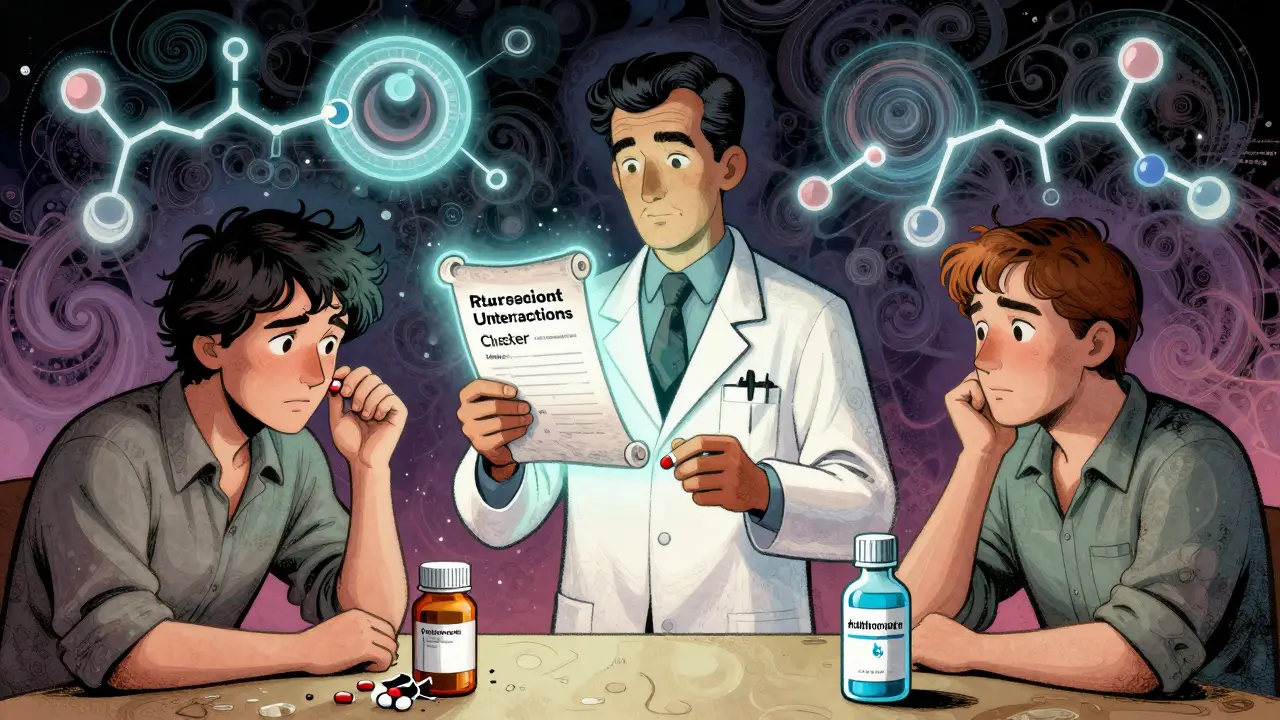
Which HIV Drugs Are the Biggest Troublemakers?
Not all antiretrovirals are equal when it comes to interactions. Here’s what you need to know:- Boosted protease inhibitors (like darunavir/ritonavir, atazanavir/cobicistat): These are the biggest offenders. Ritonavir and cobicistat are powerful CYP3A4 inhibitors. They’re the reason you can’t take most azole antifungals or certain antibiotics without adjusting doses.
- NNRTIs (like efavirenz, rilpivirine): These can either inhibit or induce enzymes unpredictably. Rilpivirine is especially sensitive to stomach acid changes, so antacids or H2 blockers can tank its levels.
- INSTIs (dolutegravir, bictegravir, islatravir): These are the safest. Minimal CYP450 involvement. Fewer interactions. Preferred when antibiotics are needed.
- NRTIs (like tenofovir, emtricitabine): Mostly safe from CYP450 issues-but watch for kidney or bone toxicity when mixed with nephrotoxic antibiotics.
- Maraviroc: Uses CYP3A4. Can be affected by strong inhibitors or inducers.
And don’t forget the long-acting injectables. Cabotegravir and rilpivirine stay in your body for weeks-even months. If you stop them and start an antibiotic that interacts with them, the interaction doesn’t vanish when the injection wears off. It lingers. That’s why you can’t just assume the risk is gone after your last shot.
Common Antibiotics That Clash With HIV Meds
Here’s what you’re likely to be prescribed-and what to watch for:- Clarithromycin: Avoid with boosted PIs. It can spike PI levels dangerously. Switch to azithromycin instead-it doesn’t rely on CYP450.
- Rifampin: Absolutely contraindicated with boosted PIs and most NNRTIs. Use rifabutin instead, but even then, reduce the dose to 150mg every other day and monitor closely.
- Ciprofloxacin, levofloxacin: Safe for most ART regimens-but risky with TDF. Monitor kidney function. Consider switching to nitrofurantoin for UTIs if you’re on tenofovir.
- Trimethoprim-sulfamethoxazole: Often used for PCP pneumonia and UTIs. Safe with INSTIs, but can raise potassium levels when used with dolutegravir. Get your blood tested.
- Voriconazole: Used for fungal infections. Can be used with cobicistat-but only if you cut the dose in half. Posaconazole is a safer alternative.
- Azithromycin: Your best friend. No CYP450 metabolism. Works well with nearly all HIV regimens. First-line for pneumonia in HIV patients.
Even over-the-counter stuff matters. St. John’s wort? It’s a CYP3A4 inducer. One pill can knock your HIV meds down to ineffective levels. Grapefruit juice? It blocks CYP3A4. It’s fine with INSTIs-but dangerous with boosted PIs.
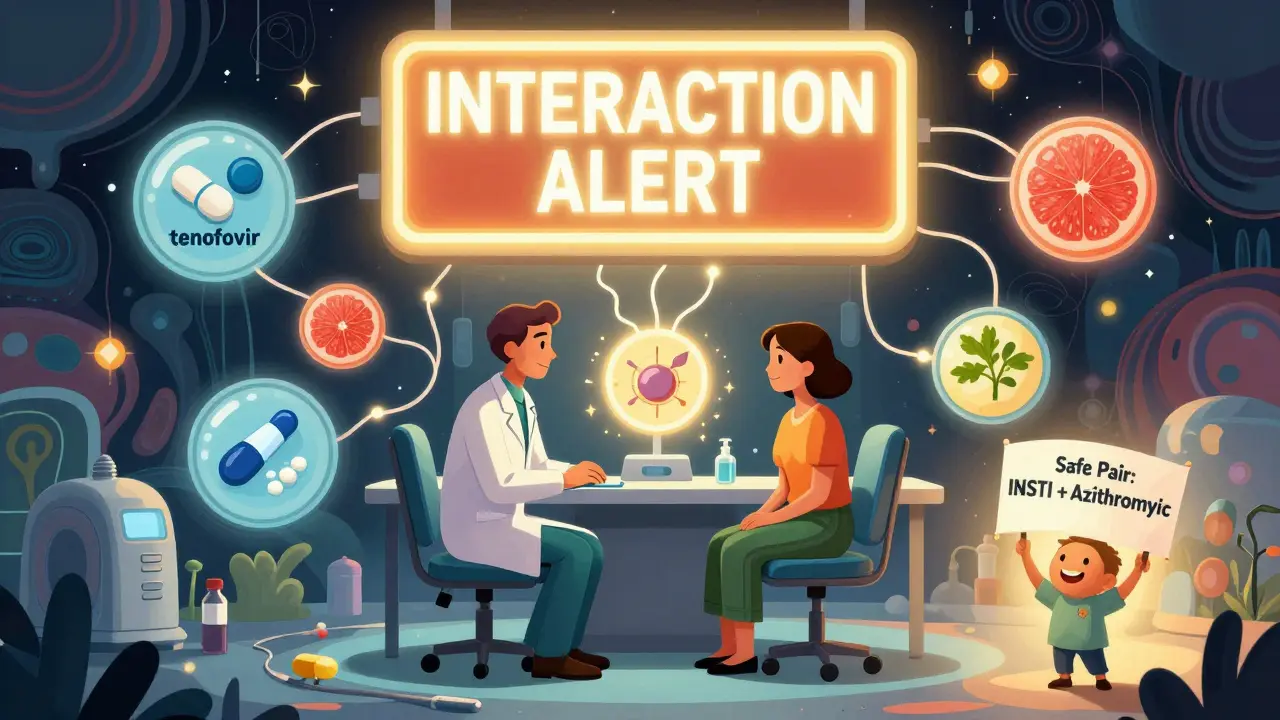
What You Should Do Right Now
If you’re on HIV treatment and your doctor wants to prescribe an antibiotic, here’s your checklist:- Never assume it’s safe. Even if it’s a common antibiotic, it might not be safe with your specific HIV meds.
- Always check the Liverpool HIV Drug Interactions Checker. It’s free, updated monthly, and used by clinics worldwide. It’s more accurate than most hospital systems.
- Ask your pharmacist. Not every doctor knows the latest DDI data. Pharmacists are trained to spot these clashes.
- Bring your full list. Include vitamins, supplements, herbal teas, and recreational drugs. Even CBD can interfere.
- Get lab tests. If you’re on tenofovir and an antibiotic, check kidney function before and after. If you’re on a boosted PI, monitor liver enzymes.
And if you’re starting a new HIV regimen? Ask your doctor: "Which drug has the fewest interactions with antibiotics?" That’s not a weird question. It’s smart.
The Bigger Picture: Why This Matters Beyond Your Prescription
This isn’t just about your health. It’s about public health. Inappropriate antibiotic use in HIV patients is fueling antibiotic resistance. The CDC reports that over 22% of multidrug-resistant infections in the U.S. now occur in people with HIV-many because they were given the wrong antibiotic or the wrong dose because of an interaction.And it’s getting worse. As more people with HIV live into their 60s and 70s, they’re taking more meds-for diabetes, heart disease, high blood pressure. Polypharmacy is the new normal. That means more chances for something to go wrong.
That’s why the NIH just launched a $15.7 million project to build personalized dosing algorithms using genetic data. The goal? To predict your risk before you even take a pill.
Right now, your best tool is knowledge. And the best resource is the Liverpool HIV Drug Interactions Checker. Bookmark it. Use it before every new prescription-even if it’s just for a sinus infection.
Can I take azithromycin with my HIV meds?
Yes, azithromycin is one of the safest antibiotics to use with most HIV medications. It doesn’t rely on the CYP450 system, so it won’t interfere with boosted protease inhibitors, NNRTIs, or INSTIs. It’s often the first choice for pneumonia or bronchitis in people with HIV. Always confirm with your doctor or pharmacist, but in general, azithromycin is a low-risk option.
Is rifampin ever safe with HIV treatment?
Only in rare cases, and only with major adjustments. Rifampin is too strong an enzyme inducer for most HIV drugs. It’s contraindicated with boosted PIs and most NNRTIs. If you have tuberculosis and need treatment, your doctor will switch you to rifabutin instead. Even then, the dose must be reduced (usually to 150mg every other day), and your HIV drug levels should be monitored. Never take rifampin without expert supervision.
What’s the safest HIV medication if I need antibiotics often?
Dolutegravir and bictegravir are currently the safest options. They’re integrase inhibitors with minimal CYP450 involvement, meaning they don’t interfere much with antibiotics-and antibiotics don’t interfere with them. If you’re on a boosted regimen and need antibiotics regularly, talk to your doctor about switching to one of these. It’s a simple change that can prevent serious complications.
Can I use over-the-counter painkillers with my HIV meds?
Most OTC painkillers like acetaminophen (Tylenol) and ibuprofen (Advil) are generally safe with HIV meds, but they’re not risk-free. Ibuprofen can increase kidney strain when used with tenofovir. Acetaminophen is safer for the kidneys but can stress the liver, especially if you’re on boosted protease inhibitors. Always stick to the lowest effective dose and avoid long-term use without checking in with your provider.
How do I know if an interaction is serious?
Use the Liverpool HIV Drug Interactions Checker. It classifies interactions as mild, moderate, major, or contraindicated. A "major" interaction means you need a dose change or alternative drug. "Contraindicated" means don’t take them together. If your doctor says an interaction is "not a big deal," ask them to check the Liverpool database. If they’re not familiar with it, ask for a referral to an HIV pharmacist.
Are there apps or tools I can use to check interactions?
Yes. The University of Liverpool’s HIV Drug Interactions website (hiv-druginteractions.org) is the gold standard. It’s free, updated monthly, and trusted by clinics worldwide. Avoid generic drug interaction apps-they’re not designed for HIV and often miss critical interactions. Stick to the Liverpool tool. If you’re unsure, ask your clinic if they use it.

Alex LaVey
Just wanted to say thanks for laying this out so clearly. I’ve been on dolutegravir for two years and just got prescribed azithromycin last month for bronchitis. Didn’t think twice until I read this. Now I’m bookmarking the Liverpool checker for good.
It’s crazy how many people just assume antibiotics are ‘safe’-like they’re aspirin. This stuff can kill you if you’re not careful. Seriously, if you’re on ART, treat every new script like a bomb squad call.
Also, shoutout to pharmacists. They’re the real MVPs here. My doc didn’t even mention the interaction risk-I had to ask my pharmacist point-blank. She pulled up the Liverpool site on her tablet and showed me why azithromycin was the only safe option. That’s the kind of care we need more of.
Shelby Price
So… can I still drink grapefruit juice? 😅
Jesse Naidoo
Why is no one talking about how Big Pharma hides this stuff? They make billions off people getting sick from interactions. You think they want you to switch to safer drugs? Nah. They want you on the expensive combo that needs constant fixing. The Liverpool site? Free. The meds? Not so much.
They’re not trying to help you live-they’re trying to keep you dependent.
Nathan King
While the content presented herein is largely accurate and commendably detailed, one must acknowledge that the implicit assumption of universal access to the Liverpool HIV Drug Interactions Checker is somewhat idealistic. In many resource-constrained settings, particularly within underserved communities in the Global South, digital literacy and internet infrastructure remain significant barriers.
Moreover, the emphasis on pharmacists as frontline arbiters of drug safety presupposes an adequately staffed pharmaceutical workforce-an assumption that does not hold true across all healthcare systems. A more equitable approach would involve integrating these interaction protocols into electronic health records at the institutional level, rather than relying on patient-initiated research.
rahulkumar maurya
Let me tell you something-this is why India’s HIV program is so far ahead. We don’t waste time on fancy apps. We use WHO guidelines. Rifabutin at 150mg every other day? Standard. Azithromycin? First-line. No one’s checking a website. We have protocols. We have training. We have discipline.
Meanwhile, you Americans treat your meds like a Tinder date-swipe left if it’s risky, swipe right if it’s safe. You need structure, not a website. Your system is broken because you think knowledge is a click away. It’s not. It’s a culture.
Alec Stewart Stewart
Thank you for this. I’m new to HIV treatment and honestly terrified of every new pill. This made me feel less alone.
Also-yes, azithromycin is the GOAT. My doc gave me a Z-pack last year and I didn’t even think about interactions. Now I know to always ask. And yes, grapefruit juice is officially banned in my house. 😅
PS: I told my mom about the Liverpool site. She’s 72 and on blood pressure meds. Now she checks too. We’re all learning together.
Demetria Morris
People need to stop treating their meds like candy. I’ve seen too many folks pop St. John’s wort because it’s ‘natural’ and think it’s harmless. Natural doesn’t mean safe. It means unregulated. And now we’re paying the price.
It’s not just about your body-it’s about the people who have to clean up your mess when you end up in the ER because you thought ‘herbal’ meant ‘no side effects.’
Geri Rogers
OMG YES. This is everything. 🙌
I’m on Biktarvy and my doc tried to prescribe clarithromycin for my sinus infection. I said ‘hold up’ and pulled up the Liverpool site on my phone. He looked at it, paused, and said ‘you’re right-switch to azithromycin.’ I didn’t even ask for a second opinion. I just showed him the truth.
PS: If you’re on TDF and get a UTI, ask for nitrofurantoin. It’s a game-changer for your kidneys. I’ve been on it for 3 years now. My creatinine is perfect. 💪
PPS: Tell your pharmacist you’re HIV+. They’ll treat you like family.
Samuel Bradway
My cousin got hospitalized last year because he took rifampin with his atazanavir. He thought TB was more urgent than HIV. Turns out, both matter.
He’s fine now, but it took three weeks in ICU. Just… please, if you’re on ART, don’t guess. Don’t assume. Don’t Google it yourself. Go to your pharmacist. They’ll tell you the truth.
And if they don’t know? Find someone who does.
Caleb Sutton
They’re lying about the liverpool site. It’s a trap. The CDC and WHO know this. They want you dependent on the system. The real cure is in fasting, ozone therapy, and avoiding vaccines. They don’t want you to know that. They profit from your sickness.
Roshan Gudhe
There’s a deeper truth here: medicine has become a language of fear. We’re taught to fear every interaction, every pill, every herb-because the system profits from anxiety. But what if the real problem isn’t the drugs, but the isolation? The lack of community care?
My grandfather in Delhi took three medicines for decades without a single interaction. He never checked a website. He had his family, his doctor, his rhythm. We lost that. We replaced wisdom with apps.
Use the Liverpool site. Yes. But don’t forget to talk to someone who’s lived with this longer than you’ve been alive.
Jhoantan Moreira
Really appreciate this. I’m from the UK and we don’t talk enough about this stuff. My mate’s on dolutegravir and got prescribed cipro for a UTI-he didn’t know about the kidney risk. I sent him this post. He’s now seeing his pharmacist next week.
Small acts like this save lives. Thanks for writing it so plainly. 🙏
Justin Fauth
Why are we letting foreigners tell us how to treat our own people? This is American healthcare-why are we following some Indian website? We have our own doctors. Our own standards. This ‘Liverpool’ thing sounds like a foreign agenda. We don’t need their advice. We need strong American medicine.