
Symptom Impact Calculator
How Your Symptoms Impact Treatment
Based on FDA research showing patients report 3-5x more symptoms than clinicians, this calculator demonstrates how your reported symptoms might influence treatment decisions. Real data: Patients report fatigue 4.2x more than doctors, neuropathy 3.8x more, and cognitive issues 5x more.
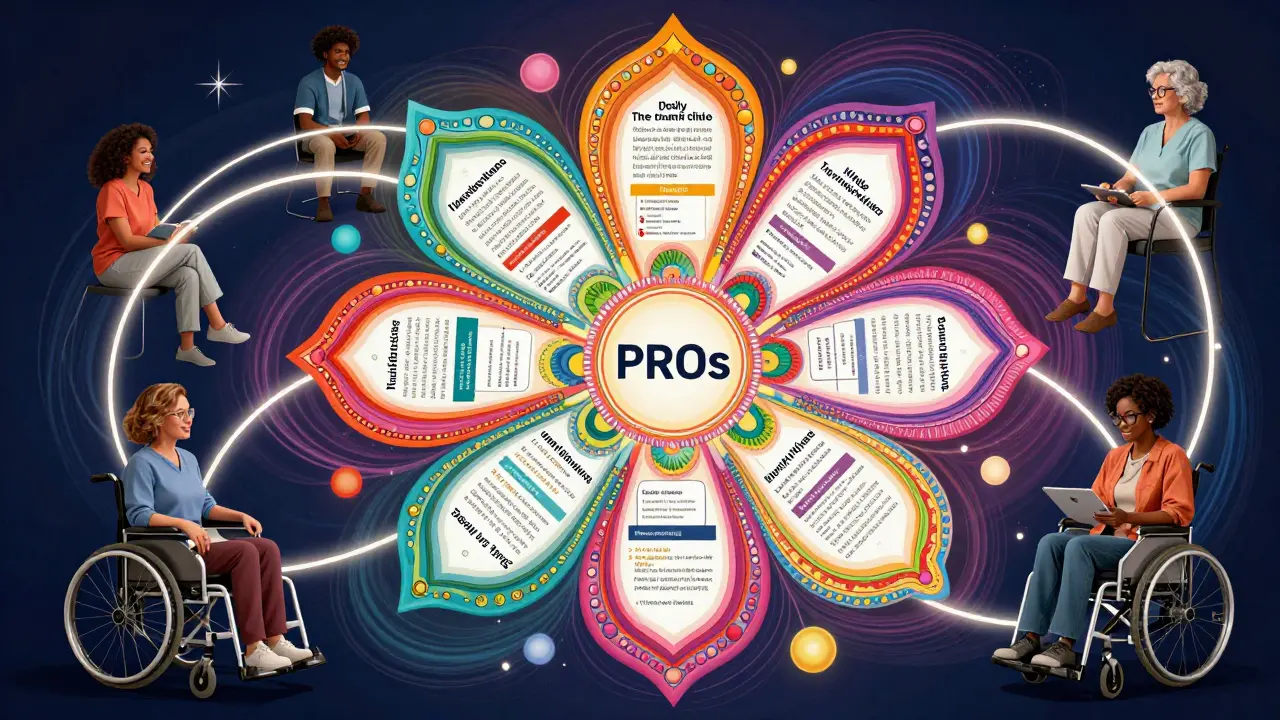
When you take a new medication, your doctor doesn’t know everything you’re feeling. They can’t see your fatigue, your brain fog, or the way your hands shake after dinner. But patient-reported outcomes-or PROs-change that. These are your direct, unfiltered reports about how you’re doing, day after day. And they’re becoming a critical part of how drugs are monitored for safety.
For decades, drug safety relied mostly on doctors reporting side effects during clinic visits. But many symptoms never make it to the chart. Fatigue? You might say you’re "just tired." Numbness in your feet? You figure it’s aging. Nausea after taking pills? You push through because you don’t want to seem weak. These are the exact things PROs catch-because only you can report them.
What Exactly Are Patient-Reported Outcomes?
PROs aren’t guesses. They’re structured answers to specific questions you answer yourself-no doctor interpreting, no nurse summarizing. You might get a text message asking: "On a scale of 0 to 10, how severe was your nausea in the last 24 hours?" Or you might log into a secure app and rate your energy level, sleep quality, or pain intensity. These aren’t random surveys. They’re validated tools, tested over years, with strict standards for accuracy.
The U.S. Food and Drug Administration defines a PRO as "a report that comes directly from a patient without interpretation by a clinician or anyone else." That’s it. No filters. No assumptions. Just your experience.
These tools have names like PRO-CTCAE, PROMIS, and EORTC QLQ-C30. They’re not made in a lab by scientists alone-they’re built with input from real patients. Developers interview people living with conditions like cancer, MS, or chronic pain to make sure the questions actually match what matters to them. One instrument might have 78 symptom items. Another might ask just 10 questions about physical function. But every one has been tested for reliability, validity, and sensitivity to change.
Why Your Reports Matter More Than You Think
Here’s the hard truth: doctors miss a lot. A 2019 FDA study found patients reported 30-40% more side effects than clinicians did. Why? Because some symptoms don’t show up in exams. They don’t show up on blood tests. They’re invisible unless you say them out loud.
Take fatigue. Patients reported it 4.2 times more often than doctors noted it. Neuropathy? 3.8 times more. Cognitive issues? Five times more. These aren’t small differences. They’re life-altering symptoms that affect whether you can work, drive, or play with your kids. Without your input, drug makers and regulators wouldn’t know how common or severe these effects really are.
PROs also catch problems earlier. In one study, patient reports flagged safety signals in 14 days-compared to 42 days for traditional reports. That’s almost six weeks faster. For drugs treating aggressive cancers or rare diseases, that speed can mean the difference between adjusting a dose before a hospital visit-or after.
And it’s not just about counting side effects. PROs help answer the real question: Is this treatment worth it? A drug might shrink a tumor, but if it leaves you too exhausted to leave the house, is that a win? PROs give regulators the full picture-not just the science, but the lived experience.

How PROs Are Collected Today
Most PROs are no longer on paper. Over 87% of global clinical trials now use electronic PROs, or ePROs. You’ll get reminders on your phone. You’ll log in through an app. You might even answer questions via voice call if you don’t use smartphones. These systems are designed to be simple: tap a number, slide a bar, pick from a list. Some even let you type a quick note: "My hands feel like I’m gripping ice all day."
Response rates for ePROs are high-85-92%-because they’re convenient. Paper surveys? Those drop to 65-75%. And timing matters. If you’re asked to report symptoms right after taking your pill, your memory is fresh. If you wait a week? Accuracy drops by about 25%, according to research.
Modern systems also connect to wearables. In one Pfizer trial, patients with eczema wore patches that tracked scratching. The device picked up 73% of the itch episodes patients reported. That’s powerful validation. It proves your words match your body’s behavior.
But it’s not perfect. Some people struggle with tech. Others find the surveys too frequent. One Reddit user said they had to fill out three different questionnaires three times a week. "It became a job," they wrote. That’s a real problem. Too many surveys lead to burnout-and skipped answers.
What Happens When You Report Something?
You might wonder: Does anyone even look at this? The answer is yes-and it changes things.
A breast cancer patient on MedHelp shared that reporting her side effects through an app helped her oncologist lower her dose before she ended up in the ER. That’s not hypothetical. That’s real. PRO data is now part of FDA reviews for cancer drugs. The agency’s 2022 draft guidance says all new oncology drugs must include data from validated PRO tools measuring symptoms, physical function, and disease-specific issues.
Pharmaceutical companies are hiring hundreds of PRO specialists. All of the top 20 drug makers now have dedicated teams. Why? Because regulators demand it. The EU requires patient input in risk management plans. The FDA’s Patient-Focused Drug Development program pushes for PROs in more therapeutic areas every year.
And it’s not just about approval. PROs help shape how drugs are labeled. If a drug causes severe fatigue in 1 in 4 patients, that gets listed in the prescribing information. That helps future patients make better choices.
Challenges and Concerns
PROs aren’t magic. They come with limits.
First, not all tools are equal. An unvalidated questionnaire can give false signals. Dr. Janet Woodcock, former head of the FDA’s drug center, warned that poor tools can mislead regulators. That’s why validation takes 18-24 months and costs up to $750,000 per instrument. It’s expensive-but necessary.
Second, literacy and language matter. If questions are too complex, or not translated well, responses get skewed. Forward-backward translation (translating then translating back to check accuracy) costs about $25,000 per language. Many trials still don’t do this well.
Third, feedback is often missing. A 2022 survey found 68% of patients felt their PRO responses didn’t lead to any change in their care. That’s disheartening. If you’re reporting pain every day and never hear back, you stop caring. The best programs send simple replies: "Thanks for sharing. We’ve noted your fatigue report and will discuss it at your next visit."
Finally, access isn’t equal. Older adults, low-income patients, and those without smartphones may be left out. If PROs become mandatory, we risk widening health gaps. That’s why some trials still offer phone-based or paper options.
What You Can Do Right Now
If you’re in a clinical trial, your participation matters. Don’t skip your PRO entries-even if you think it’s "not a big deal." Your fatigue, your sleeplessness, your mood swings-they all add up. These aren’t just data points. They’re signals that could change how future patients are treated.
If you’re not in a trial but take prescription drugs, ask your doctor: "Do you use patient-reported outcomes to track side effects?" If they don’t know what you mean, share this: "There are apps and forms where patients report how they feel daily. It helps doctors catch problems early. Could we use something like that?"
And if you’re frustrated by too many surveys? Say so. Patient advocates are pushing for smarter, shorter PRO tools. Your voice can help shape them.
PROs are turning passive patients into active partners in drug safety. You’re not just taking a pill. You’re helping build a safer system-for yourself and for everyone who comes after you.

rahulkumar maurya
Let’s be real-PROs are just another corporate veneer wrapped around the same old paternalistic healthcare model. You think your ‘daily feedback’ changes anything? Nah. It’s data mining with a woke sticker. The FDA doesn’t care about your fatigue; they care about liability metrics. And don’t get me started on ‘validated tools’-half of them were designed by PhDs who’ve never taken a pill that made them vomit at 3 a.m.
Meanwhile, pharma hires ‘PRO specialists’ like they’re hiring PR flacks. 87% ePRO adoption? Cute. That’s just another way to shift the burden of monitoring onto the patient while the company collects patentable datasets. You’re not a partner. You’re a sensor.
And yes, I’ve seen the studies. I’ve read the white papers. I’ve sat through the webinars. This isn’t innovation. It’s rebranding exploitation as empowerment. Wake up.
Demetria Morris
I’m not saying this is wrong, but I’ve filled out 37 PRO surveys in 14 months. I’ve reported nausea, brain fog, anxiety, numbness, and two episodes where I couldn’t lift my coffee cup. No one ever responded. No one ever changed anything. I’m not even mad anymore-I’m just… tired. Like, soul-tired.
They say ‘your voice matters.’ But when your voice echoes in an empty server room, it stops feeling like a voice. It feels like a tax.
pradnya paramita
From a clinical methodology standpoint, PRO instruments like PROMIS and PRO-CTCAE represent a paradigm shift in outcome measurement validity. The psychometric rigor behind item response theory (IRT)-based scoring allows for longitudinal precision that traditional Likert scales cannot achieve. Moreover, the use of adaptive testing reduces respondent burden while maintaining measurement fidelity.
However, the operationalization of ePRO systems often fails to account for ecological validity-i.e., how symptom reporting interacts with real-world contextual variables (sleep hygiene, socioeconomic stressors, medication adherence patterns). Without integrating these covariates, we risk generating high-fidelity noise.
Additionally, the lack of standardized ontologies across platforms (e.g., HL7 FHIR vs. CDISC) creates interoperability fractures that undermine aggregate analytics. This is not a patient problem-it’s an infrastructure failure.
Jamillah Rodriguez
Ugh. I just filled out a 12-question survey at 11:47 p.m. after taking my meds. Again. 😩
I’m not even mad. I’m just… emotionally exhausted. Like, can we please have a ‘skip this week’ button? Or a ‘I’m too tired to rate my energy’ option? 😭
Also, why does the app keep asking me if I ‘felt emotionally drained’ when I literally just cried over my cat’s sneeze? 🤦♀️
Susheel Sharma
Let’s cut through the PR fluff. PROs are a Trojan horse. The industry doesn’t want your feedback-they want your compliance. They want your digital footprint. They want to monetize your suffering through predictive analytics.
And don’t let them fool you with ‘validated tools.’ Validation is a $750k tax on patient pain. Meanwhile, the same companies that built these systems are lobbying to remove safety warnings for drugs that cause suicidal ideation in 1 in 500 patients. Why? Because your ‘fatigue score’ doesn’t fit their profit margin.
And yes, I’ve worked in pharma. I’ve seen the spreadsheets. The patient is not a partner. The patient is a data point with a pulse.
👏👏👏
Joseph Cooksey
It’s fascinating how the narrative around PROs has been so thoroughly sanitized. On the surface, it sounds noble-‘your voice matters.’ But dig deeper and you’ll find that the entire ecosystem is designed to extract value while minimizing accountability.
Think about it: a patient reports severe cognitive dysfunction. The system logs it. The pharma company gets a ‘positive safety signal.’ The FDA says, ‘Good, we have evidence.’ But then? Nothing changes. The drug stays on the market. The dose stays the same. The patient is left to suffer while the company markets the drug as ‘well-tolerated.’
And now, with AI-driven analytics, they’re building models that predict which patients are ‘likely to drop out’ based on their reporting patterns. That’s not patient-centric. That’s predictive attrition engineering.
They’re not listening to you. They’re filtering you.
And worse? They’ve convinced you that you’re helping.
Justin Fauth
Look, I get it. We need better data. But this isn’t ‘patient empowerment.’ It’s digital serfdom. You’re being asked to monitor your own side effects like you’re some kind of unpaid lab tech.
Meanwhile, the same companies that run these systems are lobbying to weaken drug safety laws. They’re cutting clinical trial sizes. They’re pushing for accelerated approvals. And now they want you to do their dirty work for free?
Real talk: if this was a job, you’d get a paycheck. But you’re a patient. So you get a notification. And a badge. And a pat on the head.
Thanks, America.
Meenal Khurana
Thank you for writing this. I filled out my first PRO survey last week. I didn’t think it mattered. But I did it anyway. Just in case.
Shelby Price
So… I’ve been doing this for 8 months. I report my symptoms. I get zero feedback. But I keep doing it. Why? Because I think someone, somewhere, might actually read it. Even if it’s just one person. Even if it’s just once.
It’s not about being heard. It’s about not letting it be silent.
❤️
Jesse Naidoo
I don’t care about the science. I care about the fact that I’ve been reporting the same fatigue for 11 months and my doctor still says, ‘It’s probably the chemo.’
What if I just… stopped? Would they notice? Would they care? Or would they just replace me with someone else who still taps the buttons?
I’m so tired. I’m so tired. I’m so tired.
Sherman Lee
PROs are part of the Great Patient Surveillance Initiative. You think this is about safety? No. It’s about building a behavioral database on millions of people under the guise of healthcare.
Next thing you know, your insurance will deny coverage if your ‘fatigue score’ dips below 6.2 for three consecutive weeks. Or your employer will flag you for ‘non-compliance’ with wellness metrics.
They’re not collecting data to help you. They’re collecting data to control you.
And don’t think I’m paranoid. I’ve seen the patents. I’ve read the filings. They’re already talking about ‘patient risk scoring’ in internal memos.
🚨
Lorena Druetta
Thank you for sharing this important perspective. As someone who works in patient advocacy, I want to affirm that your experience matters deeply-even when it feels invisible. The systems are flawed, yes. But your consistency, your honesty, your courage in reporting-even when no one responds-is not in vain.
Change does not always come with a reply. Sometimes, it comes with a ripple. And your voice? It is part of the wave.
You are not alone.
With deep respect and gratitude,
Lorena