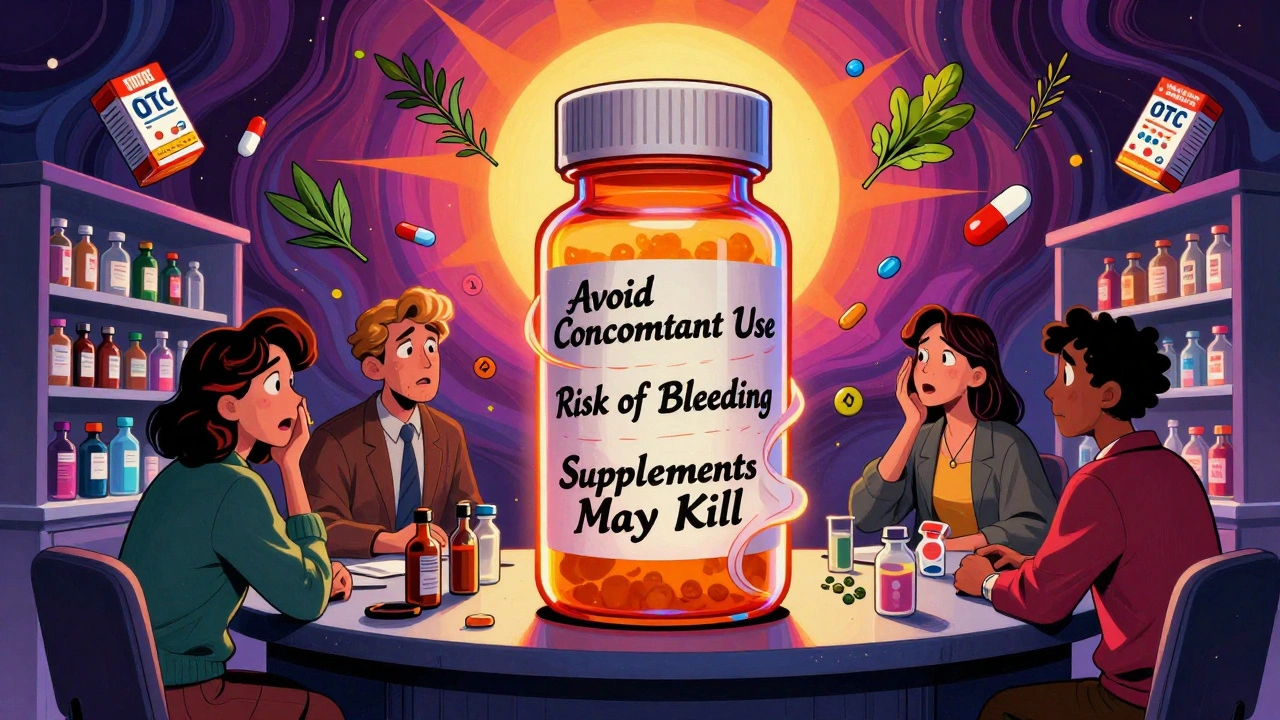
Every time you pick up a prescription, there’s a label on that bottle that could save your life-or hurt you if you don’t know how to read it. It’s not just about when to take the pill. The real danger often hides in the fine print: drug interactions. These happen when two or more medications, supplements, or even foods change how a drug works in your body. The result? Too much of a drug in your system, not enough, or worse-life-threatening side effects like internal bleeding, heart problems, or organ damage.
According to the FDA, preventable drug interactions lead to over 100,000 hospitalizations every year in the U.S. alone. And here’s the scary part: most of these could be avoided if people actually understood what their prescription labels were telling them. But here’s the problem-labels are written in medical jargon, crammed into tiny fonts, and often ignored. A CDC study found that only 41% of adults consistently read their prescription labels. For people taking five or more medications? That number drops to 28%.
What’s on Your Prescription Label (And Where to Look First)
Your prescription label isn’t just a reminder to take your medicine. It’s a legal document with strict FDA requirements. By law, every label must include specific sections that spell out risks, including drug interactions. But they’re not always easy to find. Here’s where to look:
- Warnings and Precautions (Section 5): This is where the FDA requires manufacturers to highlight the most serious interactions-those that can cause death or hospitalization. If your label says, “Avoid concomitant use with warfarin” or “May cause severe bleeding”, this is the red flag section. Don’t skip it.
- Drug Interactions (Section 7): This is the full list. It includes interactions with other prescription drugs, over-the-counter medicines, herbal supplements, and even certain foods. Look for phrases like “Reduce dosage when used with…” or “Monitor for dizziness or low blood pressure.”
- Over-the-Counter (OTC) Labels: Even if you’re not on a prescription, your ibuprofen, allergy pills, or sleep aids have interaction warnings too. Check the “Warnings” section. A BeMedWise study found that 98% of OTC products list critical interactions-but only 57% of people read them.
Here’s a trick: flip the label over. The most important warnings are often printed on the back, in smaller font. Don’t assume the front has everything. The FDA’s 2024 guidance now requires manufacturers to put the “bottom line” upfront-what you need to do right away. Look for bold text, caps, or icons. That’s your signal: this matters now.
Decoding the Jargon: What “Concomitant Use” Really Means
If you’ve ever read a label and thought, “What does this even mean?”-you’re not alone. A Reddit thread with over 1,200 pharmacy-related comments found that 78% of users were confused by terms like “concomitant use” or “synergistic effect.” Here’s the plain English version:
- Concomitant use = Taking two drugs at the same time.
- Avoid concomitant use = Don’t take these together. Period.
- Monitor for = Watch for these symptoms: dizziness, nausea, unusual bruising, rapid heartbeat. If you feel them, call your doctor.
- Reduce dosage = Your doctor might need to lower the amount of one or both drugs.
- May increase risk of = This combo makes a side effect more likely-like bleeding, liver damage, or low blood pressure.
Don’t guess. If you’re unsure, write down the exact phrase from the label and ask your pharmacist: “What does this mean for me?” Pharmacists are trained to translate this language. A Drugs.com survey showed that 83% of users who asked a pharmacist for help understood their label warnings better than when they read them alone.
The Hidden Danger: Supplements and Herbal Products
Many people think supplements are harmless because they’re “natural.” That’s a deadly myth. Ginkgo biloba, garlic, St. John’s wort, and even high-dose vitamin E can interact dangerously with prescription drugs. Take warfarin, a blood thinner. If you take it with ginkgo biloba, your risk of internal bleeding jumps by 300%. Yet, prescription labels only mention supplement interactions in 17% of cases-even though they cause 32% of serious drug interactions, according to Harvard Medical School.
Here’s what you need to do: make a full list of everything you take-not just prescriptions. Include:
- Every vitamin and mineral
- Herbal teas and supplements
- Probiotics and fish oil
- Over-the-counter painkillers, cold meds, and sleep aids
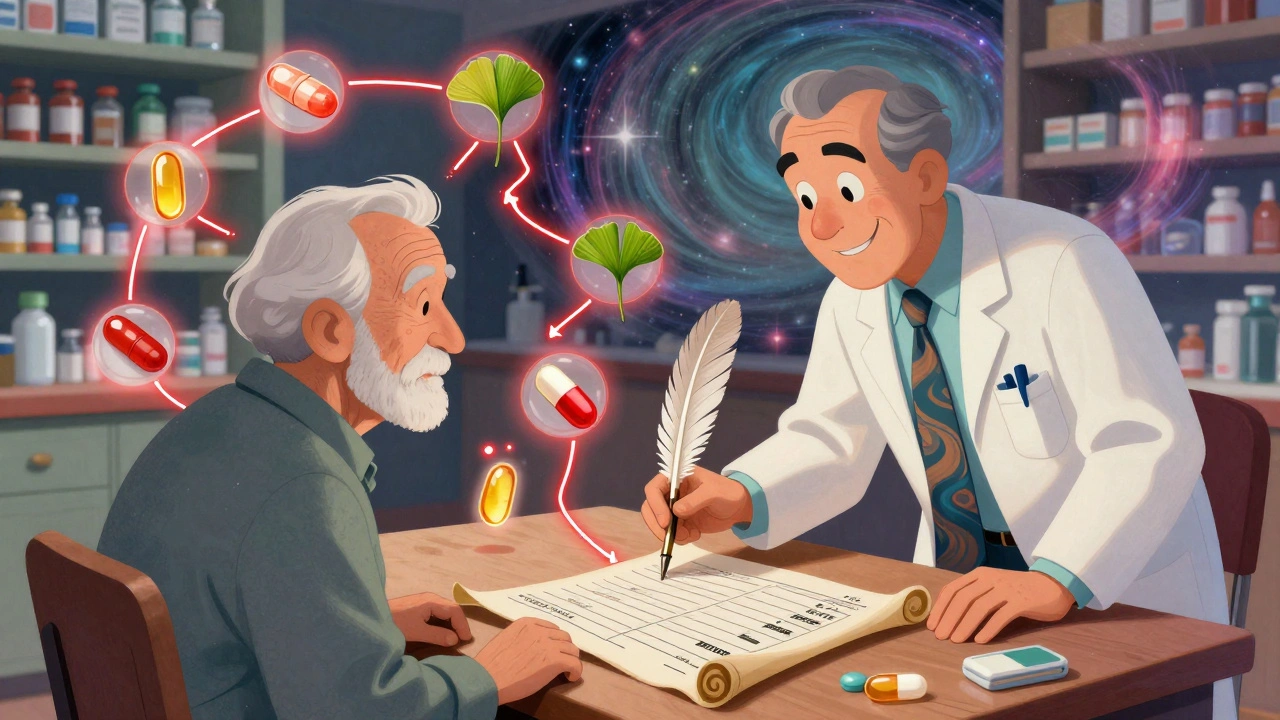
Bring this list to every doctor’s visit and every pharmacy pickup. A 2023 study of 10,000 pharmacy consultations found that 22% of patients had at least one dangerous interaction their doctor didn’t know about-because the patient didn’t mention the supplement.
How to Use Digital Tools-Without Replacing the Label
There are apps like Drugs.com Drug Interactions Checker that let you enter all your meds and get a report. They’re useful. They process 1.2 million queries a month and are 89% accurate. But here’s the catch: they only cover 92% of prescription drugs. Prescription labels cover 100%. Why? Because labels are updated by the manufacturer based on real clinical data approved by the FDA. Apps rely on databases that lag behind.
Use apps as a second check-not your first. Enter your meds into Drugs.com after you’ve read your label. If the app flags something your label didn’t, take it to your pharmacist. Don’t assume the app is right and the label is wrong. The label is the legal standard.
Also, don’t rely on Google. Searching “does aspirin interact with metoprolol?” gives you a mix of forums, ads, and outdated info. Stick to trusted sources like the FDA website or your pharmacist’s advice.
What to Do When You Pick Up a New Prescription
Don’t just walk out the door. Use this 3-step routine every time:
- Ask: “Is this safe with everything else I take?” Hand your pharmacist your full medication list. They’re legally required to review it for interactions.
- Check the label for bold text or warning icons. Look for phrases like “Avoid,” “Do not use,” or “Consult your doctor.”
- Write the reason on the bottle. Harvard Medical School recommends writing “for high blood pressure” or “for anxiety” right on the bottle. Why? People mix up pills with similar names-like Klonopin (clonazepam) and clonidine. That’s a common error that leads to 12% of medication mix-ups reported to the FDA.
For parents: When giving medicine to kids, follow the CDC’s “Check the Label” rule: Read the label, follow directions, measure dose using the device that came with the medicine. A 2023 trial showed this reduced pediatric dosing errors by 31%.
Why You Still Need to Talk to Your Doctor or Pharmacist
Even with perfect label reading, you can’t do it alone. A 2023 Duke-Margolis study found that only 38% of doctors could find critical interaction info in a label within 30 seconds during a busy clinic visit. That’s not your fault. The system is broken.
But you can fix it for yourself. If you’re on five or more medications, ask for a medication therapy management (MTM) session. Many pharmacies offer this for free. A pharmacist spends 30 minutes with you, reviews every pill, supplement, and herb, and gives you a printed plan. It’s not a luxury-it’s a safety net.
And if you’re over 65? You’re in the highest-risk group. 67% of seniors take five or more medications daily. The FDA is testing QR codes on bottles that link to updated interaction info. Pilot programs start in early 2025. Until then, your best tool is still your voice: ask questions. Write down your concerns. Bring your list. Don’t assume someone else will catch it.
Bottom Line: Your Label Is Your Shield
Prescription labels aren’t meant to be ignored. They’re your first and most reliable defense against dangerous drug interactions. You don’t need to be a doctor. You just need to be curious. Take two minutes. Read the back. Write down the warnings. Talk to your pharmacist. Keep a list. Don’t let confusion kill you.
Drug interactions are preventable. But only if you act.

Suzanne Johnston
It’s wild how we treat prescription labels like fine print on a cell phone contract-something to skim and ignore until something goes wrong. But this isn’t about legal loopholes; it’s about your liver, your heart, your brain. The fact that 72% of people don’t read the back of the bottle is a systemic failure, not a personal one. We need plain-language labels, mandatory pharmacist consultations, and maybe even a visual icon system like airport safety cards. This isn’t just education-it’s public health infrastructure.
Andrea Petrov
They don’t want you to know this, but the FDA allows drug companies to bury interaction warnings in 5-point font because they know most people won’t read it. Big Pharma profits when you mix your blood thinner with that ‘natural’ ginkgo supplement-because then you end up in the ER, and they sell you the next drug to fix what the last one broke. And don’t get me started on how they lobby to keep QR codes off bottles. This isn’t negligence-it’s deliberate.
Graham Abbas
I used to think supplements were harmless because ‘natural’ meant safe. Then my uncle ended up in ICU after mixing St. John’s wort with his antidepressants. Turns out, ‘natural’ just means unregulated. I now carry a laminated card in my wallet with every pill I take-prescription, supplement, even that turmeric tea I drink at 7 a.m. My pharmacist calls it ‘The Life List.’ It’s saved me twice. If you’re on five meds or more, do this. It’s not paranoia-it’s precision.
George Taylor
Ugh. Another ‘read your label’ article. Like anyone has time for this. I’ve got three kids, a job, and a dog who thinks my socks are his personal chew toys. I don’t have time to decode ‘concomitant use.’ If my doctor prescribes it, it’s fine. If I feel weird, I’ll call them. Why do people make this so complicated? It’s just pills. You take them. End of story. 😴
Chris Marel
This is the kind of post that reminds me why I’m grateful for my community pharmacist. She remembers my name, my allergies, and that I take fish oil for my knees. Last month, she caught that my new blood pressure med clashed with my magnesium supplement-something my doctor missed. I just handed her my list. She didn’t judge. She just fixed it. Maybe the real solution isn’t better labels… it’s better human connection.
William Umstattd
Let’s be clear: if you can’t read a prescription label, you shouldn’t be taking prescription drugs. This isn’t rocket science. It’s basic literacy. The fact that 59% of Americans can’t interpret ‘monitor for dizziness’ is a national disgrace. No one’s holding your hand through life. If you’re too lazy to read a two-minute warning, don’t blame the system when you end up in the ER. You signed the waiver. You’re responsible.
Elliot Barrett
Wow. Another ‘you’re all idiots’ lecture. I read my labels. I use apps. I bring lists. And still, my pharmacist gave me the wrong dosage because the bottle was misprinted. So what’s the point? The system is broken. Labels aren’t the problem-the manufacturers and pharmacies are. You’re blaming the patient for a design flaw that costs billions. Pathetic.
Maria Elisha
lol i just google everything now. like ‘does metformin make you dizzy with coffee?’ and 90% of the time someone on reddit already asked it. why waste time reading tiny font when the internet has the answer? 🤷♀️
iswarya bala
thank u for this post!! i was takin ginkgo for memory and my bp med and never knew it was risky. now i keep all my meds in a pill box with notes. my grandma says ‘better safe than sorry’ and she’s 82 and still walking. 🙏
Stacy Tolbert
I cried reading this. My mom died last year from a drug interaction no one saw coming. She took her meds exactly as prescribed. The label said ‘avoid with NSAIDs’ but she didn’t know ibuprofen was an NSAID. She thought ‘painkiller’ was just ‘painkiller.’ I’ve spent every day since trying to make sure no one else loses someone like this. Please. Read the back. Write it down. Ask. It’s not about being smart-it’s about being alive.
Ryan Brady
USA = safest country for meds. If you can’t read a label, maybe you shouldn’t be here. 🇺🇸 Just take your pills and shut up. We don’t need all this overthinking. Also, QR codes? Nah. That’s a globalist scam. Stick to the paper. America knows best. 💪