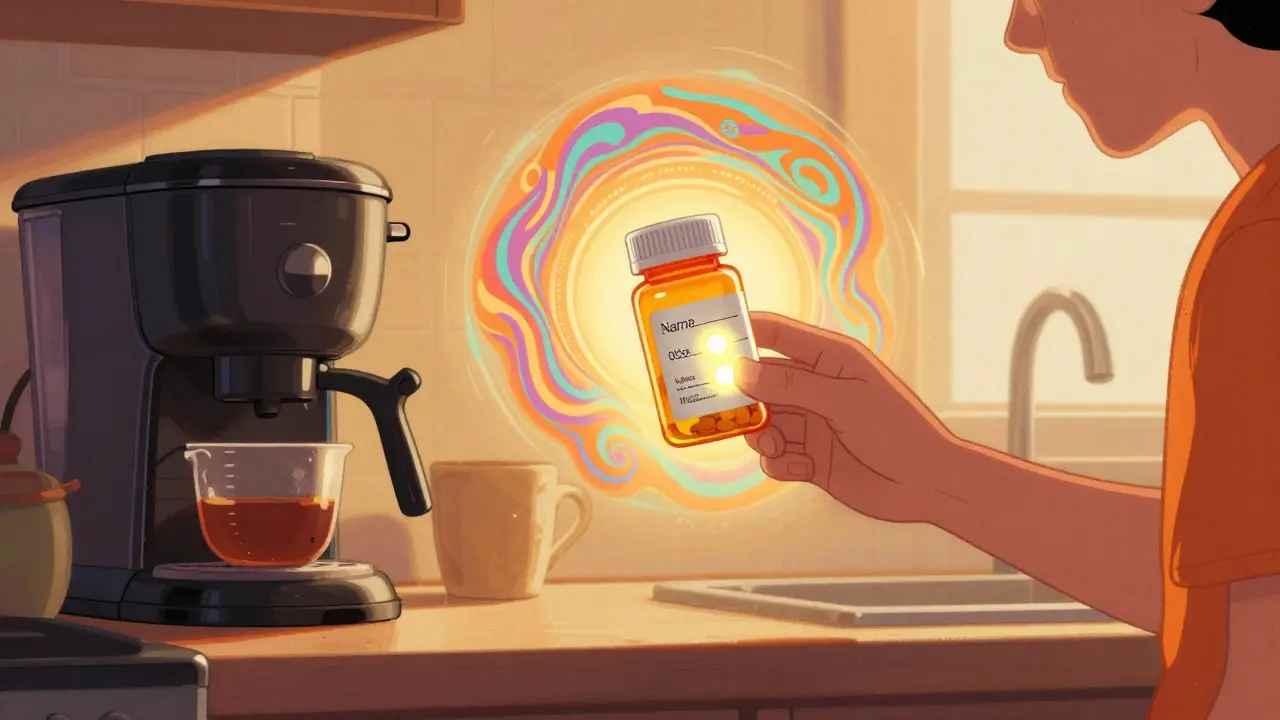
Every year, thousands of people in the U.S. die because they took the wrong pill. Not because they were careless. Not because they didn’t care. But because they didn’t stop to check the label. It happens fast. Morning rush. Coffee in one hand. Pills in the other. You’ve taken this same bottle for months. You know what’s inside. You don’t need to look. But that’s exactly when the mistake happens.
Checking your medication label before every dose isn’t just a good idea. It’s your last line of defense. And it’s not hard to do. But like brushing your teeth, it only works if you do it every single time - even when you’re tired, distracted, or sure you’re right.
Why Checking Labels Saves Your Life
Medication errors are one of the leading causes of preventable harm. According to the FDA, between 7,000 and 9,000 people die each year in the U.S. because of mistakes like taking the wrong drug, wrong dose, or wrong time. A shocking 33% of those errors come from confusion over the label - not the doctor’s prescription, not the pharmacist’s mistake. It’s the patient who doesn’t check.
Think about it: you might be on five, six, even ten different pills. Some look almost identical. One is for blood pressure. Another is for cholesterol. One might be a green capsule. Another is a white tablet. They’re both for your heart - but they do totally different things. Mix them up, and you could end up in the hospital. Or worse.
Studies show that people who check their labels before every dose reduce their risk of a medication error by up to 76%. That’s more than double the protection you get from using a pill organizer alone. And it’s way more reliable than any app that just reminds you to take your medicine - unless that app makes you verify the label first.
What to Look For: The 10 Essential Elements
You don’t need to be a pharmacist to read a label. But you do need to know what to look for. Here’s what every prescription label should have - and what you must check every single time:
- Your full name - Does it match your ID? If it says “J. Smith” and you’re “Jennifer Smith,” that’s a red flag.
- Drug name - Both brand (like Lipitor) and generic (atorvastatin). If the name changed since your last refill, ask why.
- Dosage - Is it 10 mg? 20 mg? 50 mg? Don’t guess. Read it. A 10 mg pill is not the same as a 50 mg pill.
- How often to take it - “Take once daily” doesn’t mean “take whenever you remember.” Is it morning? Night? With food?
- Quantity and refills - Did you get the right number of pills? Are there refills left?
- Expiration date - Never take expired medicine. It can lose strength or even become harmful.
- Warnings - “May cause drowsiness.” “Do not drink alcohol.” “Avoid grapefruit.” These aren’t suggestions. They’re safety rules.
- Prescriber’s name - Is this the doctor you saw? Or did someone else write this prescription?
- Pharmacy name and phone - If something looks wrong, call them. They’re there to help.
- Date filled - Was this filled last week? Or six months ago? Old meds can be dangerous.
You don’t need to memorize all ten. Just make a habit of scanning them. Spend three to five seconds on each bottle. That’s all it takes.
The Three-Touch Method: Train Your Hands, Not Just Your Memory
Memory fails. Especially when you’re tired. Or stressed. Or in a hurry. That’s why experts say: don’t rely on memory. Train your body instead.
The Three-Touch Method is simple. It’s used by pharmacists and recommended by the American Society of Health-System Pharmacists (ASHP). Here’s how it works:
- Touch the patient’s name on the label. Say it out loud: “This is Jennifer Smith.”
- Touch the drug name and dosage. Say: “This is atorvastatin, 20 milligrams.”
- Touch the instructions. Say: “Take one pill every morning with food.”
That’s it. Three touches. Three spoken words. It takes less than ten seconds. But it works. In a clinical trial, people who used this method had 92% adherence to safe dosing after 30 days. Those who just looked silently? Only 64%.
Why does it work? Because you’re engaging your senses - sight, touch, speech. Your brain doesn’t just “know” the info. It experiences it. That’s how habits stick.
Where to Place Your Meds: Trick Your Brain into Remembering
Habits form around cues. If you want to check your label every time, you need to make the cue impossible to ignore.
Most people keep their pills in a bathroom cabinet, a drawer, or a medicine cabinet. But those are places you go to get dressed, brush your teeth, or wash your hands - not places you associate with taking medicine.
Instead, place your pills where you already have a daily routine:
- Next to your coffee maker - morning dose becomes part of your coffee ritual.
- On your nightstand - evening dose links to brushing your teeth.
- On the kitchen counter - lunchtime dose ties into your meal prep.
When you see the bottle in that spot, your brain says: “Ah, this is where I check my label.” No thought required. Just action.
One study found that moving bottles into the path of daily routines reduced missed checks by 53%. That’s more than half of all errors avoided - just by changing where you keep your pills.
Tools That Help: Magnifiers, Color-Coding, and Checklists
Some people need extra help. That’s okay. You’re not weak for using tools. You’re smart.
Magnifying labels - If your vision isn’t perfect, get a small handheld magnifier. Or use your phone’s camera zoom. Many pharmacies now offer large-print labels on request. Ask for them.
Color-coded systems - Use colored stickers or tape to mark different types of pills. Red for blood pressure. Blue for cholesterol. Green for diabetes. Pharmacists say 82% of them recommend this to patients managing five or more medications.
Checklists - Print out a simple list of the 10 elements above. Tape it to your medicine cabinet. Or keep it in your wallet. When you pick up a new prescription, go through the list with the pharmacist. Say: “Can you walk me through each of these?”
And if you’re helping someone else - a parent, a partner - use the teach-back method. Ask them: “Can you tell me what this pill is for and how to take it?” If they can’t explain it clearly, they haven’t learned it. Go over it again.
Why Apps Alone Aren’t Enough
There are hundreds of medication reminder apps. They beep. They buzz. They send texts. But most of them don’t require you to verify the label. And that’s the problem.
Amazon reviews show that apps that make you take a photo of the label before logging a dose have 63% higher retention after 90 days. Why? Because they force you to look. They turn checking from a suggestion into a requirement.
If you use an app, pick one that asks: “Did you verify the name, dose, and instructions?” Don’t settle for one that just says, “Take your pill now.”
What Doesn’t Work - And Why
Some people think: “I’ve been taking this for years. I don’t need to check.” That’s the most dangerous myth.
Pharmacists see it all the time. Someone takes their insulin thinking it’s saline. Or they take two blood pressure pills because they forgot they already took one. Or they take a new version of a drug because the pill shape changed - and they didn’t notice.
And here’s the hard truth: 83% of people who rely on memory stop checking within two weeks. Even if they swear they’ll be careful. The brain is lazy. It takes shortcuts. That’s why training your hands, not your memory, is the only way to make this stick.
Label checking also doesn’t work if:
- The font is too small (FDA says labels now must be at least 6-point sans-serif for key info).
- The pharmacy uses confusing abbreviations like “QD” instead of “daily.”
- You’re overwhelmed by too many pills.
If any of these are true for you, talk to your pharmacist. Ask for a simplified label. Ask for a blister pack. Ask for help. You’re not being difficult. You’re being safe.
It’s Not Just About You
Medication safety isn’t a solo act. It’s a team sport. Your doctor. Your pharmacist. Your family. You.
One woman on Reddit shared how she trained her kids to check labels by making it a game. Every time they took a pill, they had to say the name, dose, and reason out loud. After 21 days, it became automatic. No more arguments. No more mistakes.
Another man, 78, kept confusing his insulin with saline solution. His daughter started keeping his meds in the fridge with a bright red sticker. Every time he opened the fridge, he saw it. He started checking. He’s been error-free for a year.
When you make checking labels a habit, you’re not just protecting yourself. You’re protecting everyone who loves you.
Start Today - One Bottle at a Time
You don’t need to fix everything at once. Start with one pill. The one you take every morning. The one you think you know by heart.
Tomorrow, when you pick it up, use the Three-Touch Method. Touch the name. Touch the dose. Touch the instructions. Say them out loud.
Do it again the next day. And the next. After 18 to 22 times, your hand will move to the label before you even think about it. That’s when it becomes a habit.
Medication errors aren’t caused by bad people. They’re caused by busy lives, tired brains, and habits we never trained.
You can change that. Right now. With one simple step: Check the label before every dose.
It’s not about being perfect. It’s about being present. One bottle. One check. One life saved.

shivam seo
This is the most condescending garbage I've read all week. You think people are too stupid to remember their own meds? Try telling that to the 80-year-old who's been taking the same blue pill for 12 years. My grandma doesn't need a three-touch ritual. She needs respect.
Andrew Kelly
Let me guess - this was written by someone who works for Big Pharma. The FDA doesn't care about your 'three-touch method.' They care about liability. And if you think your pill bottle is safe, you haven't seen what happens when the government mandates labels. I've seen labels changed overnight - same pill, different name, same dosage, but now you're told it's for 'cardiovascular support' instead of 'high blood pressure.' Coincidence? Or a cover-up?
Anna Sedervay
I must express my profound concern regarding the epistemological foundations of this piece. The assumption that human memory is inherently fallible presupposes a Cartesian dualism between cognition and corporeal action - a framework that has been thoroughly deconstructed by post-structuralist theorists such as Derrida and Foucault. Furthermore, the suggestion that tactile engagement with pharmaceutical packaging constitutes a 'habit' is a reductive anthropological fallacy. One must interrogate the power structures embedded in the very notion of 'label-checking' - is this not merely a mechanism of medical surveillance?
Ashley Bliss
I've been taking my meds for 17 years. I've buried two husbands. I've raised three kids through cancer. And now you want me to touch my pill bottle like I'm performing a sacred ritual? You don't get it. This isn't about memory. It's about dignity. When you make people touch and say things out loud, you're infantilizing them. I don't need a checklist. I need to be trusted. And if I make a mistake? Then I'll face the consequences. But don't you dare tell me I'm not smart enough to know my own body.
Mahammad Muradov
In India, we don't have this problem. We take medicines with tea. No labels. No apps. Just experience. Your system is broken because you overthink everything. One pill, one time. If you mix them up, you die. Simple. No need for three touches. Your brain is too busy. We just feel it.
holly Sinclair
There's something deeply poetic about the act of checking a label - it's not just safety, it's mindfulness. In a world where we're constantly rushing, where every second is monetized, where our attention is fragmented into micro-doses of dopamine, pausing for three seconds to touch, speak, and confirm - that’s a radical act of resistance. It’s a reclamation of agency. The label isn't just ink on plastic; it's a contract between your body and the pharmaceutical industrial complex. To read it is to say: 'I am still here. I still choose.' And in a culture that reduces us to data points, that’s revolutionary.
Monte Pareek
Look I've been a pharmacist for 28 years and I've seen everything. The Three-Touch Method works because it bypasses the brain and goes straight to the nervous system. You think you're being lazy? No you're being human. Your brain is wired to save energy. That's why you need to trick it. Put the bottle by your coffee. Say it out loud. Do it every morning for 21 days. That's not magic. That's neuroscience. And if you're helping an elderly parent? Don't just tell them. Do it with them. Hold their hand. Say it together. That's how you save lives. Not with apps. Not with fear. With connection.
Tim Goodfellow
Bloody brilliant. This isn't just advice - it's a revolution in tiny increments. Three touches. One breath. A moment of stillness in a world that screams at you to hurry up. I've started doing this with my insulin. Touched the name. Said it out loud. Felt the ridges on the bottle. And you know what? I stopped feeling like a patient. I started feeling like the boss of my own damn body. If you're still skipping this? You're not just risking your health. You're letting the chaos win.
mark shortus
I JUST GOT A NEW PRESCRIPTION AND THE LABEL SAID 'TAKEN ONCE DAILY' BUT THE PHARMACIST WROTE 'QD' AND I THOUGHT IT MEANT 'QUICK DAILY' SO I TOOK IT THREE TIMES. I ENDED UP IN THE ER. NOW I HAVE A STICKER ON MY FRIDGE THAT SAYS 'READ THE LABEL OR DIE.' I'M NOT KIDDING. THIS ISN'T A DRILL. I'M STILL SCARED. DON'T BE LIKE ME.
Lynsey Tyson
I get why this feels overwhelming. I used to hate checking labels because it made me feel like I was failing. But then I started doing it with my mom - we’d sit together, sip tea, and go through the bottle like it was a puzzle. It became a quiet ritual. Not a chore. Not a punishment. Just us. And now I don’t even think about it. It just… happens. Maybe that’s the real secret - not the method, but the company.
Edington Renwick
You think this is about pills? No. This is about control. Who controls your body? The doctor? The pharmacist? The algorithm that decides what pills you get? This 'habit' is just another way to make you obedient. You're being trained to perform safety like a good little citizen. But what if the pill is wrong? What if the label is wrong? What if the whole system is rigged? You checking your bottle won't fix that. It just makes you feel safe while the machine keeps spinning.
Aboobakar Muhammedali
I read this and i just cried. My uncle died because he took the wrong pill. He was 68. He thought it was his heart medicine. It was his sugar medicine. He never checked. He was too proud. I wish i had done this with him. Now i do it every morning with my mom. I touch the bottle. I say the name. I say the dose. I say i love you. And then i give it to her. Its not just about safety. Its about being there.
Laura Hamill
I used to think this was dumb. Then my sister took 50mg of her blood pressure med thinking it was 10mg. She had a stroke. Now i have a red light on my nightstand that flashes when i pick up her pills. And i scream the name out loud. I'm not ashamed. I'm alive. 😭