Imagine picking up your blood pressure medication or diabetes pill, confident it will help you feel better. Now imagine that same pill contains trace amounts of a known carcinogen. This isn't a hypothetical scenario from a sci-fi movie; it is the reality of the nitrosamine contamination crisis that has shaken the pharmaceutical industry since 2018. For patients relying on affordable generic medicines, this issue raises urgent questions about safety, trust, and what regulators are actually doing to protect public health. As we move through 2026, the landscape has shifted dramatically from panic to a complex, ongoing battle for quality control.
The Nitrosamine Crisis Explained
To understand why this matters, we first need to look at what nitrosamines are. These are chemical compounds formed when nitrites react with amines under specific conditions. They are not usually added intentionally to drugs but form as unwanted byproducts during manufacturing or storage. The International Agency for Research on Cancer (IARC) classifies many of these compounds as probable or possible human carcinogens. Even tiny amounts-measured in nanograms per day-can pose long-term cancer risks.
The trouble started in earnest in 2018 when the U.S. Food and Drug Administration (FDA) discovered N-Nitrosodimethylamine (NDMA), a potent carcinogen, in batches of valsartan, a common blood pressure medication. This wasn't an isolated incident. It triggered a domino effect across multiple drug classes. Since then, regulators have identified various nitrosamine species, including N-Nitrosodiethylamine (NDEA) and numerous nitrosamine drug substance-related impurities (NDSRIs). The scope of the problem expanded far beyond initial expectations, affecting everything from antihypertensives to antidepressants.
Recent Cases and Scope of Recalls
The scale of the response has been massive. From 2018 through mid-2025, the FDA oversaw more than 40 specific drug product recalls linked directly to nitrosamine contamination. However, the number of total recalls due to unacceptable levels in active pharmaceutical ingredients (APIs) exceeds 500. This distinction is crucial: while finished products hit the news headlines, the underlying issue often lies in the raw materials used to make them.
Which drugs have been affected? The list is extensive and includes:
- Angiotensin II Receptor Blockers (ARBs): Valsartan and losartan were the first major casualties.
- Ranitidine: The popular heartburn medication Zantac was pulled from the market entirely in many regions.
- Antibiotics: Rifampin and other immediate-release antibiotics have faced scrutiny.
- Diabetes Medications: Metformin, one of the most widely prescribed drugs globally, has seen multiple recall waves.
- Antidepressants and Smoking Cessation Aids: Duloxetine and varenicline have also been implicated.
In late 2025, even newer entrants to the generic market faced challenges. Sun Pharmaceutical Industries, for instance, recalled a generic version of Vyvanse in the fall of 2025, highlighting that the problem is not confined to older formulations. These recalls are not just bureaucratic exercises; they mean immediate shortages for patients who depend on these medications for chronic condition management.
| Impurity Type | Common Name | FDA Acceptable Intake Limit (ng/day) | Primary Risk Factor |
|---|---|---|---|
| Nitrosamine | NDMA | 96 | Synthesis solvents, excipients |
| Nitrosamine | NDEA | 26.5 | Manufacturing reagents |
| NDSRI | N-nitroso-varenicline | 96 | Drug substance reaction |
| NDSRI | N-nitroso-duloxetine | 96 | Chemical structure instability |
Regulatory Response: FDA and Global Agencies
The regulatory landscape has evolved rapidly. The FDA’s approach has been the most aggressive among global regulators, setting strict acceptable intake (AI) limits. Their September 2024 guidance, "Control of Nitrosamine Impurities in Human Drugs," established clear benchmarks. For example, the limit for NDMA is 96 ng/day, while NDEA is much stricter at 26.5 ng/day. For drug-specific impurities (NDSRIs), the limit is generally set at 96 ng/day unless toxicological data suggests otherwise.
A critical update occurred in June 2025. The FDA softened its stance on the August 1, 2025 compliance deadline for NDSRIs. Instead of demanding full compliance, the agency began accepting progress reports under 21 C.F.R. § 314.81(b)(2). This shift acknowledges the practical difficulties manufacturers face. Lilun Murphy, director of the FDA's Office of Generic Drugs, emphasized in October 2025 that while urgency remains, the path to compliance requires time for root cause analysis and stability testing.
How do other agencies compare? The European Medicines Agency (EMA) has issued 32 nitrosamine-related recalls through mid-2025. While their framework is similar, the EMA’s implementation timeline is staggered, extending through 2026. Health Canada, the UK’s MHRA, Brazil’s ANVISA, and Japan’s PMDA have also reported between 5-15 recalls each. The key difference is the pace: the FDA’s earlier deadlines created immediate pressure, whereas other regions allowed slightly more breathing room for supply chain adjustments.
Why Do Nitrosamines Form?
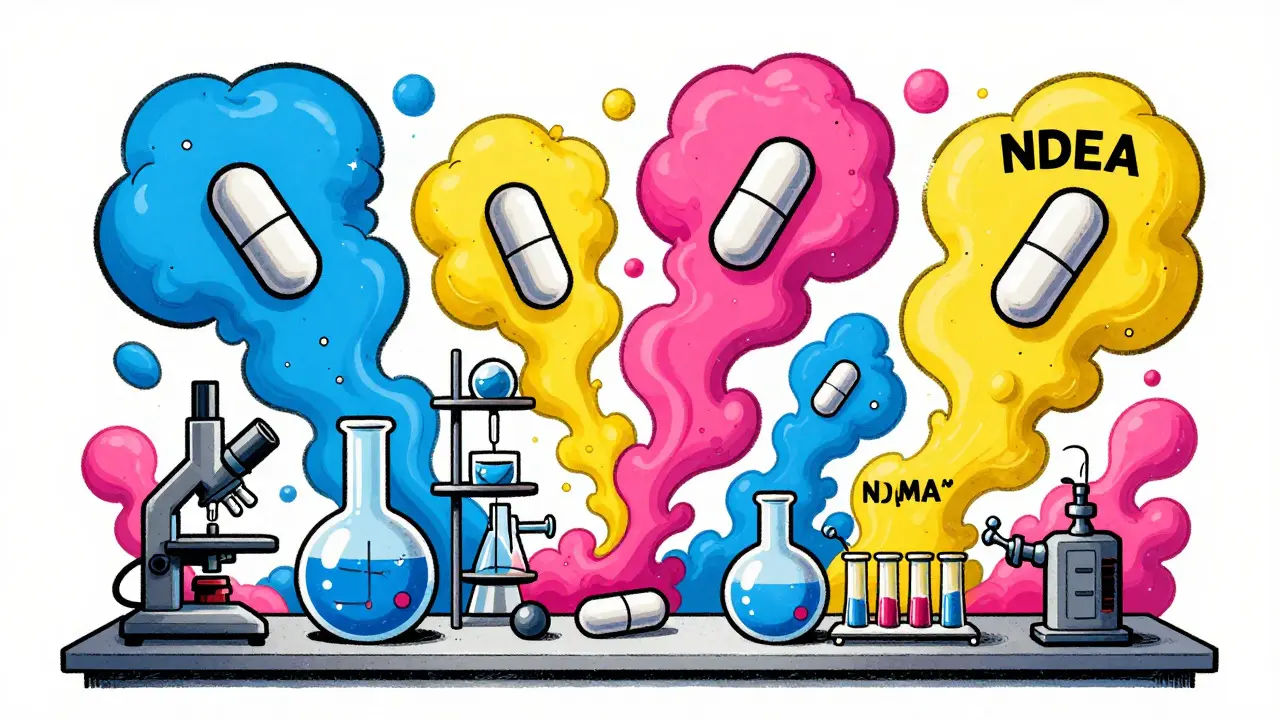
Understanding the source is key to solving the problem. Nitrosamines form through chemical reactions between nitrosating agents (like nitrites) and secondary or tertiary amines. These reactions can happen in several places:
- Active Pharmaceutical Ingredients (APIs): The chemical synthesis process itself may introduce nitrosating agents.
- Excipients: Inert ingredients like magnesium stearate can contain nitrite impurities. A 2025 case study revealed that nitrite impurities in magnesium stearate from a single supplier caused NDEA formation in three different ARB products.
- Manufacturing Conditions: Temperature, pH, and exposure to light can accelerate formation.
- Packaging: This is an emerging concern. Adhesives, colorants, or amine-based materials in blister films and bottle liners can act as sources of nitrosating agents during shelf life.
The complexity lies in the fact that fixing one pathway might create another. Manufacturers report that reformulating a product to remove a nitrite source sometimes introduces new risks elsewhere in the process. This is why the FDA now emphasizes comprehensive risk assessments rather than simple spot checks.
Impact on Patients and Supply Chains
The human cost of this crisis is significant. During the peak of the ARB recalls in 2018-2020, 15-20% of these products experienced temporary shortages. For patients with hypertension, missing doses can lead to dangerous spikes in blood pressure, increasing the risk of stroke or heart attack. Similar disruptions have affected metformin supplies, impacting millions of diabetics.
Beyond shortages, there is the issue of trust. When patients hear "carcinogen" associated with their daily medication, anxiety rises. Many switch brands unnecessarily or stop taking medication altogether. Pharmacists play a vital role here, providing reassurance based on current testing data and alternative options.
For the industry, the financial impact is severe. Comprehensive nitrosamine testing programs cost mid-sized generic manufacturers between $500,000 and $2 million annually. Evaluate Pharma’s 2025 analysis shows that compliance costs have reduced profit margins for generic manufacturers by 3-5 percentage points industry-wide. This has accelerated consolidation, with smaller players struggling to afford the required analytical capabilities. Larger companies like Teva Pharmaceuticals and Fresenius Kabi have gained a competitive edge by investing early in robust quality systems.
What Is Being Done to Fix It?
Manufacturers are implementing multi-layered control strategies. First, they conduct thorough risk assessments per FDA guidance, identifying all potential formation pathways. Second, they deploy highly sensitive analytical methods, such as LC-MS/MS, capable of detecting nitrosamines at parts-per-billion levels (0.3-3 ng/mL). Third, they reformulate products where necessary, swapping out problematic excipients or changing synthesis routes.
Success stories exist. One FDA case study highlighted a manufacturer that identified potential nitrosamine formation during the development phase and reformulated excipients before launch, avoiding post-market recalls entirely. Conversely, failure cases often involve underestimating the complexity. Forum posts from quality assurance managers describe scenarios where fixing one pathway created new risks, requiring multiple reformulation cycles and months of delay.
The learning curve is steep. It typically takes 6-12 months for a manufacturer to develop internal capabilities for nitrosamine mitigation. Cross-functional teams with expertise in organic chemistry, analytical method development, and process engineering are essential. The FDA’s acceptance of progress reports in 2025 reflects an understanding of this timeline, allowing companies to demonstrate commitment while they gather stability data for reformulated products.
Looking Ahead: Safety and Efficacy in 2026 and Beyond
As we navigate 2026, the focus is shifting from emergency recalls to sustainable prevention. The FDA indicates that nitrosamine control will remain a top priority. We can expect continued scrutiny and potential expansion of testing requirements to additional drug classes. For patients, the message is one of cautious optimism. The system is working, albeit painfully. Recalls are happening because detection methods are improving, not necessarily because drugs are becoming dirtier. Transparency is increasing, and regulatory frameworks are maturing.
However, vigilance is still required. Patients should stay informed about recalls via official FDA notifications and consult their pharmacists if they have concerns about specific medications. For manufacturers, the era of cheap, low-quality generics is ending. Quality assurance is no longer just a regulatory hurdle; it is a core component of business survival. The balance between affordability and safety is being recalibrated, ensuring that the next generation of generic drugs meets the highest standards of purity.
Are generic drugs safe despite nitrosamine concerns?
Yes, the vast majority of generic drugs on the market are safe. Recalls target specific lots where testing revealed contamination above acceptable limits. Regulatory agencies continuously monitor and test products. If a drug is on the shelf, it has passed current safety thresholds. However, staying informed about specific recalls for your medication is always prudent.
What should I do if my medication is recalled?
Do not stop taking your medication abruptly without consulting your doctor. Contact your pharmacist immediately. They can provide information on whether your specific batch is affected and offer alternatives. In many cases, a different brand or formulation of the same drug is available and unaffected.
How are nitrosamine levels measured?
Levels are measured using highly sensitive laboratory techniques like Liquid Chromatography-Tandem Mass Spectrometry (LC-MS/MS). These methods can detect contaminants at parts-per-billion levels, ensuring that even trace amounts are identified before they reach patients.
Why did the FDA soften the 2025 deadline?
The FDA recognized that fully eliminating nitrosamine formation pathways requires extensive time for root cause analysis, reformulation, and stability testing. Softening the deadline allows manufacturers to submit progress reports, ensuring continuous improvement without causing widespread drug shortages due to rushed, incomplete fixes.
Does packaging contribute to nitrosamine contamination?
Yes, recent investigations have shown that packaging materials, such as adhesives, colorants, and certain plastics in blister packs or bottle liners, can release nitrosating agents over time. This has led manufacturers to review and upgrade packaging components to prevent interaction with the drug substance during storage.
